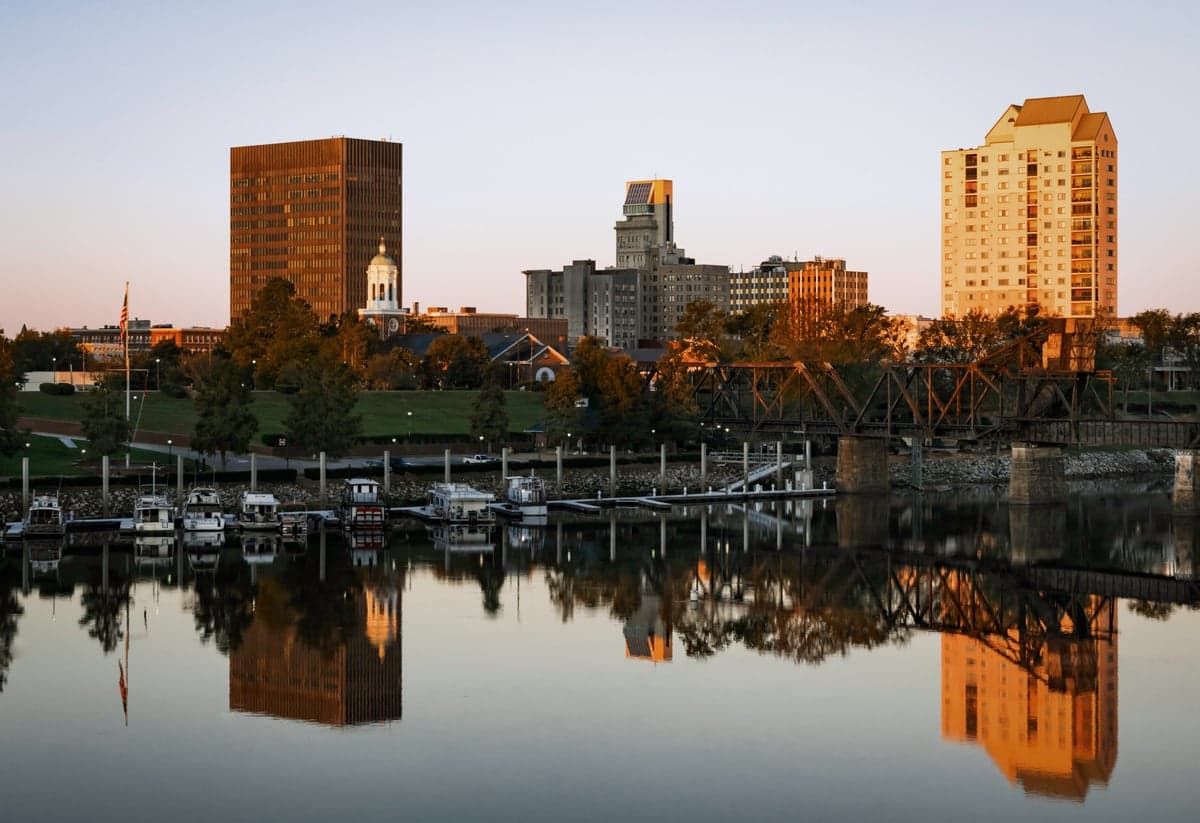
Photo: Wikipedia
Demographics of Augusta, GA
Affluence Level in Augusta, GA
A below-average socioeconomic profile. Incomes, home values, and educational attainment trail the U.S., with higher poverty and unemployment.
People of Augusta, GA
The people of Augusta, Georgia today form a majority-Black city of 201,504 residents, shaped by deep-rooted Southern traditions, a large military and medical employment base, and a notably low foreign-born share of just 1.6%. The city’s character is defined by a stark racial composition — 55.8% Black, 31.4% White, 5.7% Hispanic, and 1.4% East/Southeast Asian — alongside a college-educated rate of 24.2%, reflecting the influence of Augusta University and the Cyber Center of Excellence. Distinctive markers include a strong sense of place anchored by the Masters Tournament, a growing cybersecurity sector, and a population that remains overwhelmingly native-born, with little recent international immigration reshaping the city’s fabric.
How the city was settled and grew
Augusta was founded in 1736 as a fur-trading outpost on the Savannah River, part of Georgia’s colonial buffer against Spanish Florida. The original European settlers were primarily English and Scots-Irish traders and planters, drawn by the promise of fertile river-bottom land and the lucrative deerskin trade. By the early 19th century, the city became a major inland cotton market, and the enslaved African population — brought to work the surrounding plantations — grew rapidly. The historic Olde Town district, with its 19th-century brick storefronts and Greek Revival homes, was built by this antebellum merchant class and their enslaved laborers. After the Civil War, freedmen established their own communities, most notably in the Laney-Walker neighborhood, which became a thriving Black business and cultural corridor during the Jim Crow era. The 20th century brought a new wave: the establishment of Camp Gordon (later Fort Gordon) in 1917 drew military families and civilian workers, while the Medical College of Georgia (now Augusta University) attracted medical professionals. These institutions anchored the Summerville neighborhood, a historic district of Victorian homes that became a white professional enclave, and the Harrisburg neighborhood, a working-class area settled by German and Irish immigrants who worked in the city’s textile mills and railroad yards.
Modern era (post-1965)
The post-1965 era saw dramatic demographic shifts as the Civil Rights movement dismantled legal segregation and the Hart-Cellar Act opened immigration, though Augusta’s foreign-born population remained minimal. The most significant change was the acceleration of White flight to suburban counties like Columbia and Richmond, leaving the city core increasingly Black. By 2020, Augusta’s White population had fallen to 31.4%, while the Black share rose to 55.8%. The West Augusta area, near the river and the Masters course, became a predominantly White, affluent enclave, while the East Augusta neighborhoods — including the historic Sand Hills district — remained overwhelmingly Black and working-class. The Hispanic population, now 5.7%, grew modestly from the 1990s onward, concentrated in the Peach Orchard Road corridor, where Mexican and Central American immigrants found work in construction, landscaping, and poultry processing. The East/Southeast Asian community (1.4%) is largely tied to the medical and academic sectors, with many Vietnamese and Filipino families settling near the Augusta University campus. The Indian-subcontinent population (0.3%) remains tiny, mostly professionals in healthcare and IT. The city’s low foreign-born share (1.6%) means that Augusta has not experienced the large-scale immigrant-driven growth seen in Atlanta or Charlotte; instead, its population changes have been driven by domestic migration, particularly the movement of Black families from rural Georgia and the Carolinas into the city’s established neighborhoods.
The future
Augusta’s population is heading toward a slow, modest growth, projected to reach roughly 210,000 by 2035, driven primarily by the expansion of the U.S. Army Cyber Command at Fort Gordon (now Fort Eisenhower) and the continued growth of Augusta University’s medical and research campus. The city is not homogenizing; rather, it is tribalizing into distinct enclaves. The West Augusta and Summerville areas are becoming whiter and wealthier, while the Laney-Walker and Sand Hills neighborhoods remain predominantly Black and economically stagnant. The Hispanic population is expected to grow slowly, possibly reaching 8-9% by 2040, but will likely remain concentrated in the Peach Orchard Road corridor rather than dispersing. The East/Southeast Asian community is plateauing, as the medical and tech sectors that attract them are not expanding rapidly enough to draw large new cohorts. The Indian-subcontinent population will remain a tiny professional niche. The city’s low college attainment rate (24.2%) and high poverty rate (over 25%) suggest that without a major economic shift, Augusta will continue to be a city of stark contrasts: a prosperous, largely White professional class in the western neighborhoods, and a struggling, majority-Black population in the east and south.
For someone moving in now, Augusta is becoming a city where your neighborhood choice largely determines your economic and social experience. The city is not diversifying rapidly through immigration; instead, it is solidifying its existing racial and economic boundaries. The growth areas are in the western suburbs and near the medical/cyber corridor, while the historic Black neighborhoods face continued disinvestment. A newcomer should expect a deeply Southern, majority-Black city with a strong military and medical presence, limited ethnic diversity, and a clear divide between the prosperous riverfront and the struggling interior.

* Values derived from national, state, county, city and local statistics and may differ in a specific area. Last updated: 2026-04-22T01:38:06.000Z
Narrative content on this page is AI-generated and may contain mistakes. Verify any details that matter before acting on them.
ReloMaps may earn a commission from affiliate links at no extra cost to you.

