Photo: Wikipedia
Demographics of Bellevue, WA
Affluence Level in Bellevue, WA
A wealthy area with high-earning, well-educated households. Incomes, home values, and educational attainment meaningfully outpace national averages.
People of Bellevue, WA
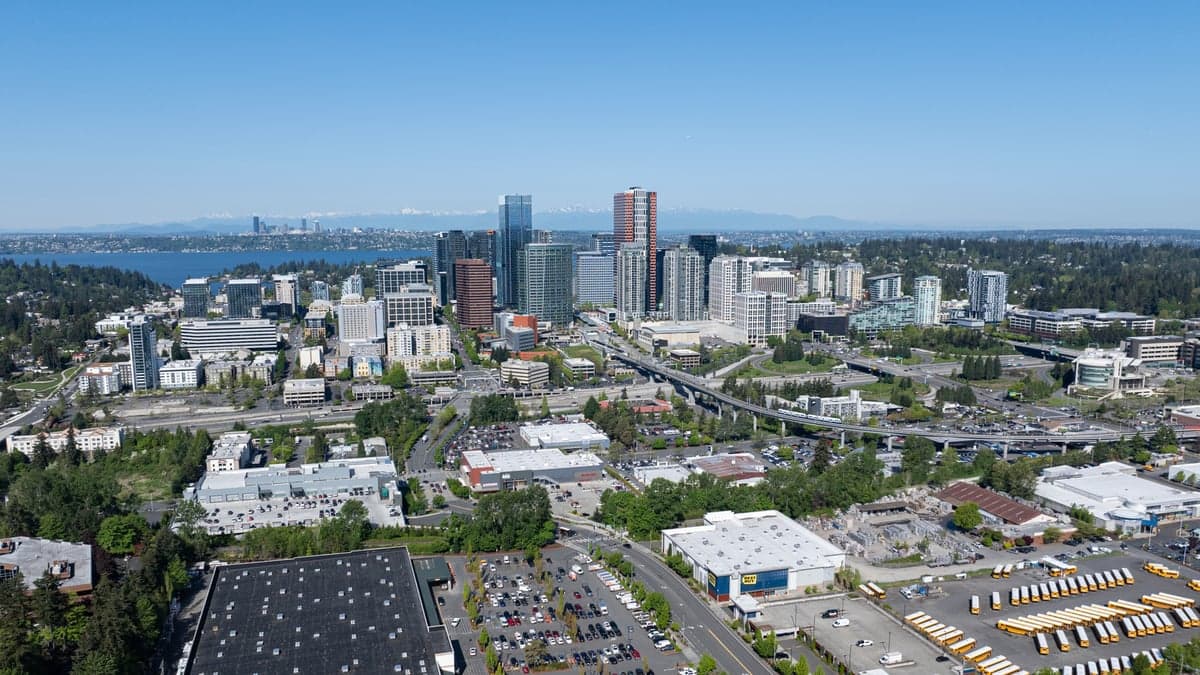
The people of Bellevue, Washington today number 151,199, forming one of the most highly educated and demographically complex cities in the Pacific Northwest. With 71.4% of adults holding a college degree and a foreign-born population of 25.3%, the city is a dense, affluent hub where East and Southeast Asian communities (26.3%) and Indian-subcontinent residents (14.6%) together outnumber the non-Hispanic white population (42.4%). This is not a city of gradual, organic growth but one shaped by deliberate economic strategy, tech-industry migration, and successive waves of international immigration that have remade its neighborhoods in distinct ways.
How the city was settled and grew
Bellevue’s human history begins later than most West Coast cities. The area was originally inhabited by the Duwamish and Snoqualmie peoples, but the first permanent white settlers arrived only in the 1860s, drawn by the promise of timber and coal. The city was officially incorporated in 1953, making it a genuinely post-1900 suburb. The early population was overwhelmingly white, Anglo, and working-class, clustered in what is now Old Bellevue (the original downtown core around Main Street) and the Lake Hills neighborhood, which was developed in the 1950s as a post-war bedroom community for Seattle commuters. The construction of the Mercer Island floating bridge in 1940 and the Evergreen Point Floating Bridge in 1963 transformed Bellevue from a rural outpost into a commuter suburb. By 1960, the population had reached just 12,809, and the city was nearly entirely white. The defining early industry was not agriculture but the construction of suburban infrastructure itself—roads, schools, and shopping centers like the Bellevue Square mall (opened 1946).
Modern era (post-1965)
The 1965 Hart-Cellar Immigration Act opened the door for the demographic transformation that defines Bellevue today. The first major non-white wave was East and Southeast Asian, beginning in the 1970s and accelerating through the 1990s. Chinese and Taiwanese professionals, many working in the expanding tech sector, settled in Bridle Trails and West Bellevue, drawn by top-rated schools and proximity to Microsoft’s Redmond campus. The 1990s and 2000s saw a second, larger wave of Indian-subcontinent immigrants—engineers, doctors, and entrepreneurs—who concentrated in Newport Hills and the Somerset neighborhood, where large single-family homes and excellent school districts (Bellevue High School, Newport High School) became major draws. The Hispanic population (8.5%) is smaller and more dispersed, with a notable presence in the Crossroads area, a historically more affordable and diverse district. The Black population (2.1%) remains very small, concentrated in no single neighborhood. The white population, which was near 100% in 1960, has declined to 42.4% as of the most recent data, a shift driven almost entirely by Asian and Indian immigration, not by white out-migration. The city’s college-educated rate (71.4%) is among the highest in the nation, reflecting the self-selection of highly skilled immigrants and domestic migrants into the tech economy.
The future
Bellevue’s population is not homogenizing; it is tribalizing into distinct, education- and income-stratified enclaves. The East and Southeast Asian and Indian-subcontinent communities are growing, but they are not assimilating into a single "Asian" bloc—they maintain separate cultural institutions, religious centers, and social networks. The white population is plateauing, not declining further, as the city’s high housing costs (median home price above $1.5 million) limit new in-migration from lower-income groups. The Hispanic and Black populations are growing slowly, largely through second-generation families aging into the housing market. Over the next 10–20 years, Bellevue will likely become even more bifurcated: a highly educated, majority-Asian-and-Indian professional class living in the expensive west-side neighborhoods (Bridle Trails, Somerset, West Bellevue) and a smaller, more diverse population in the east-side neighborhoods (Crossroads, Lake Hills) where housing is slightly more attainable. The city’s school system, already among the best in Washington, will continue to be the primary driver of migration for families who can afford the entry price.
For a conservative-leaning individual or family considering relocation, Bellevue is a city where economic opportunity and educational excellence are unmatched in the region, but where the social fabric is increasingly defined by ethnic and economic clustering rather than a shared civic identity. The city is safe, prosperous, and orderly, but newcomers should expect to live among people who share their professional and educational background more than their cultural or political one. The next decade will see Bellevue solidify its role as a Pacific Rim tech hub, not a traditional American suburb.

* Values derived from national, state, county, city and local statistics and may differ in a specific area. Last updated: 2026-04-21T11:04:03.000Z
Narrative content on this page is AI-generated and may contain mistakes. Verify any details that matter before acting on them.
ReloMaps may earn a commission from affiliate links at no extra cost to you.

