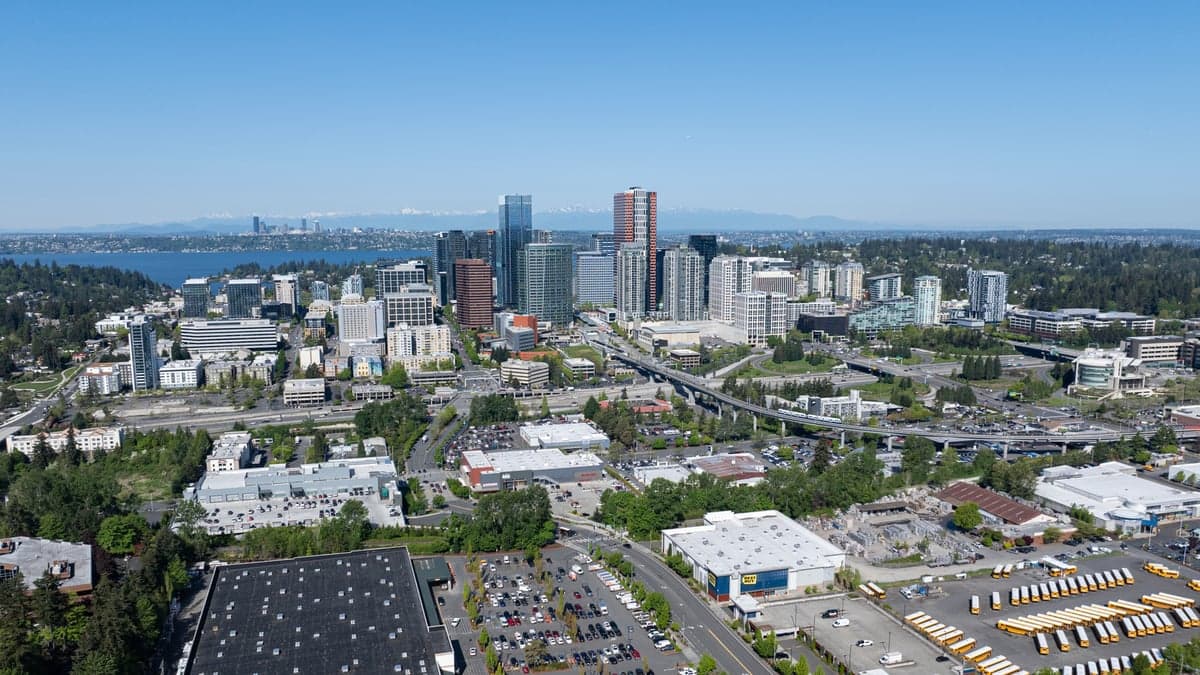
Photo: Wikipedia
Political ClimatePolitical Climate in Bellevue, WA
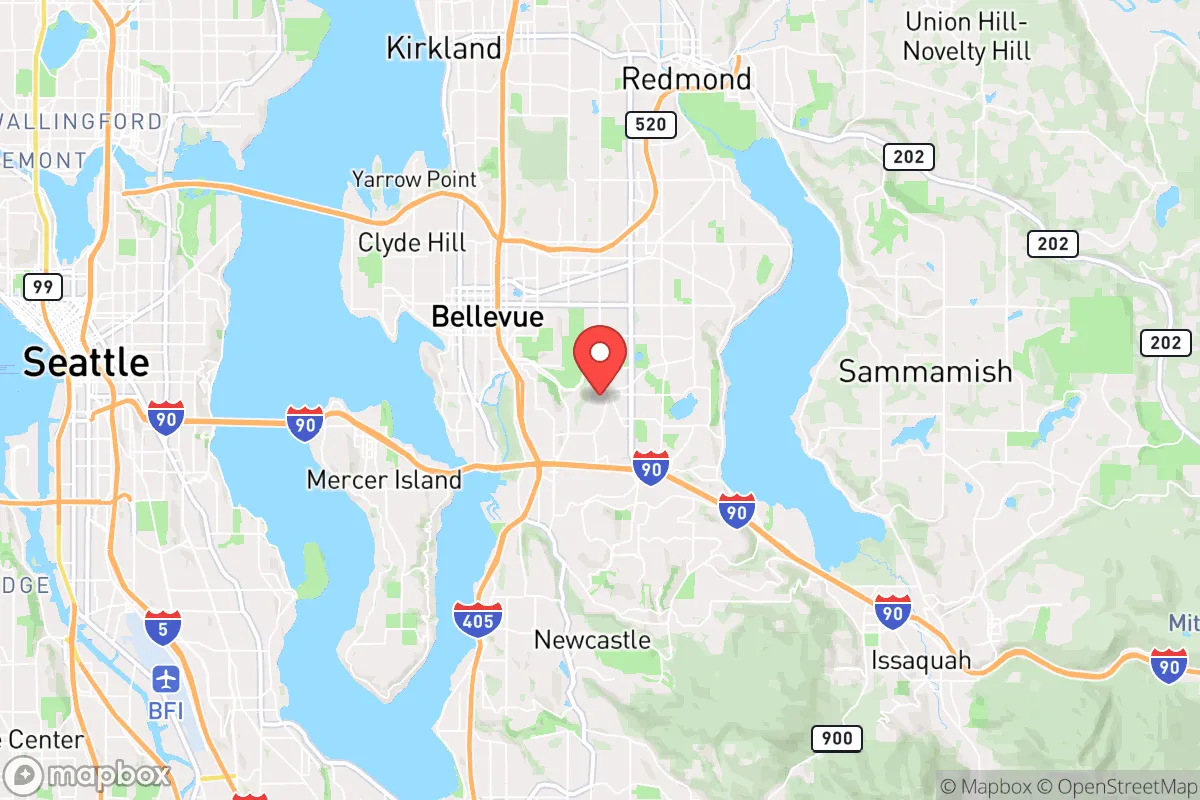
District shown is the primary district for this city’s centroid. Cities may span multiple districts.
Local Political AnalysisPolitical Analysis of Bellevue, WA
Bellevue has shifted hard to the left over the past decade, and it’s not slowing down. The Cook PVI of D+22 tells you everything you need to know—this isn’t a purple suburb anymore. Back in the 2000s, you could still find a healthy mix of conservative and moderate voices at city council meetings and neighborhood barbecues. Now, the political machine here is firmly progressive, and anyone who leans right is increasingly treated like an outlier. The trajectory is clear: more regulation, higher taxes, and a growing tolerance for government intrusion into what used to be personal decisions.
How it compares
If you drive 15 minutes east to Issaquah or Sammamish, you’ll find a slightly more balanced political scene—still blue, but with enough red to keep things honest. Head south to Renton or Kent, and you’re in deep-blue territory, but with a working-class vibe that sometimes pushes back on the most extreme policies. The real contrast is north toward Bothell or east toward North Bend, where you still see signs of fiscal conservatism and a “live and let live” attitude. Bellevue, though? It’s become a mirror of Seattle’s politics, just with better landscaping. The city council has embraced zoning overhauls that strip property rights, and the school board has pushed curriculum changes that prioritize ideology over academics. Compared to its neighbors, Bellevue is the epicenter of King County’s progressive experiment.
What this means for residents
For a conservative or libertarian-leaning resident, daily life here means watching your freedoms get nibbled away one ordinance at a time. The city has aggressively pursued mandatory density and affordable housing quotas that override what you can do with your own property. Business owners face a thicket of new regulations—from paid sick leave mandates to energy efficiency standards that drive up costs. And if you value parental rights in education, the school district’s embrace of social-emotional learning frameworks and gender ideology policies will have you sitting through tense board meetings. The police department is still professional, but defunding rhetoric has crept into local activist circles, and you can feel the pressure to de-prioritize public safety in favor of social justice initiatives. It’s not a police state, but it’s a place where the government assumes it knows better than you do about how to run your life.
The cultural shift is the hardest part for someone who remembers the old Bellevue. This used to be a place where success meant you kept your head down, worked hard, and didn’t have to apologize for your prosperity. Now, there’s a constant undercurrent of guilt and re-education—from the city’s “equity” training for employees to the way local media frames every issue through a lens of systemic injustice. The long-term outlook? Unless there’s a major political realignment, expect more of the same: higher taxes, tighter regulations, and a steady erosion of the personal freedoms that made this area great in the first place. If you’re thinking of moving here, just know what you’re signing up for.

State Political ClimatePolitical Climate in Washington
State Political AnalysisPolitical Environment in the State
Washington State has shifted from a purple battleground to a solidly blue stronghold over the past two decades, with Democrats controlling every statewide office and both legislative chambers since 2012. The state’s overall partisan lean is roughly D+8 to D+10 in presidential elections, but this masks a deep and growing urban-rural chasm. For a conservative considering relocation, the key takeaway is that your vote will be drowned out in statewide races, but your local community—if you choose wisely—can still reflect your values.
Urban vs. rural divide
The political map of Washington is essentially a tale of two states. The Puget Sound corridor—Seattle, Bellevue, Redmond, and Tacoma—drives the state’s blue tilt, with King County alone casting roughly one-third of all votes and delivering margins of 70-80% for Democrats. Snohomish and Pierce counties have trended blue as well, though Pierce (home to Joint Base Lewis-McChord) retains a more moderate, working-class character. Meanwhile, Spokane County in the east has flipped from reliably red to a competitive swing area, with Spokane Valley and the rural outskirts still voting conservative. The true red strongholds are the Yakima Valley, the Tri-Cities (Kennewick, Pasco, Richland), and the rural counties east of the Cascades—places like Walla Walla, Colville, and Republic—where Republican margins often exceed 60-70%. The Olympic Peninsula and Whatcom County (Bellingham) are mixed, with rural pockets of conservatism surrounded by college-town and coastal progressive enclaves.
Policy environment
Washington’s policy environment is a case study in progressive governance. The state has no personal income tax, which sounds appealing, but it relies heavily on a high sales tax (state rate 6.5%, with local add-ons pushing it to 9-10% in many cities) and a business-and-occupation tax that hits small businesses hard. Property taxes are moderate but rising. The regulatory posture is aggressive: the state has a cap-and-trade program (Climate Commitment Act), a long-term care payroll tax (WA Cares Fund) that took effect in 2023, and some of the nation’s strictest gun laws, including a ban on many semi-automatic rifles (HB 1240, 2023) and a 10-day waiting period. Education policy is dominated by teachers’ unions, with no school choice programs and a fully state-funded public system. Healthcare is heavily regulated, with a state-based insurance exchange and a public option (Cascade Care). Election laws are among the most progressive: universal mail-in voting, same-day voter registration, and no voter ID requirement—a system that conservatives often criticize for lacking integrity safeguards.
Trajectory & freedom
Over the past five years, Washington has become demonstrably less free by any measure of personal liberty. The 2023 legislative session alone saw the passage of HB 1240 (assault weapons ban), HB 1143 (firearm training and storage requirements), and SB 5078 (raising the purchase age for semi-automatic rifles to 21). Parental rights have been eroded by SB 5599 (2023), which allows minors to access shelter and certain services without parental consent, and by the state’s affirmative consent law for sex education, which critics argue undermines parental authority. Medical autonomy took a hit with the state’s COVID-19 vaccine mandates for healthcare workers and state employees, which were among the nation’s strictest and led to thousands of terminations. Property rights are constrained by the Growth Management Act, which forces dense urban development and limits rural building. On the plus side, Washington has no state income tax and no capital gains tax (a recent attempt to impose one was struck down by the state supreme court in 2024, though it may return). The trend is clearly toward more government control, not less.
Civil unrest & political movements
Washington has been a flashpoint for political unrest. The 2020 CHOP/CHAZ occupation in Seattle’s Capitol Hill neighborhood—a six-block autonomous zone that lasted three weeks—became a national symbol of progressive governance gone awry. The 2021 insurrection at the state capitol in Olympia saw armed protesters storm the building during a COVID-19 special session, leading to a heavy police response and ongoing tensions. On the left, Antifa and anarchist groups have a visible presence in Seattle and Portland-adjacent Vancouver, while on the right, the Three Percenters and Patriot Prayer have held rallies in places like Spokane and Vancouver. Immigration politics are a major fault line: Washington is a sanctuary state (since 2019), and King County has actively resisted federal immigration enforcement. Election integrity remains a hot-button issue, with conservatives pointing to the state’s mail-in system and lack of voter ID as vulnerabilities. A new resident will notice political yard signs, bumper stickers, and even flags are far more common in rural areas than in the cities, where progressive views are assumed and rarely advertised.
Projection
Over the next 5-10 years, Washington will likely become more blue, not less. In-migration from California and other high-cost states is accelerating, and these newcomers tend to be younger, more diverse, and more progressive. The Seattle metro area is projected to add another 500,000 people by 2035, while rural counties continue to lose population. The state’s Democratic supermajority in the legislature is likely to hold, meaning more gun control, higher taxes (including a possible income tax), and further erosion of parental rights. However, there are countercurrents: the Tri-Cities and Spokane Valley are growing faster than the state average, and these areas are reliably red. The 2024 election saw some rural counties flip back to Trump after a slight Biden bump in 2020, suggesting the rural base is energized. A conservative moving in now should expect to live in a state where their values are increasingly marginalized at the state level, but where local communities—especially east of the Cascades—can still offer a refuge.
Bottom line for a new resident: If you’re a conservative, Washington is a state where you can find like-minded neighbors in the right county, but you will be fighting an uphill battle in statewide elections and policy. The natural beauty, outdoor recreation, and lack of income tax are real draws, but the cost of living, regulatory burden, and cultural drift toward progressivism are significant downsides. Choose your city carefully—Spokane Valley, the Tri-Cities, or a small town like Colville or Ellensburg will feel far more welcoming than Seattle or Olympia. And be prepared to engage locally, because your vote in state races will be a drop in a very blue bucket.
* Values derived from national, state, county, city and local statistics and may differ in a specific area. Last updated: 2026-04-21T11:04:03.000Z
Narrative content on this page is AI-generated and may contain mistakes. Verify any details that matter before acting on them.
ReloMaps may earn a commission from affiliate links at no extra cost to you.

