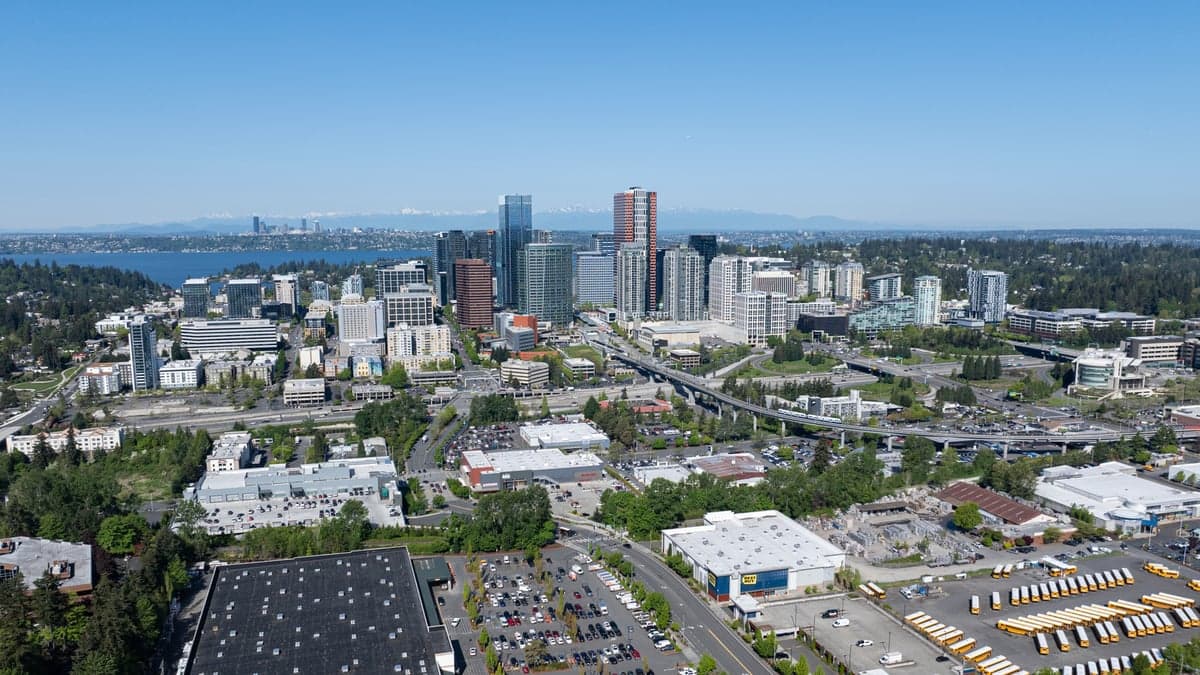
Photo: Wikipedia
Personal Sovereignty in Bellevue, WA
Viable for self-reliance. Generally workable, though some barriers may limit total independence.
What does Personal Sovereignty tell us?
Personal Sovereignty measures your capacity for self-reliance and independence with minimal government friction. Higher scores mean fewer barriers between you and the way you want to live... but it assumes you have the space you need and good neighbors.
What does this tell us?
Personal Sovereignty measures your capacity for self-reliance and independence with minimal government friction. Higher scores mean fewer barriers between you and the way you want to live... but it assumes you have the space you need and good neighbors.
State Policy
Energy independence: Importer (55% of energy produced in-state)
Personal Liberty
Homesteading

Personal Liberty Analysis
Bellevue, Washington presents a complex and often contradictory environment for personal sovereignty, one that demands careful strategic calculation from anyone prioritizing autonomy, self-reliance, and resistance to government overreach. While the city's affluence and tech-driven economy offer certain material advantages, the legal and regulatory climate—shaped overwhelmingly by Washington State's progressive governance—imposes significant constraints on gun rights, medical freedom, parental authority, and property use. For the survivalist or prepper, Bellevue is less a sanctuary and more a high-stakes chessboard where financial opportunity must be weighed against a steadily eroding foundation of individual liberties.
Tax burden and regulatory posture in King County
Washington State's lack of a personal income tax is a genuine bright spot for those seeking to keep more of their earnings, but it is not the full picture. Bellevue residents face a combined state and local sales tax rate of 10.4%—among the highest in the nation—which hits hard on every major purchase, from vehicles to building supplies. Property taxes in King County are also substantial, with effective rates around 0.93% of assessed value, and assessments have climbed sharply alongside home values. More concerning for the autonomy-minded is the regulatory posture: Washington's Growth Management Act imposes strict land-use controls that limit what you can do with your property, and King County's environmental regulations add layers of permitting for even modest construction or land alteration. The state's Business & Occupation (B&O) tax applies to gross receipts, not profit, making it a punitive levy on entrepreneurs and small-scale operators. While no income tax is a real advantage, the overall tax and regulatory burden in Bellevue is high, and the trend is toward more, not less, government control over economic activity.
Self-defense and gun law specifics in Washington State
This is the most critical area of concern for the sovereignty-minded. Washington State has moved aggressively to restrict firearm ownership and carry rights. The 2023 ban on certain semi-automatic firearms (often mislabeled "assault weapons") directly limits the types of rifles and handguns law-abiding citizens can purchase. Magazine capacity is capped at 10 rounds for long guns and 15 for handguns. A 10-day waiting period applies to all firearm purchases, and a state-issued permit is now required to purchase a semi-automatic rifle, which involves a mandatory training course and fingerprinting. Open carry is legal without a permit, but the state's constitutional carry law was effectively nullified by the new permit requirements for semi-autos. Concealed carry requires a license, which is shall-issue but subject to local law enforcement discretion. Bellevue itself is a relatively safe city, but the legal framework means that preparing for self-defense is now a bureaucratic and costly process, and the political climate in Olympia suggests further restrictions are likely. For the prepper, this is a major liability—your ability to defend your home and family is increasingly subject to state permission.
Self-reliance and homesteading viability in an urban setting
Bellevue's zoning and land-use policies are fundamentally hostile to traditional homesteading and off-grid living. The vast majority of residential lots are small (5,000 to 10,000 square feet) and governed by strict homeowners' associations (HOAs) that prohibit livestock, extensive gardening, and visible infrastructure like solar panels or rainwater collection. Even in unincorporated King County, where lot sizes can reach 1-5 acres, the Critical Areas Ordinance restricts clearing, grading, and building near wetlands or steep slopes. Off-grid systems—solar, composting toilets, well water—are heavily regulated and often require permits that are difficult to obtain. Backup power generation is limited by noise ordinances and HOA covenants. For anyone serious about self-reliance, Bellevue is a poor fit. The city's infrastructure is designed for dependence on the grid, municipal water, and waste services. A more viable option for homesteading would be eastern Washington counties like Stevens or Ferry, where land is cheaper, zoning is looser, and the regulatory climate is far less intrusive.
Personal liberties: parental rights, medical autonomy, speech, and property
Washington State has been a national leader in expanding government authority over personal and family decisions. Parental rights are under direct assault: the state's 2023 "shield law" prohibits schools from notifying parents if a child requests a name or pronoun change, and the state has aggressively pursued legal action against parents who resist gender-related medical interventions for minors. Medical autonomy is similarly constrained—COVID-19 vaccine mandates were enforced for state employees and healthcare workers, and the state maintains a centralized vaccine registry that tracks immunization status. Informed consent for medical procedures is weakened by laws that allow minors to consent to certain treatments without parental knowledge. Free speech protections are nominally strong under the state constitution, but local governments have enacted "hate speech" ordinances and social media regulations that chill political expression. Property rights are the most compromised: the Growth Management Act gives the state and counties broad authority to downzone land, restrict development, and impose environmental easements without compensation. For the conservative individualist, Bellevue's legal environment is increasingly adversarial to traditional family structures, medical choice, and the right to control one's own property.
In the final analysis, Bellevue offers a high-income, low-income-tax environment that can fund a relocation strategy, but it is a poor location for anyone seeking genuine personal sovereignty. The state's trajectory is toward greater government control over firearms, family decisions, medical choices, and land use. For the survivalist or prepper, the city's value is as a financial staging ground—earn and save here, but do not plan to dig in and defend. The regulatory and cultural headwinds are too strong. A more prudent approach would be to use Bellevue's economic advantages to acquire property in a freer jurisdiction—eastern Washington, Idaho, or Montana—where the legal climate still respects the individual's right to self-determination. In the current political landscape, Bellevue is a place to pass through, not a place to stand your ground.

* Values derived from national, state, county, city and local statistics and may differ in a specific area. Last updated: 2026-04-21T11:04:03.000Z
Narrative content on this page is AI-generated and may contain mistakes. Verify any details that matter before acting on them.
ReloMaps may earn a commission from affiliate links at no extra cost to you.

