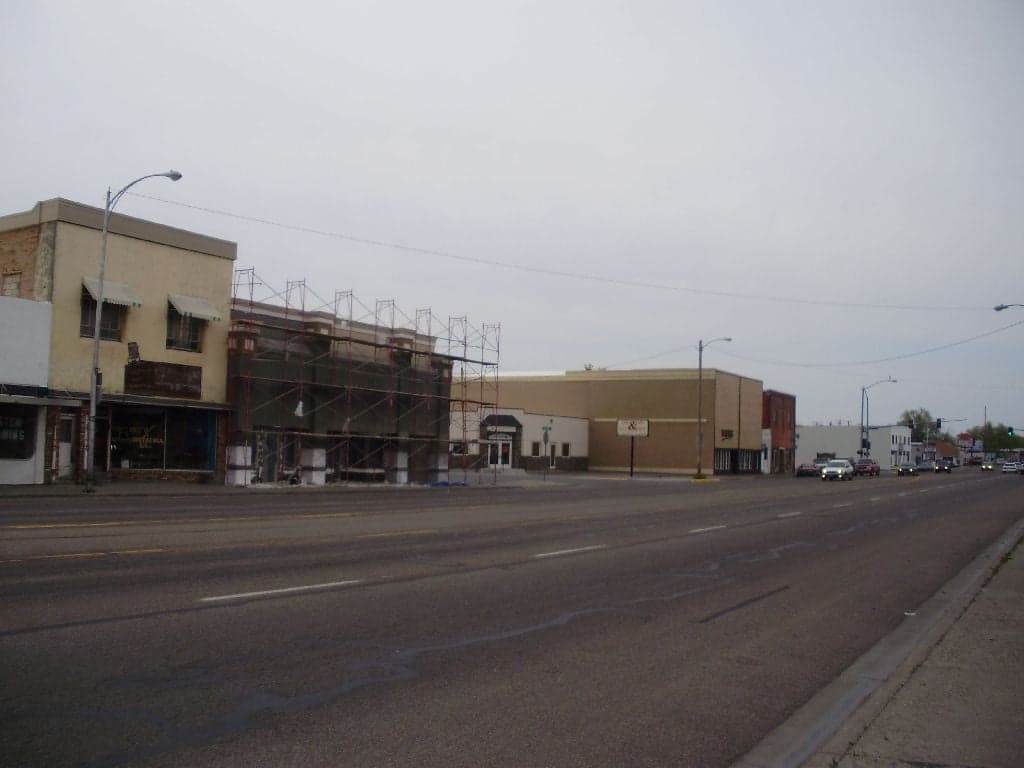
Photo: Wikipedia
Personal Sovereignty in Blackfoot, ID
Moderate friction. Expect trade-offs in some aspect of personal liberty and independence.
What does Personal Sovereignty tell us?
Personal Sovereignty measures your capacity for self-reliance and independence with minimal government friction. Higher scores mean fewer barriers between you and the way you want to live... but it assumes you have the space you need and good neighbors.
What does this tell us?
Personal Sovereignty measures your capacity for self-reliance and independence with minimal government friction. Higher scores mean fewer barriers between you and the way you want to live... but it assumes you have the space you need and good neighbors.
State Policy
Energy independence: Importer (25% of energy produced in-state)
Personal Liberty
Homesteading

Personal Liberty Analysis
Blackfoot, Idaho, offers a personal sovereignty environment that is among the strongest in the Intermountain West, largely because Idaho’s state-level legal framework actively resists federal overreach and empowers local control. For those approaching relocation from a survivalist or prepper mindset, the key takeaway is that Blackfoot sits in a county (Bingham) where the prevailing culture and legal code prioritize individual autonomy over collective mandates. The state’s constitutional carry law, its aggressive pushback against federal land management, and its low-tax, low-regulation posture create a baseline of freedom that is increasingly rare in the United States. However, the devil is in the details—zoning restrictions, water rights, and local ordinances can still constrain a truly independent lifestyle, so understanding the specific levers of power here is critical.
Tax burden and regulatory posture: How Idaho’s fiscal conservatism protects your autonomy
Idaho’s tax structure is deliberately designed to minimize government intrusion into personal finances, and Blackfoot benefits directly from this. There is no state inheritance tax, no estate tax, and no tax on Social Security benefits—meaning your wealth and retirement savings remain yours to control. The state’s income tax is a flat 5.8% (as of 2025), and Bingham County’s property tax rates are among the lowest in the state, typically hovering around 0.6–0.7% of assessed value. This is not accidental: Idaho’s legislature has repeatedly rejected proposals for a state property tax and has capped annual property tax increases at 2% for homeowners. For a prepper, this means your land and improvements are not a target for government revenue grabs. The regulatory posture is equally lean. Idaho is a “right-to-work” state with no state-level occupational licensing for many trades, and Bingham County has no county-wide building codes outside of incorporated city limits. This means that on unincorporated land near Blackfoot, you can build a shop, a greenhouse, or a bunker without permits—provided you are not violating septic or well regulations. The state’s “red flag” law resistance is also notable: Idaho explicitly prohibits any state or local enforcement of federal red flag orders, a clear assertion of sovereignty against federal gun control overreach.
Self-defense and gun law specifics: Constitutional carry and stand-your-ground in practice
Blackfoot is located in a state that treats the right to keep and bear arms as a fundamental, pre-existing right, not a privilege granted by the government. Idaho adopted permitless (constitutional) carry in 2016, meaning any law-abiding adult 18 or older can carry a concealed firearm without a license. There is no state-level firearm registration, no waiting periods, and no magazine capacity restrictions. The state’s “stand your ground” law (Idaho Code § 19-202A) is unambiguous: there is no duty to retreat from any place you have a legal right to be, and you may use deadly force if you reasonably believe it is necessary to prevent death or great bodily harm to yourself or another. Bingham County’s sheriff’s office is known for a pro-Second Amendment stance, and local gun culture is deeply embedded—you will see firearms openly carried in grocery stores and at church without incident. For the prepper, this means your defensive capabilities are not subject to the whims of local politicians. However, note that Idaho does have a “use of force” reporting requirement: you must report any use of deadly force to law enforcement within 72 hours, and the burden of proof for self-defense rests on the defender in civil suits. This is a minor but real legal consideration. Also, while state law preempts local gun ordinances, the city of Blackfoot itself has no additional restrictions—so you are operating under the full scope of state law.
Self-reliance and homesteading viability: Lot sizes, zoning, and off-grid feasibility
For those seeking to live off-grid or establish a self-sufficient homestead, Blackfoot’s surrounding area offers significant opportunities, but with important caveats. Bingham County has no county-wide zoning, meaning that on unincorporated land, you can raise livestock, build alternative structures (yurts, earthships, shipping container homes), and install solar panels without bureaucratic approval. Minimum lot sizes in the county are generally 1 acre for a single-family dwelling with a septic system, but many parcels in the rural areas around Blackfoot are 5, 10, or 20 acres—ideal for a homestead. Water rights are the primary constraint: Idaho follows the prior appropriation doctrine, meaning you must have a water right to divert surface water or drill a well. New wells on parcels under 5 acres require a permit from the Idaho Department of Water Resources, and the process can take months. For off-grid solar, Idaho has no net metering requirement for utilities, but Rocky Mountain Power (the local provider) does allow net metering at a reduced rate. The more practical path for a prepper is to go fully off-grid with battery storage, as there are no state laws prohibiting it. The city of Blackfoot itself has standard zoning (R-1, R-2, etc.) that restricts livestock and accessory structures, so the real autonomy lies in the county. The Snake River Plain’s volcanic soil is fertile, and the growing season (about 120 days) supports potatoes, grains, and cold-hardy vegetables. For long-term sustainability, the area’s access to the Snake River aquifer provides reliable groundwater—but you must secure your water right early.
Personal liberties: Parental rights, medical autonomy, speech, and property
Idaho has become a national battleground for parental rights, and Blackfoot reflects that. The state’s “Parents’ Bill of Rights” (Idaho Code § 33-5201) explicitly affirms that parents have the fundamental right to direct their children’s education, healthcare, and upbringing. This means you can opt your child out of any curriculum or activity you find objectionable, and schools must obtain parental consent before administering any medical or mental health services. Idaho also prohibits mask mandates in schools and has banned vaccine passports. On medical autonomy, Idaho is one of the few states with a “Right to Try” law for experimental treatments and has no state-level vaccine mandate for adults. However, the state does require certain vaccines for school attendance (with broad philosophical exemptions available). For speech, Idaho has no “hate speech” laws that criminalize political or religious expression, and the state’s constitution provides robust protections for peaceful assembly and petition. Property rights are protected by Idaho’s “private property rights” act, which requires government agencies to compensate landowners for any regulatory taking that reduces property value by more than 20%. This is a powerful tool against overreach by county planning departments. The one area where personal liberty is constrained is in the realm of drug policy: Idaho has some of the strictest marijuana laws in the nation, with no medical or recreational use allowed, and possession of even small amounts can result in jail time. For the prepper who values total bodily autonomy, this is a notable restriction, but it also reflects the state’s broader resistance to federal drug policy overreach.
In the broader context of the American West, Blackfoot offers a sovereignty profile that is significantly stronger than what you would find in Colorado, Oregon, or Washington—states where local governments routinely preempt state-level protections. Compared to Montana or Wyoming, Idaho’s legal framework is more explicitly codified in statute, meaning your rights are less dependent on the goodwill of local sheriffs. The trade-off is that Idaho’s state government is actively involved in preempting local control, which can feel like a double-edged sword: it protects you from progressive city councils, but it also means that state-level changes (e.g., a future legislature) could shift the ground quickly. For now, Blackfoot remains a place where a determined individual can live largely outside the reach of government, provided they secure their water rights, stay within the bounds of property law, and understand that the county’s lack of zoning is both a blessing and a responsibility. If your goal is to maximize personal sovereignty while maintaining access to a regional hospital, a Walmart, and a decent school system, Blackfoot is a strong candidate—but it is not a libertarian utopia. It is a working agricultural community where freedom is earned through self-reliance, not granted by the state.

* Values derived from national, state, county, city and local statistics and may differ in a specific area. Last updated: 2026-04-19T09:33:10.000Z
Narrative content on this page is AI-generated and may contain mistakes. Verify any details that matter before acting on them.
ReloMaps may earn a commission from affiliate links at no extra cost to you.

