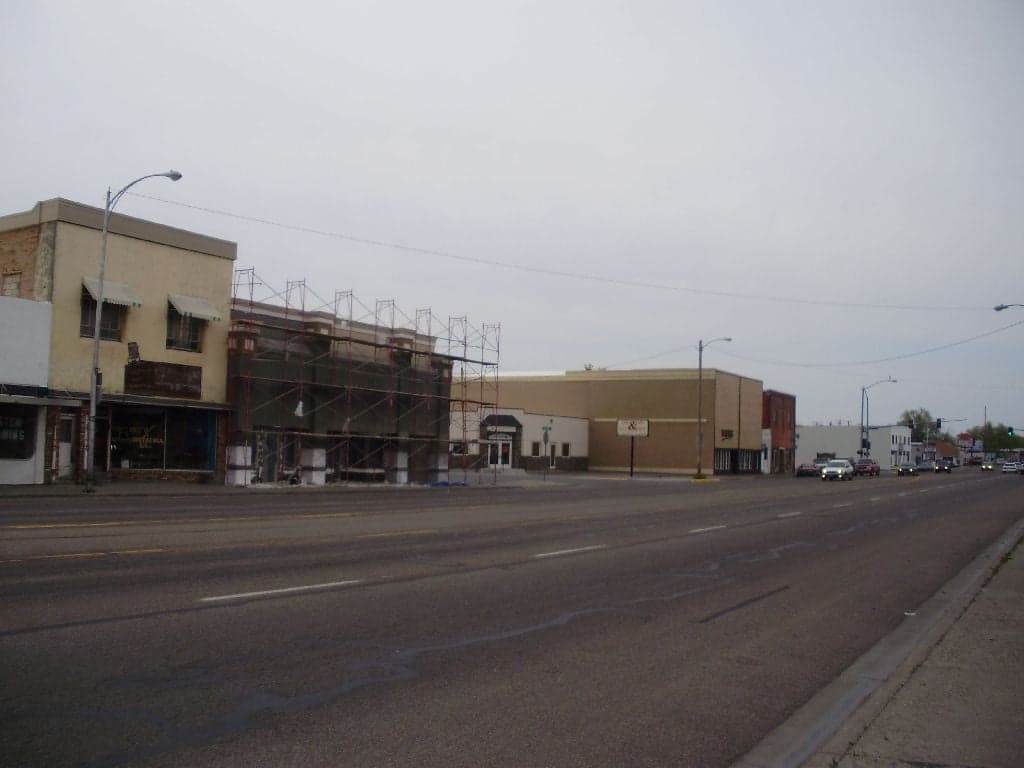
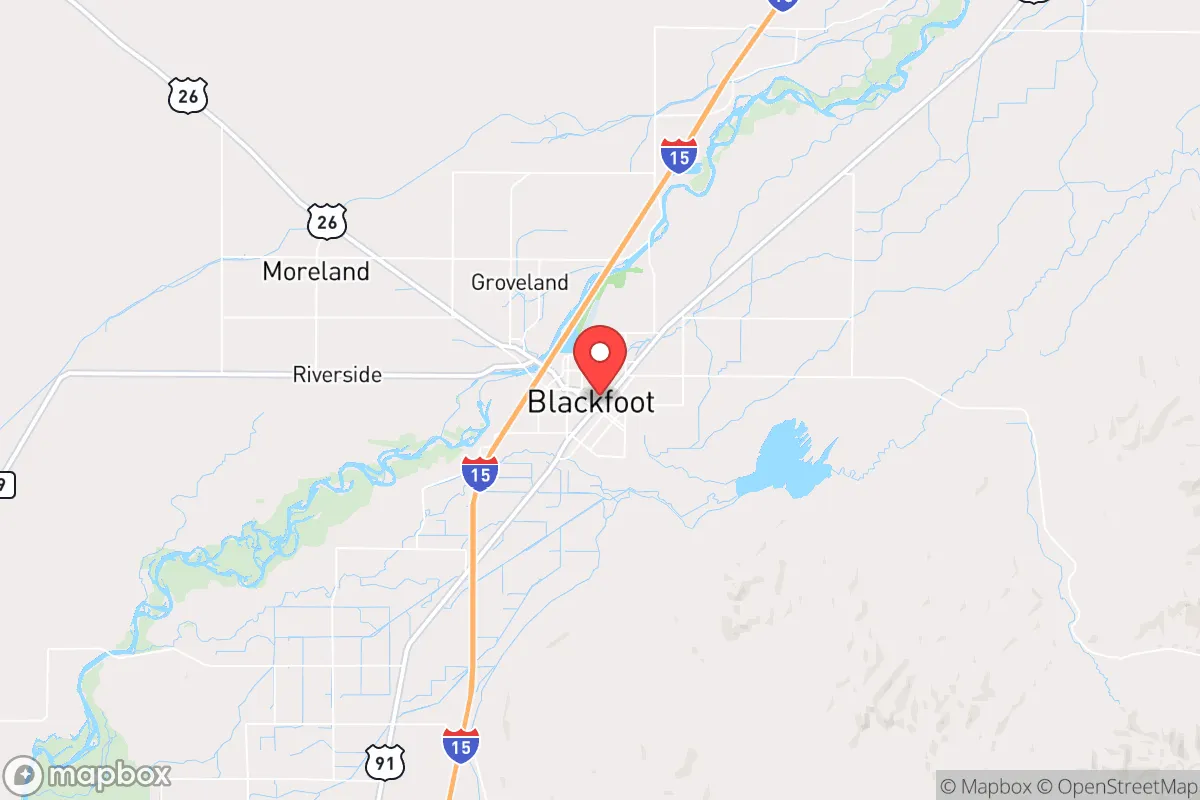
Photo: Wikipedia
Demographics of Blackfoot, ID
Affluence Level in Blackfoot, ID
A middle-class area roughly in line with national averages across income, home values, education, and employment.
People of Blackfoot, ID
The people of Blackfoot, Idaho, today number 12,628, forming a community that is predominantly white (72.1%) with a significant Hispanic minority (20.1%) and a very small foreign-born population (1.8%). The city’s identity is rooted in its agricultural and industrial heritage, with a notably lower college attainment rate (22.2%) than the national average, reflecting a workforce concentrated in farming, food processing, and manufacturing. Blackfoot is a stable, family-oriented town where generational roots run deep, and the population is slowly diversifying through Hispanic growth while remaining culturally conservative.
How the city was settled and grew
Blackfoot was founded in 1878 as a railroad town on the Utah and Northern Railway, drawing its first wave of settlers—Mormon pioneers from Utah and northern European immigrants (English, Danish, and Swedish)—who established the original downtown core along the tracks. The 1890s saw a second wave of farmers, lured by the Carey Act irrigation projects that transformed the arid Snake River Plain into potato and sugar beet fields. These early residents built the Riverside neighborhood along the Snake River, where many of the original farmsteads still stand. By the 1920s, the establishment of the Bingham County seat and the Oregon Short Line Railroad depot cemented Blackfoot as a regional trade hub, attracting a small but steady influx of Basque sheepherders and Italian laborers who settled in the West End district near the rail yards. The city’s population remained overwhelmingly white and native-born through the mid-20th century, with the 1950 census recording a 99.2% white population.
Modern era (post-1965)
The post-1965 era brought two major demographic shifts. First, the expansion of the J.R. Simplot Company’s potato-processing plants in the 1970s and 1980s drew a wave of Hispanic migrant workers, primarily from Mexico and Texas, who initially lived in seasonal labor camps on the city’s outskirts. Over time, many settled permanently in the South Blackfoot neighborhood, an area south of the railroad tracks that today has the highest Hispanic concentration in the city. Second, the 1990s and 2000s saw a modest influx of East/Southeast Asian families—mostly Vietnamese and Filipino—who came to work at the nearby Lamb Weston and McCain Foods facilities; they established a small enclave in the Northgate subdivision near the high school. The white population, while still dominant, has declined from 92% in 1990 to 72.1% today, while the Hispanic share grew from 6% to 20.1% over the same period. The Black and Indian subcontinent populations remain negligible (0.6% and 0.0%, respectively), and the foreign-born share (1.8%) is far below the national average of 13.7%, indicating that most Hispanic growth comes from U.S.-born children of earlier migrants.
The future
Blackfoot’s population is slowly homogenizing into two distinct enclaves: the older, white-majority neighborhoods (Riverside and the Historic Downtown) and the newer, Hispanic-majority areas (South Blackfoot and the Meadowbrook subdivision). The Hispanic community is growing through natural increase—higher birth rates among second- and third-generation families—rather than new immigration, which means the city is becoming more bicultural rather than more diverse in a multi-ethnic sense. The East/Southeast Asian population is plateauing at around 0.4%, with little new migration expected given the lack of a co-ethnic network or ethnic-specific institutions. Over the next 10–20 years, Blackfoot will likely see its Hispanic share rise to 25–30%, while the white share continues a slow decline. The city will remain a predominantly white, working-class community with a growing Hispanic minority, but without the rapid diversification seen in larger Idaho cities like Boise or Twin Falls.
For someone moving in now, Blackfoot offers a stable, low-crime environment where community ties are strong and the cost of living is low. The city is becoming more culturally Hispanic in its southern neighborhoods, but the overall character remains conservative, family-focused, and rooted in agriculture. New residents should expect a place where change is gradual and where the population’s future is shaped more by births than by migration.

* Values derived from national, state, county, city and local statistics and may differ in a specific area. Last updated: 2026-04-19T09:33:10.000Z
Narrative content on this page is AI-generated and may contain mistakes. Verify any details that matter before acting on them.
ReloMaps may earn a commission from affiliate links at no extra cost to you.

