
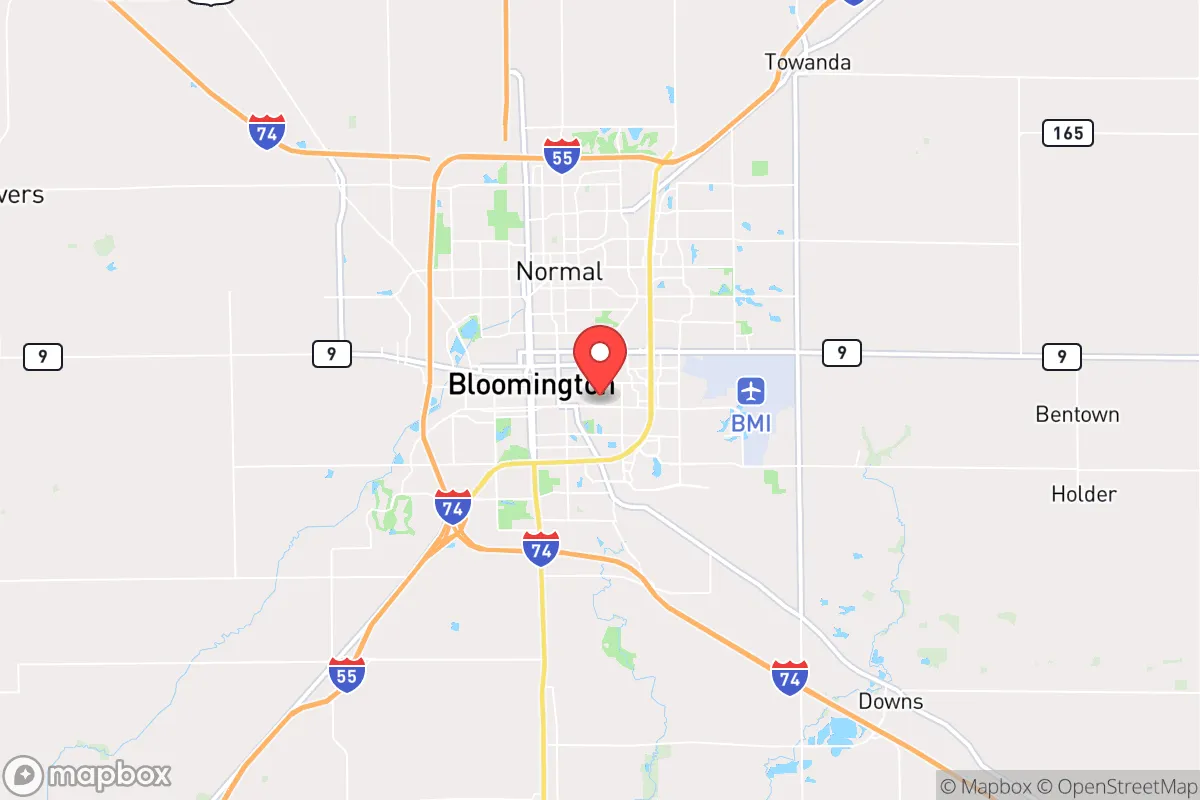
Photo: Wikipedia
Personal Sovereignty in Bloomington, IL
Viable for self-reliance. Generally workable, though some barriers may limit total independence.
What does Personal Sovereignty tell us?
Personal Sovereignty measures your capacity for self-reliance and independence with minimal government friction. Higher scores mean fewer barriers between you and the way you want to live... but it assumes you have the space you need and good neighbors.
What does this tell us?
Personal Sovereignty measures your capacity for self-reliance and independence with minimal government friction. Higher scores mean fewer barriers between you and the way you want to live... but it assumes you have the space you need and good neighbors.
State Policy
Energy independence: Importer (45% of energy produced in-state)
Personal Liberty
Homesteading

Personal Liberty Analysis
For the individualist or prepper evaluating Bloomington, Illinois, as a potential base of operations, the personal sovereignty picture is a study in contradictions: the local culture and geography offer tangible advantages for self-reliance, but the state-level legal and tax framework imposes significant constraints on autonomy. Bloomington sits in McLean County, a politically moderate island in a deep-blue state, which creates a buffer against the most aggressive state-level overreach—but it is not a sanctuary. The real question for a survivalist-minded relocator is whether the local practical freedoms (affordable land, a strong DIY culture, and a relatively hands-off local government) outweigh the burdens of a state that actively limits your choices on self-defense, medical autonomy, and taxation. The answer depends heavily on your tolerance for state-level friction versus your need for local community resilience.
Tax burden and regulatory posture: how much of your income and time does the state take?
Illinois is a high-tax state, and Bloomington residents cannot escape that reality. The state income tax is a flat 4.95%, and while there is no local income tax in Bloomington, the combined state and local sales tax rate in McLean County is 8.5%—that adds up fast on every purchase of gear, supplies, or building materials. Property taxes are the real sting: McLean County’s effective property tax rate hovers around 2.1% of assessed value, one of the highest in the nation. On a $250,000 home, that’s over $5,000 annually, money that could otherwise fund your own preparedness projects. The regulatory posture at the state level is heavy-handed, particularly on environmental and business licensing, but Bloomington’s local government is comparatively pragmatic. Zoning is generally permissive for home-based businesses and hobby farming, and the city does not aggressively enforce the kind of nuisance ordinances that plague more suburban areas. However, the state’s Prevailing Wage Act and strict building codes mean any major construction—like a workshop, root cellar, or reinforced safe room—will cost more than in a right-to-work state. For a prepper, the tax burden is a constant drain, but the local regulatory climate is not actively hostile to self-reliance projects.
Self-defense and gun law specifics: what can you legally own and where can you carry?
This is the most critical area where Illinois state law directly conflicts with a survivalist mindset. Illinois is a may-issue state for concealed carry, meaning local law enforcement has discretion—though in practice, McLean County is shall-issue and permits are routinely granted to qualified applicants. The process requires a 16-hour training course, fingerprinting, and a $150 fee, plus a 90-120 day wait. That is a bureaucratic gauntlet that many preppers find unacceptable. More concerning: Illinois has a statewide assault weapons ban (effective 2023) that prohibits possession of many common semi-automatic rifles, including the AR-15 platform, and standard-capacity magazines over 10 rounds for long guns and 15 rounds for handguns. Existing owners must register them with the state police—a registry that many view as a precursor to confiscation. There is no state preemption on firearm laws, so Bloomington could theoretically pass its own restrictions, though the city council has shown no appetite for that. On the positive side, stand-your-ground does not exist in Illinois; you have a duty to retreat if safely possible before using deadly force. Castle doctrine applies only inside your home. For a prepper, this means your defensive options are legally limited, and your ability to stockpile standard-capacity rifles for community defense is effectively outlawed. If self-defense sovereignty is your top priority, Bloomington is a poor choice compared to Indiana or Missouri.
Self-reliance and homesteading viability: lot sizes, zoning, and off-grid feasibility
This is where Bloomington shines relative to its state context. The city’s zoning code allows for urban agriculture—chickens, bees, and even small livestock (goats, sheep) on lots as small as a quarter-acre, provided you follow setback and noise ordinances. Outside the city limits in unincorporated McLean County, zoning is extremely lax; you can buy a 5-10 acre parcel for $15,000-$25,000 per acre and build a homestead with minimal permitting. The soil is rich Illinois black dirt, ideal for a serious garden or food forest. Off-grid feasibility is mixed: the county does not require connection to municipal water or sewer if you can demonstrate a well and septic system, but the state’s health department regulates well depth and septic design strictly. Solar panels are legal and net metering is available, but the state’s Renewable Portfolio Standard means you cannot fully disconnect from the grid without a fight—the utility (Ameren) will still charge a monthly connection fee. Rainwater collection is legal for non-potable use, but the state has no explicit protection for it. For a prepper, the key advantage is that you can buy a modest acreage within 15 minutes of downtown, build a self-sufficient homestead, and remain under the radar. The local Amish and Mennonite communities in surrounding counties (like Arthur) also provide a network for traditional skills and barter—something rare in the Midwest.
Personal liberties: parental rights, medical autonomy, speech, and property
Illinois has aggressively expanded state authority in areas that directly affect family and medical sovereignty. Parental rights are under constant pressure: the state mandates comprehensive sex education in public schools, and there is no opt-out for specific topics like gender ideology—only a general opt-out for “sex education” as a whole. The state also has a universal vaccine mandate for school attendance (though medical and religious exemptions exist, they are increasingly contested in court). Medical autonomy is similarly constrained: Illinois has no legal protection for alternative or holistic medicine practitioners, and the state medical board aggressively pursues unlicensed practice. COVID-era mandates were enforced vigorously in Bloomington, with local businesses and schools requiring masks and vaccines longer than in surrounding counties. Free speech is protected by the First Amendment, but Illinois has a broad hate speech statute that has been used to prosecute online言论, and the state’s anti-SLAPP law is weak, making it easier for wealthy interests to sue critics. Property rights are relatively strong: eminent domain is rarely abused in McLean County, and the state’s Private Property Protection Act provides some compensation for regulatory takings. However, the state’s Environmental Protection Act allows third-party lawsuits against landowners for alleged pollution, a tool used by activist groups to block development or farming practices. For a prepper, the biggest liberty concern is medical and educational autonomy—you will need to homeschool or use private schools to avoid state-mandated curricula, and you will need to travel out of state for any medical treatment that falls outside the mainstream.
Overall, Bloomington offers a moderate local sovereignty environment that is heavily constrained by state-level overreach. Compared to a free state like Texas or New Hampshire, you are giving up significant ground on self-defense, taxation, and medical autonomy. But compared to Chicago or the coastal blue states, Bloomington’s practical freedoms—affordable land, a permissive homesteading culture, and a community that values self-reliance—make it a viable compromise for the prepper who cannot or will not move to a red state. The key is to treat Bloomington as a base for local resilience while accepting that you will need to fight state battles on gun rights and parental control. If you can live with that friction, the area’s low crime, strong local economy, and access to farmland make it a defensible outpost in an increasingly restrictive state.

* Values derived from national, state, county, city and local statistics and may differ in a specific area. Last updated: 2026-04-30T01:34:36.000Z
Narrative content on this page is AI-generated and may contain mistakes. Verify any details that matter before acting on them.
ReloMaps may earn a commission from affiliate links at no extra cost to you.

