Photo: Wikipedia
Demographics of Bremerton, WA
Affluence Level in Bremerton, WA
A middle-class area roughly in line with national averages across income, home values, education, and employment.
People of Bremerton, WA
The people of Bremerton, Washington today number 44,531, forming a city that is notably less diverse than the broader Seattle metro area yet more varied than its own historic reputation suggests. The population is 64.3% white, with a significant Hispanic minority at 12.9%, East and Southeast Asian communities at 4.9%, Black residents at 4.4%, and a small Indian-subcontinent population at 0.4%. Only 3.7% of residents are foreign-born, and 26.9% hold a college degree, reflecting a working-class character shaped by the Puget Sound Naval Shipyard and a slower pace than nearby Seattle.
How the city was settled and grew
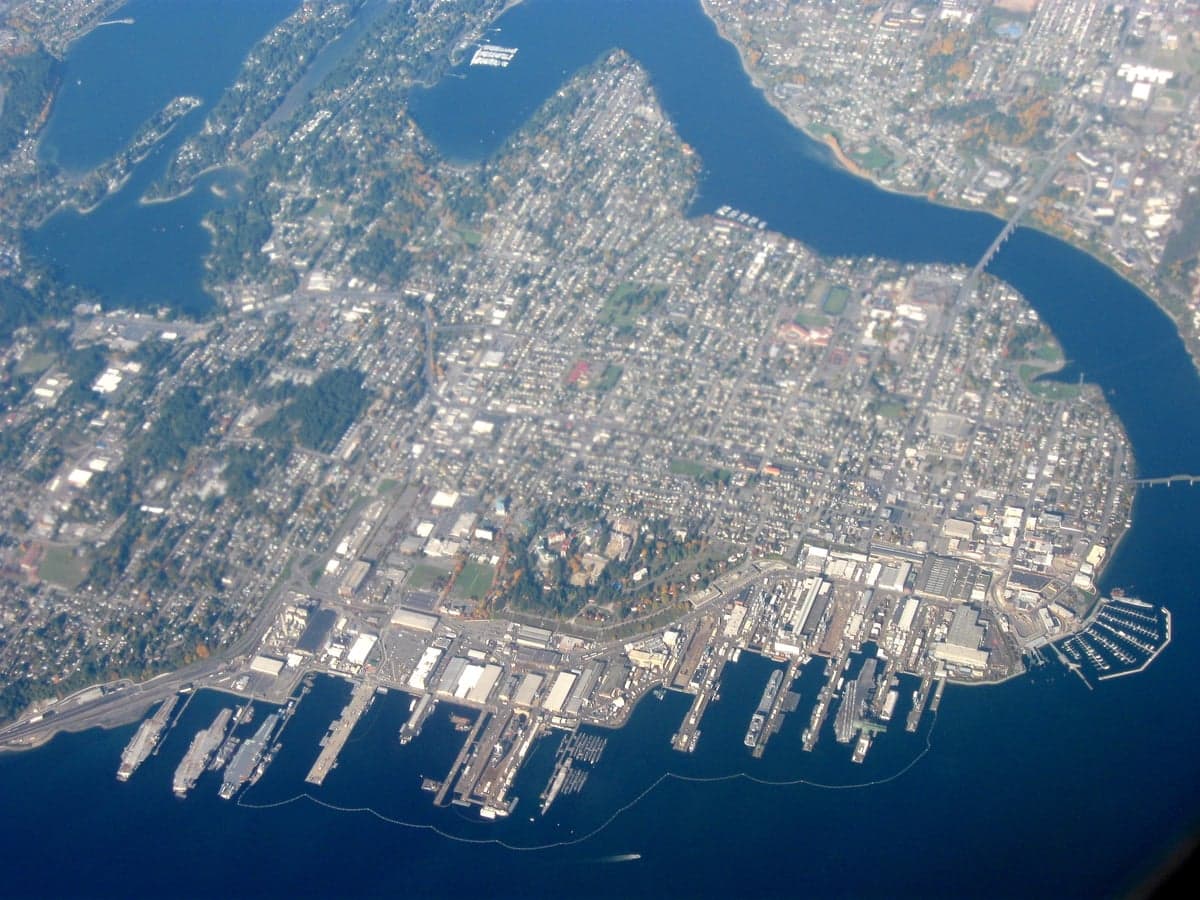
Bremerton’s human history begins not with colonial settlement but with the U.S. Navy. The city was founded in 1891 when the Navy established the Puget Sound Naval Shipyard, drawing a first wave of workers from the Midwest and Northeast—skilled tradesmen, machinists, and engineers. The original population was overwhelmingly white and native-born, settling in the Charleston neighborhood near the shipyard and the Manette peninsula, which became the city’s first residential district. A second wave arrived during World War I and again during World War II, when the shipyard swelled to over 30,000 workers. This era brought a small influx of Black workers from the South, who settled primarily in the West Hills and Anderson Cove areas, though Bremerton remained heavily segregated by custom and practice. The city’s growth peaked in the 1950s at roughly 30,000 residents, then plateaued as the Navy downsized after the Cold War.
Modern era (post-1965)
The post-1965 period reshaped Bremerton’s demographics more slowly than in other West Coast cities. The Hart-Cellar Act did not trigger a large immigrant wave here; the foreign-born share remains low at 3.7%. Instead, the major shift came from domestic in-migration. The 1990s and 2000s saw an influx of Hispanic workers, many from Mexico and Central America, drawn to construction, service jobs, and the shipyard’s support industries. They concentrated in the East Bremerton corridor, particularly around the Sheridan Park neighborhood, where Hispanic-owned businesses and a Spanish-language church now anchor the community. East and Southeast Asian residents—Filipino, Vietnamese, and Korean families—arrived in smaller numbers, many connected to Navy service or military contracting, settling in Navy Yard City and the West Park area. The Black population, which had been around 6% in the 1970s, declined to 4.4% as younger families moved to Kitsap County’s more affordable suburbs. The Indian-subcontinent population remains tiny at 0.4%, reflecting Bremerton’s lack of the tech-sector pull that draws South Asian professionals to Redmond or Bellevue.
The future
Bremerton’s population is slowly diversifying, but the trend is toward a more Hispanic and Asian mix rather than a broad multi-ethnic transformation. The Hispanic share has risen from roughly 8% in 2010 to 12.9% today, driven by both births and continued migration into East Bremerton. East and Southeast Asian communities are growing modestly, likely reaching 6-7% by 2035, as Navy-related families and service workers settle in Navy Yard City. The white share, while still a majority, is declining gradually as older residents age out and younger white families choose newer suburbs like Silverdale or Port Orchard. The city is not tribalizing into sharply divided enclaves; instead, neighborhoods like Sheridan Park are becoming more Hispanic, while Manette and Charleston remain predominantly white and older. The foreign-born share is expected to rise only to about 5-6% by 2040, still low by regional standards.
For someone moving to Bremerton now, the city is becoming a more Hispanic-influenced, working-class community with a stable Navy anchor and a slow diversification that lags behind the rest of Kitsap County. It is not a melting pot in the Seattle sense, but a place where distinct ethnic clusters—white in the historic core, Hispanic in East Bremerton, Asian near the shipyard—coexist without much friction. The population is aging, with a median age of 38, and the college-educated share is rising slowly as remote workers from Seattle discover the ferry commute. The bottom line: Bremerton remains a Navy town at heart, with a demographic future that is more Hispanic and Asian, but still predominantly white and native-born, and unlikely to see the rapid change that characterizes the Eastside tech suburbs.

* Values derived from national, state, county, city and local statistics and may differ in a specific area. Last updated: 2026-04-21T11:08:12.000Z
Narrative content on this page is AI-generated and may contain mistakes. Verify any details that matter before acting on them.
ReloMaps may earn a commission from affiliate links at no extra cost to you.

