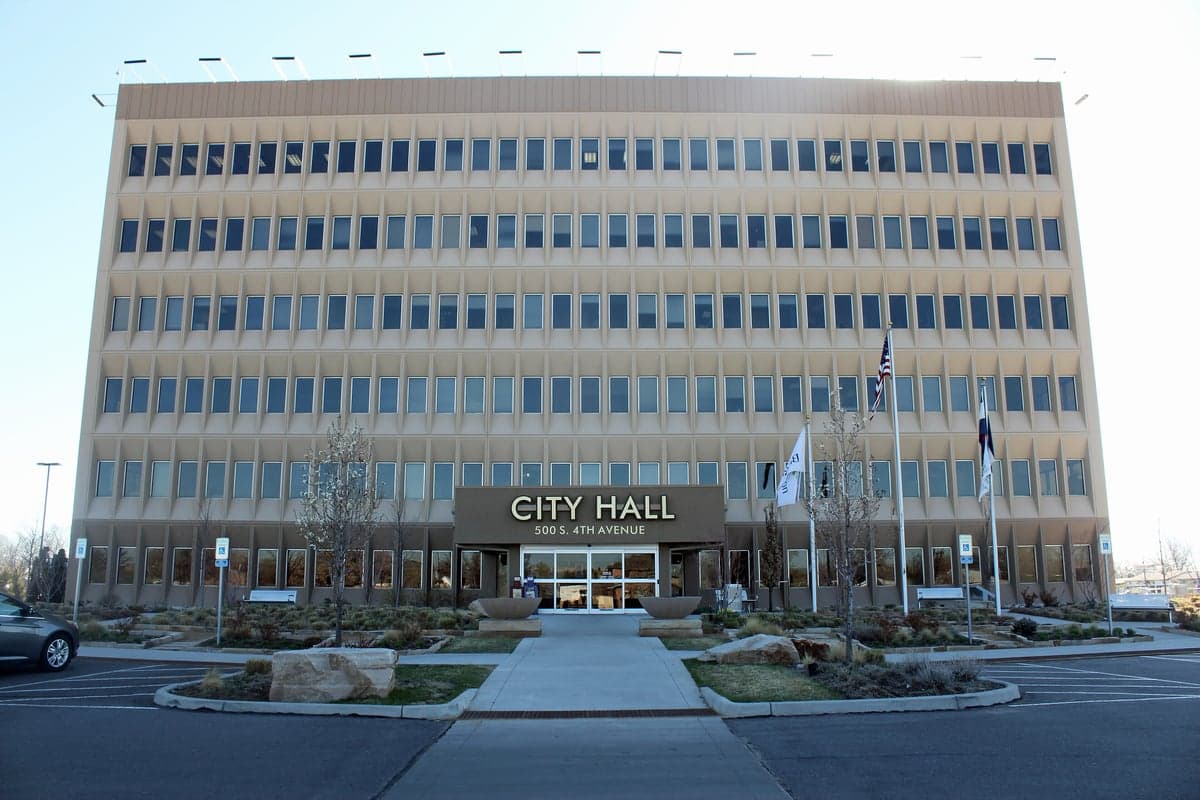
Photo: Wikipedia
Demographics of Brighton, CO
Affluence Level in Brighton, CO
A middle-class area roughly in line with national averages across income, home values, education, and employment.
People of Brighton, CO
The people of Brighton, Colorado, today form a working-class, family-oriented community of 41,196 that is notably younger and more ethnically diverse than Colorado as a whole. The city’s identity is shaped by a near-even split between White (52.0%) and Hispanic (38.5%) residents, with small but growing Black (2.9%), East/Southeast Asian (1.4%), and Indian-subcontinent (0.7%) populations. Brighton feels less transient than many Front Range suburbs — a place where multi-generational families, many rooted in the area’s agricultural and railroad past, live alongside newer arrivals drawn by lower housing costs and commuter access to Denver. The foreign-born share sits at just 4.8%, well below the national average, indicating that most growth comes from domestic migration rather than international immigration.
How the city was settled and grew
Brighton’s population history begins with the 1859 gold rush, when the confluence of the South Platte River and the future railroad route made this spot a natural supply stop. The town was formally platted in 1881 as a division point on the Union Pacific Railroad, and the first major wave of settlers were Anglo-American railroad workers and farmers drawn by irrigated sugar beet fields. By the 1910s, the Great Western Sugar Company had built a massive processing plant, attracting a second wave: Mexican and Mexican-American laborers who came as seasonal beet workers and later settled permanently. These families concentrated in what is still known as Old Town Brighton, the historic core along Bridge Street, and in the South Side neighborhood south of the railroad tracks, where modest worker cottages and early 20th-century bungalows remain. A smaller wave of German-Russian immigrants, also recruited for sugar beet agriculture, settled in the East Brighton area near the sugar factory. Through the 1950s, Brighton remained a small, predominantly White farming town of roughly 5,000 people, with a significant Hispanic minority that had been present for generations.
Modern era (post-1965)
The post-1965 period transformed Brighton from an agricultural service town into a Denver exurb. The 1965 Immigration and Nationality Act had limited direct effect here — Brighton’s foreign-born population remains low — but the broader suburbanization of the Front Range did. From the 1970s through the 1990s, White middle-class families moved east from Denver and Adams County, attracted by larger lots and newer housing in subdivisions like Bromley Park and Eagle Creek, both north of the original town. These neighborhoods remain predominantly White and owner-occupied today. Meanwhile, the historic Hispanic population grew through natural increase and continued domestic migration from the Southwest, expanding into West Brighton near Highway 85 and the Riverdale corridor. The 2000s brought a third wave: younger, cost-burdened families — both White and Hispanic — priced out of Denver and Boulder, who filled new master-planned communities like Prairie Center in the city’s northern annexation area. This wave has been predominantly domestic, not foreign-born, and has increased Brighton’s college-educated share to 23.5%, though that remains well below the state average of roughly 40%. The Black population, while small at 2.9%, has grown steadily since 2000, concentrated in the newer subdivisions near E-470. East/Southeast Asian and Indian-subcontinent communities remain tiny but visible in the medical and tech sectors, with no single ethnic enclave yet formed.
The future
Brighton’s population is heading toward greater ethnic balance but not toward the hyper-diversity seen in Denver or Aurora. The Hispanic share is likely to continue rising slowly through natural increase and domestic migration, potentially reaching 45-48% by 2040, while the White share will decline proportionally. The city is not tribalizing into distinct ethnic enclaves — most neighborhoods are already mixed, with the exception of the older, more homogeneous subdivisions like Bromley Park. The foreign-born share is expected to remain low (under 7%) because Brighton lacks the dense job networks and rental housing stock that attract new immigrants. The bigger demographic story is age: Brighton’s median age of 33.5 is significantly younger than Colorado’s 37.0, driven by families with children. The school district is already majority Hispanic, and that trend will continue. For the next 10-20 years, Brighton will likely become a more solidly working-class, family-oriented, and Hispanic-influenced suburb — less white-collar than nearby Broomfield or Westminster, but more stable and less transient than the urban core.
For someone moving in now, Brighton offers a community that is ethnically diverse but culturally cohesive, with deep roots in its agricultural and railroad past. The population is growing steadily but not explosively, and the city is becoming more Hispanic and more family-centered with each passing decade. It is not a place of rapid demographic churn or immigrant-driven change, but rather a slow, organic evolution shaped by domestic migration and generational continuity.

* Values derived from national, state, county, city and local statistics and may differ in a specific area. Last updated: 2026-05-01T10:55:43.000Z
Narrative content on this page is AI-generated and may contain mistakes. Verify any details that matter before acting on them.
ReloMaps may earn a commission from affiliate links at no extra cost to you.

