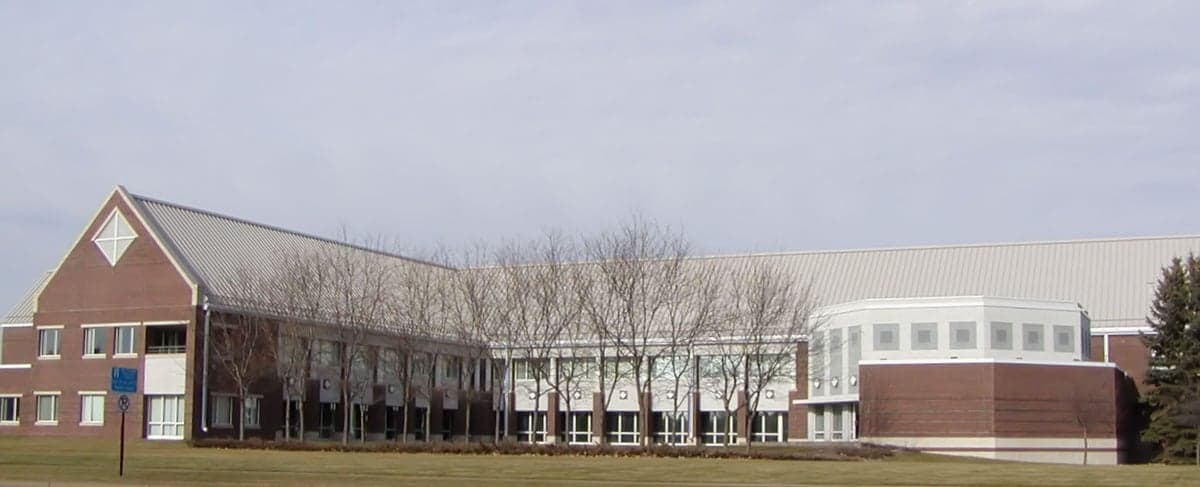
Photo: Wikipedia
Strategic Assessment of Brooklyn Park, MN
Multiple tactical vulnerabilities. Population density, target proximity, or disaster risk are likely compounding. A retreat property and exit planning is required.
What does the Strategic Assessment tell us?
Our Strategic Assessment grades tactical survivability of an area. Major population centers, military targets, fallout zones, natural disasters, and border exposure all drive risk — lower exposure means a more defensible position in a crisis.
This is heavily inspired by Joel Skousen's Strategic Relocation book. Highly recommended you checkout the book ($)What does this tell us?
Our Strategic Assessment grades tactical survivability of an area. Major population centers, military targets, fallout zones, natural disasters, and border exposure all drive risk — lower exposure means a more defensible position in a crisis.
This is heavily inspired by Joel Skousen's Strategic Relocation book. Highly recommended you checkout the book ($)Strategic Pillars

Key Distances
Regional Safe Places
Below is our recommended "safe zones" in Minnesota and the surrounding area based on our strategic heuristics. For most people, it's unrealistic to live in a “safe zone” full-time due to work, family or other personal reasons. They tend to be more rural. However, many of these areas are perfect for second homes and retreat properties that double as a vacation home or even a short-term rental.
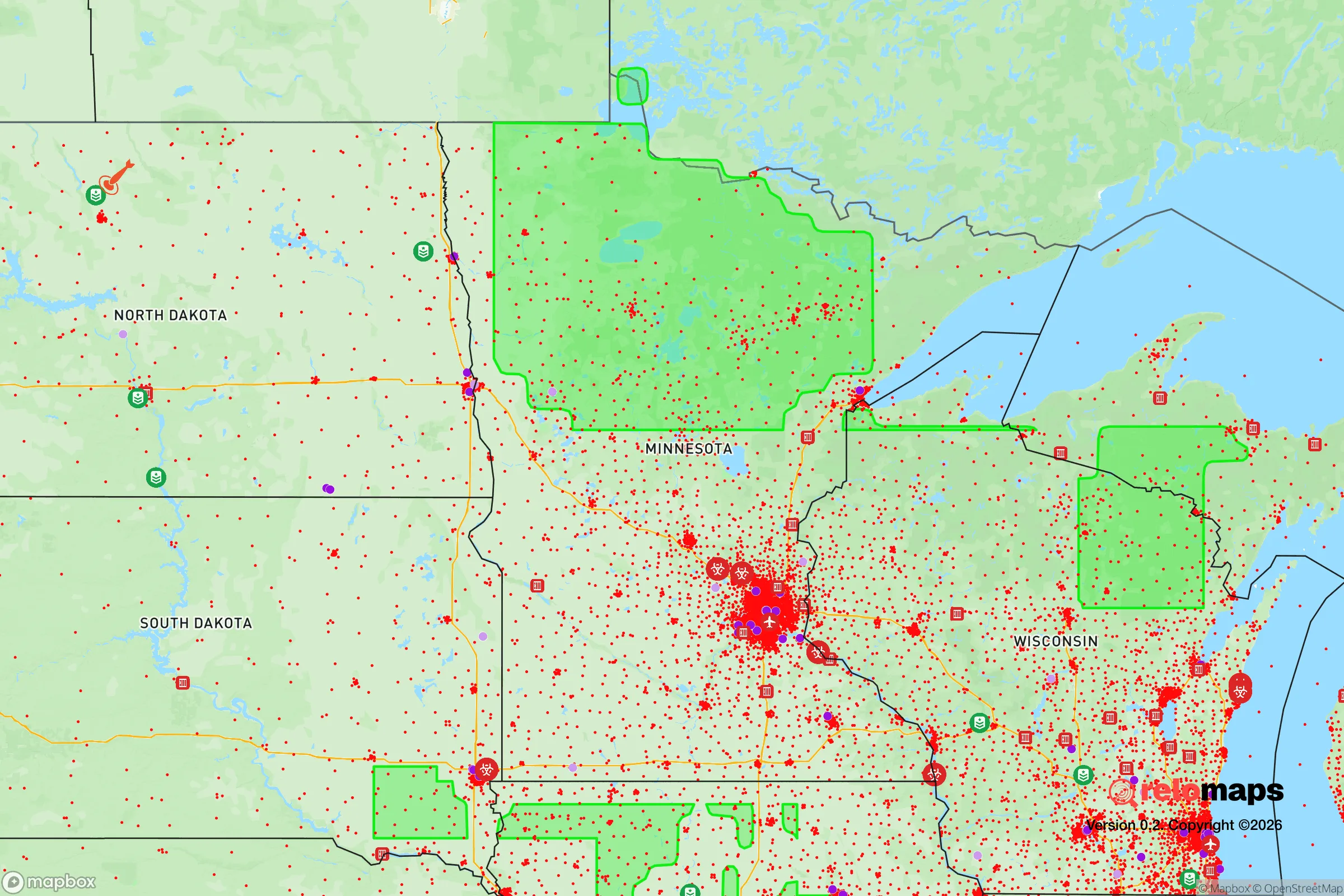
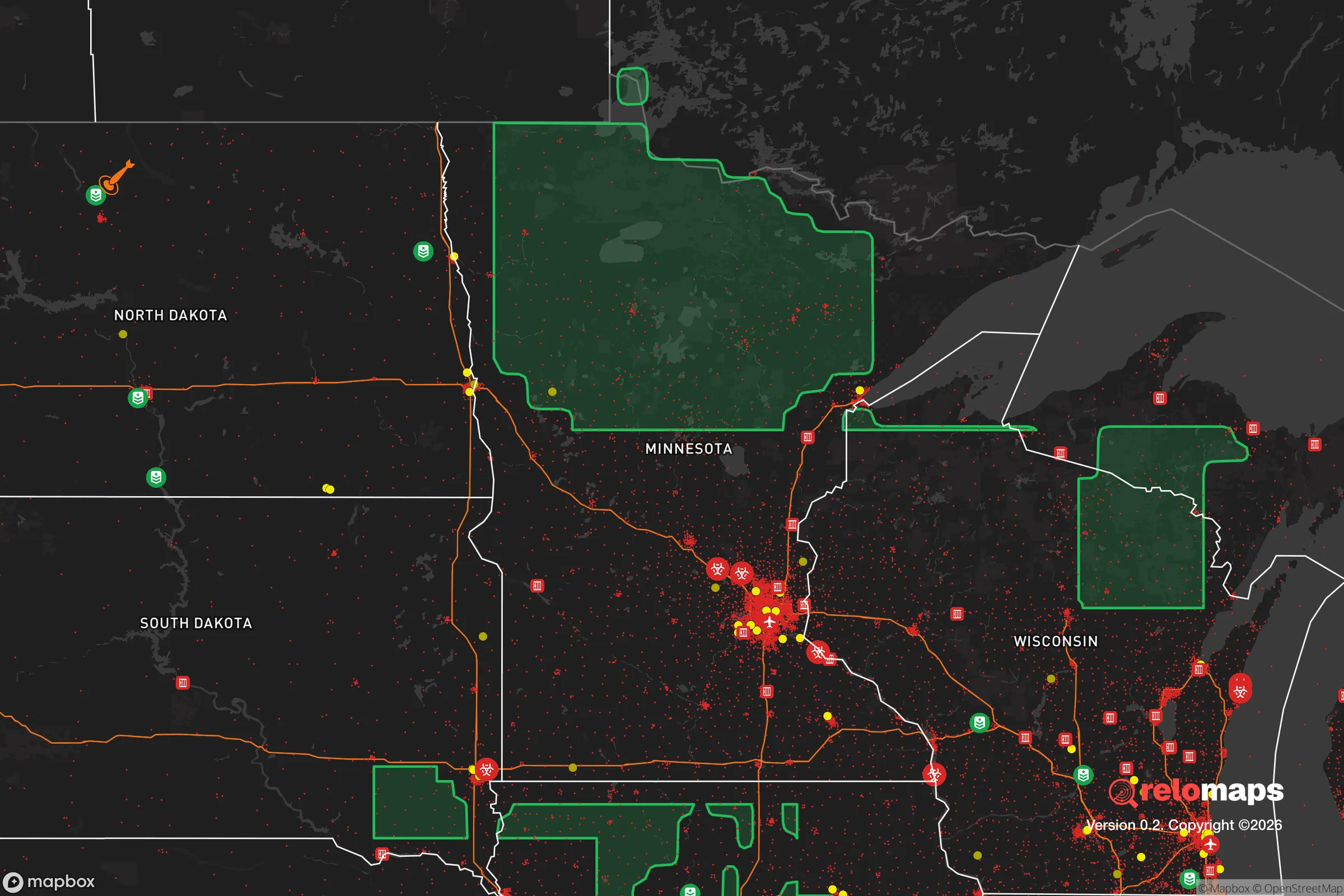


Important Note: For informational purposes only. This does not mean nothing bad ever happens in the green zones. Please use common sense. This is based on public data and modeled with AI. We tried to take a conservative approach but mistakes happen. We update this regularly as new information becomes available.
Solar Generator Recommendations
Backup power matters more here than in safer locations. We've picked three solar generators across budgets and capacity tiers — start with the budget unit if you only need a few essentials, or step up if you want to run a fridge and HVAC for days at a time.

Jackery Portable Power Station Explorer 300
Budget OptionPower on the Go: Weighing only 11 lbs, it's convenient to set up and store with book-sized foldable solar panels

BLUETTI Portable Power Station AC180
Designed for both indoor and outdoor scenarios, AC180 is highly capable as it has a robost capacity and continuous output power.

EF ECOFLOW DELTA Pro Ultra Power Station
Upgraded PickEcoFlow DELTA Pro Ultra is a whole-home energy system designed to grow with your family. Integrated with the Smart Home Panel 2, it scales to meet your evolving energy needs — keeping your home powered, intelligent, and secure through every stage of life.
We earn a commission, at no additional cost to you.
Strategic Assessment Analysis
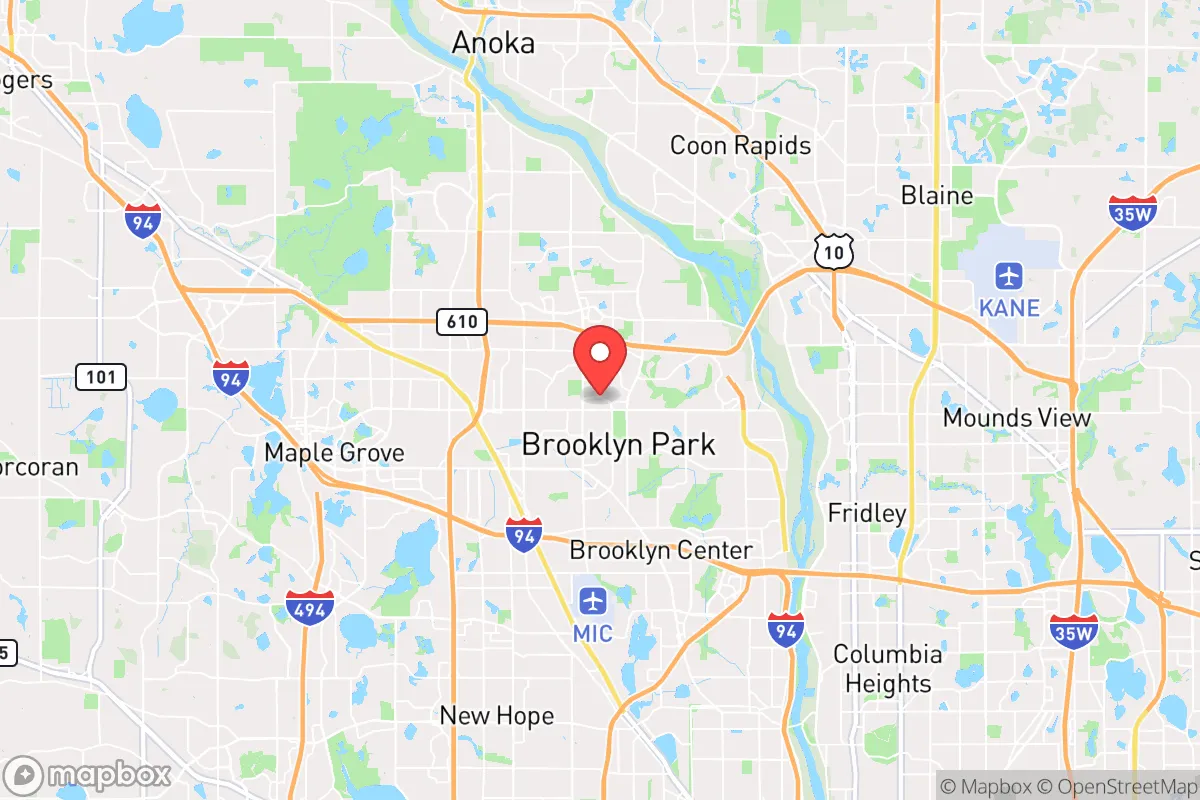
Brooklyn Park, Minnesota, sits in a precarious strategic position that demands a clear-eyed assessment for anyone serious about long-term resilience. As the sixth-largest city in the state with over 80,000 residents, it offers the infrastructure and economic base of a major suburb, but its proximity to Minneapolis—just 10 miles from downtown—introduces significant vulnerabilities that a prepper or survivalist cannot ignore. The city’s location along the Mississippi River and its access to major highways like I-94 and I-694 provide logistical advantages, but these same corridors become liabilities during civil unrest or mass casualty events, funneling chaos directly into the community. For a conservative-leaning relocator weighing security against convenience, Brooklyn Park represents a trade-off: it is not a remote redoubt, but it can serve as a staging ground if you understand its risks and prepare accordingly.
Geographic position and natural advantages for long-term survival
Brooklyn Park’s geography offers a mixed bag for strategic relocation. The city spans roughly 26 square miles along the west bank of the Mississippi River, giving residents direct access to a major freshwater source—a critical asset for any long-term survival scenario. The river itself is a double-edged sword: it provides water for filtration, fishing, and potential transport, but it also acts as a natural corridor for population movement during a crisis. The surrounding terrain is relatively flat, part of the Minnesota River Valley watershed, which means flooding is a recurring risk, especially in low-lying areas near the Mississippi. The city’s numerous parks and green spaces, such as the 1,000-acre Elm Creek Park Reserve to the north, offer some buffer and potential for foraging or small-scale agriculture, but these are not wilderness refuges. The area’s cold climate—winters average 10°F to 20°F, with occasional deep freezes—demands serious preparation for heating, food storage, and water line protection. For a prepper, the natural advantages here are real but limited: the river is a lifeline, but the urban sprawl and lack of defensible terrain mean you cannot rely on geography alone for security.
Risks, exposures, and proximity to fallout-relevant landmarks
The most glaring risk for Brooklyn Park is its proximity to Minneapolis and the broader Twin Cities metro area, a population center of over 3 million people. In the event of civil unrest, mass casualty events, or a major disaster, this density becomes a liability. The city is within 15 miles of the Minneapolis–Saint Paul International Airport (MSP), a likely target for any coordinated attack or disruption. Additionally, the nearby Mississippi River locks and dams, such as the Lock and Dam No. 1 in Minneapolis, are critical infrastructure that could be compromised, causing downstream flooding or disrupting water supplies. Brooklyn Park itself hosts several industrial sites, including chemical storage and manufacturing facilities along the river, which pose secondary hazards like toxic spills or explosions. The city’s location along I-694 and I-94 means evacuation routes will be choked during any crisis, and the lack of natural barriers—no mountains, dense forests, or significant elevation changes—makes it hard to establish a defensible perimeter. For a survivalist, the key takeaway is that Brooklyn Park is not a fallout-safe zone; it is a suburban buffer that will absorb the first wave of chaos from the urban core. If you are looking for true isolation, this is not it.
Practical resilience for a relocator: food, water, energy, and defensibility
For a relocator focused on practical resilience, Brooklyn Park requires a proactive, layered approach. Water access is the strongest asset: the Mississippi River is a reliable source, but you must have filtration systems (e.g., Berkey or Sawyer filters) and storage capacity, as municipal water treatment could fail during a prolonged outage. The city’s water utility is part of the Minneapolis system, which is vulnerable to cyberattacks or physical sabotage. Food security is a challenge: the area is heavily suburban, with limited farmland within city limits. Community gardens exist, but they are not sufficient for long-term self-sufficiency. You would need to rely on stockpiling, bartering, or establishing relationships with rural growers in nearby counties like Sherburne or Wright, which are 30–45 minutes northwest. Energy resilience is mixed: Xcel Energy provides electricity, and natural gas is common for heating, but both grids are susceptible to weather-related outages (ice storms, derecho winds) and targeted attacks. Solar panels with battery backup are viable here, given the region’s 200+ sunny days per year, but winter generation drops significantly. Defensibility is the weakest link: Brooklyn Park’s suburban layout—cul-de-sacs, strip malls, and interconnected neighborhoods—makes it difficult to secure a single property without drawing attention. The city’s police force is professional but stretched thin; during the 2020 George Floyd protests, Brooklyn Park saw its own unrest, including looting and arson, demonstrating that civil order can break down quickly. For a single individual or family, the best strategy is to choose a home on a dead-end street with limited access points, reinforce doors and windows, and maintain a low profile. Community resilience groups or church networks can provide mutual aid, but trust must be built before a crisis.
The overall strategic picture for Brooklyn Park is one of calculated risk. It is not a survivalist’s paradise—the urban proximity, flat terrain, and infrastructure vulnerabilities are real drawbacks. However, for a conservative relocator who values economic opportunity, access to healthcare (North Memorial Health Hospital is local), and a relatively stable housing market (median home price around $300,000 as of 2025), it can work as a base if you are willing to invest in preparation. The key is to treat Brooklyn Park as a hub, not a haven: build your supplies, establish a retreat plan to rural Minnesota (e.g., areas north of St. Cloud or west toward South Dakota), and maintain situational awareness. The city’s diversity and political leanings—it votes reliably Democratic, with a significant Somali-American population—may feel culturally distant for some conservative readers, but in a survival scenario, competence and preparedness matter more than politics. If you can navigate the trade-offs, Brooklyn Park offers a foothold in the Upper Midwest with real resources, but only if you are ready to leave when the sirens sound.

* Values derived from national, state, county, city and local statistics and may differ in a specific area. Last updated: 2026-04-24T08:37:26.000Z
Narrative content on this page is AI-generated and may contain mistakes. Verify any details that matter before acting on them.
ReloMaps may earn a commission from affiliate links at no extra cost to you.

