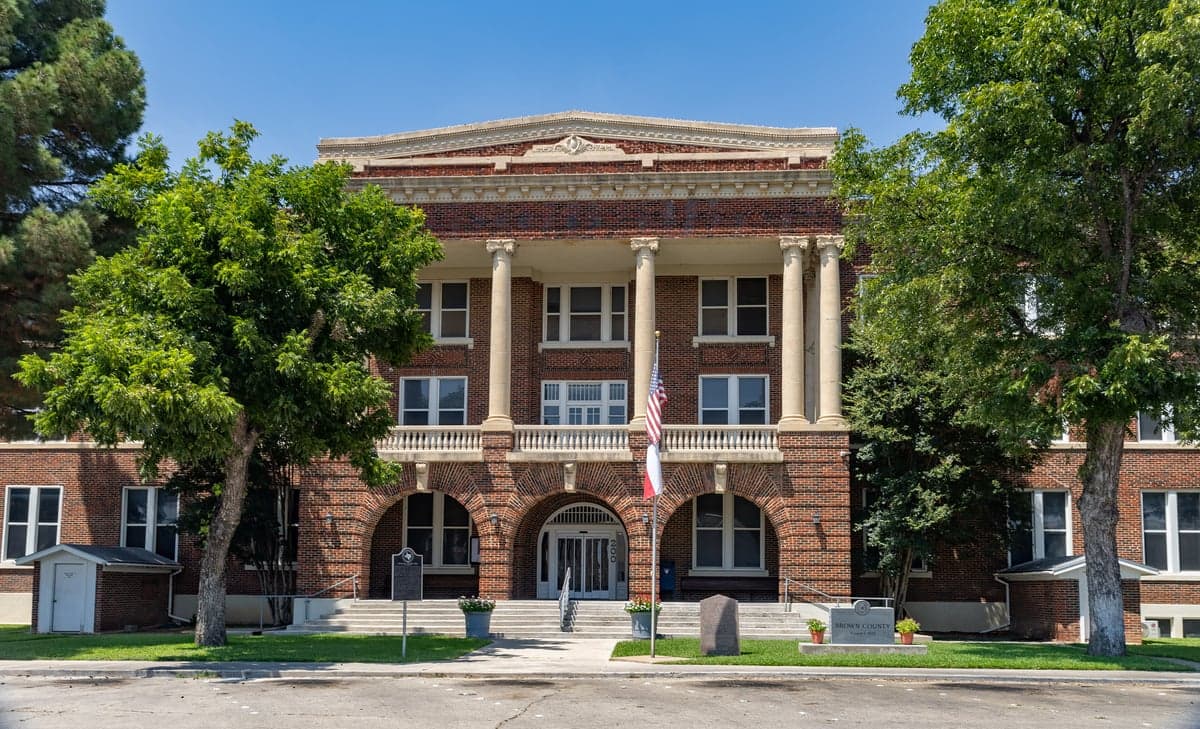
Photo: Wikipedia
Quality of Life in Brownwood, TX
A high quality of life with strong walkability, manageable living costs, healthy neighborhood signals, and solid amenity access.
What does Quality of Life tell us?
Quality of Life blends cost of living, nearby amenities, socioeconomic signals, and neighborhood character. City-level scores represent the whole municipality; individual neighborhoods can differ.
What does this tell us?
Quality of Life blends cost of living, nearby amenities, socioeconomic signals, and neighborhood character. City-level scores represent the whole municipality; individual neighborhoods can differ.
Cost of Living
40% below national average
The Real Cost of Living in Brownwood, TX for 2026
| Tier | Individual | Family (4) |
|---|---|---|
| Survival | $25k | $47k |
| Comfortable | $35k | $52k |
| Luxury | $86k+ | $134k+ |
| Elite (Top 5%) | $116k+ | $179k+ |
92%
The Area Signal
A metric tracking the socioeconomic signals of the area.


Hobbies
Explore the areaGroceries
5 within 10 miles
Gas
0 within 10 miles
Hospital
3 within 20 miles
Airport
SAN — San Angelo Regional
Post Office
USPS — Brownwood, TX
Critical Amenities
Quality-of-Life Analysis
Brownwood, Texas, presents a notably affordable quality of life that attracts a mix of retirees, young families, and workers in healthcare and manufacturing, with a cost-of-living index of 60 (40% below the U.S. average). The median household income hovers around $42,000, reflecting a community where modest wages stretch further than in most of the state. This is not a wealthy enclave but a practical, middle-American town where financial stability is attainable on a single income, drawing people who prioritize low overhead over urban amenities.
How housing costs compare to Abilene and San Angelo
Brownwood’s housing market is among the most accessible in West Texas. The median home value sits at $123,700, roughly half the Texas statewide median of $240,000, while the median rent of $829 undercuts both Abilene ($950) and San Angelo ($900). For context, a household earning the area’s median income can afford a mortgage on a median-priced home with a standard 30-year loan at 6.5% interest, requiring only about 22% of gross monthly income—well below the 28% threshold lenders typically recommend. The average commute of 14.4 minutes is among the shortest in the state, meaning residents spend less than 250 hours per year in transit compared to the national average of 400. This combination of low housing costs and minimal commuting effectively boosts disposable income by thousands annually versus living in Austin or Dallas.
What daily life is like for families and retirees
Daily life in Brownwood revolves around a compact downtown anchored by Howard Payne University, a private liberal arts college that hosts cultural events and public lectures. The Brownwood Independent School District serves roughly 4,500 students across seven campuses, with Brownwood High School offering dual-credit courses through the local community college. For recreation, Lake Brownwood State Park provides 7.5 miles of hiking trails and fishing access within a 15-minute drive, while the Brownwood Coliseum hosts rodeos and concerts. Groceries and retail are concentrated along US-377 and US-183, with a Walmart Supercenter and a H-E-B serving as primary shopping anchors. The town lacks a major hospital—Brownwood Regional Medical Center is a 99-bed facility—so residents requiring specialized care often travel 90 minutes to Abilene or 2 hours to Fort Worth. Restaurants are predominantly local diners and Tex-Mex spots, with no national fine-dining chains present.
This environment suits individuals and families who value financial breathing room and a slower pace over career diversity or nightlife. Retirees on fixed incomes find the low property taxes (roughly 1.2% of assessed value) and Medicare-friendly healthcare costs particularly attractive. Young families benefit from the short commute and affordable child care, which averages $600 per month for full-time care—about 30% less than the Texas average. Professionals in remote or hybrid roles can leverage the low cost of living while earning salaries tied to higher-cost metros, though local job growth is concentrated in healthcare (Brownwood Regional Medical Center employs over 600), education (Howard Payne University and the school district), and manufacturing (3M and Lennox International operate plants here). Those seeking vibrant arts scenes, diverse dining, or rapid career advancement will likely find Brownwood limiting; it is a place built for stability, not upward mobility.

Crime in Brownwood, TX
Crime rates similar to the national median for U.S. locations.
Violent CrimeViolent Crime Analysis
Property CrimeProperty Crime Analysis
Crime Analysis
Brownwood, Texas, reports a violent crime rate of 421.1 incidents per 100,000 residents and a property crime rate of 2,334.8 per 100,000, placing it above national averages for both categories. These figures indicate that while Brownwood is not a high-crime urban center, residents face a statistically elevated risk compared to the typical U.S. community. The city’s safety profile is shaped by its status as a regional hub in Brown County, where economic factors and law enforcement resources play a significant role.
Crime in context
Brownwood’s violent crime rate of 421.1 per 100,000 is roughly 20% higher than the national average of approximately 380 per 100,000 and significantly exceeds the Texas state average of about 447 per 100,000. Property crime in Brownwood, at 2,334.8 per 100,000, is nearly 30% above the national average of roughly 1,950 per 100,000 and aligns closely with the Texas state average of 2,350 per 100,000. These numbers place Brownwood in a moderate-risk tier among Texas communities of similar size, though the property crime rate is a particular concern for homeowners and businesses. It is important to note that Brownwood operates under a traditional criminal justice framework; unlike some large metropolitan areas with progressive district attorneys who prioritize diversion over prosecution, Brown County’s elected officials generally emphasize enforcement and victim rights, which can contribute to a more predictable public safety environment.
What residents experience
Residents commonly report property crimes such as burglary, theft from vehicles, and vandalism as the most frequent safety issues, particularly in areas near commercial corridors like Commerce Street and the Brownwood Regional Airport. Violent incidents, including aggravated assault and robbery, are less common but tend to cluster in specific neighborhoods and around late-night establishments. The Brownwood Police Department maintains a visible presence through community policing initiatives, and the city’s relatively compact geography allows for quicker response times than in sprawling metro areas. However, the elevated property crime rate means that basic precautions—such as locking vehicles, using outdoor lighting, and securing sheds—are strongly advised for all residents.
Neighborhood-level variation
Safety conditions vary noticeably across Brownwood. The historic downtown area and newer subdivisions near the Brownwood Country Club and Howard Payne University generally report lower crime rates, with residents describing a quieter, more secure atmosphere. In contrast, older neighborhoods near the city’s core, particularly around Austin Avenue and the industrial zones near the railroad tracks, experience higher concentrations of property crime and occasional violent incidents. Areas immediately adjacent to U.S. Highway 377 and the commercial strip along Coggin Avenue also see elevated theft and burglary rates due to easier access and higher foot traffic. Prospective residents should consult local crime maps and speak with neighbors to gauge specific block-level conditions, as the difference between a low-crime street and a higher-risk block can be significant within a single neighborhood.
* Values derived from national, state, county, city and local statistics and may differ in a specific area. Last updated: 2026-04-15T06:21:19.000Z
Narrative content on this page is AI-generated and may contain mistakes. Verify any details that matter before acting on them.
ReloMaps may earn a commission from affiliate links at no extra cost to you.

