

Photo: Wikipedia
Demographics of Calais, ME
Affluence Level in Calais, ME
A below-average socioeconomic profile. Incomes, home values, and educational attainment trail the U.S., with higher poverty and unemployment.
People of Calais, ME
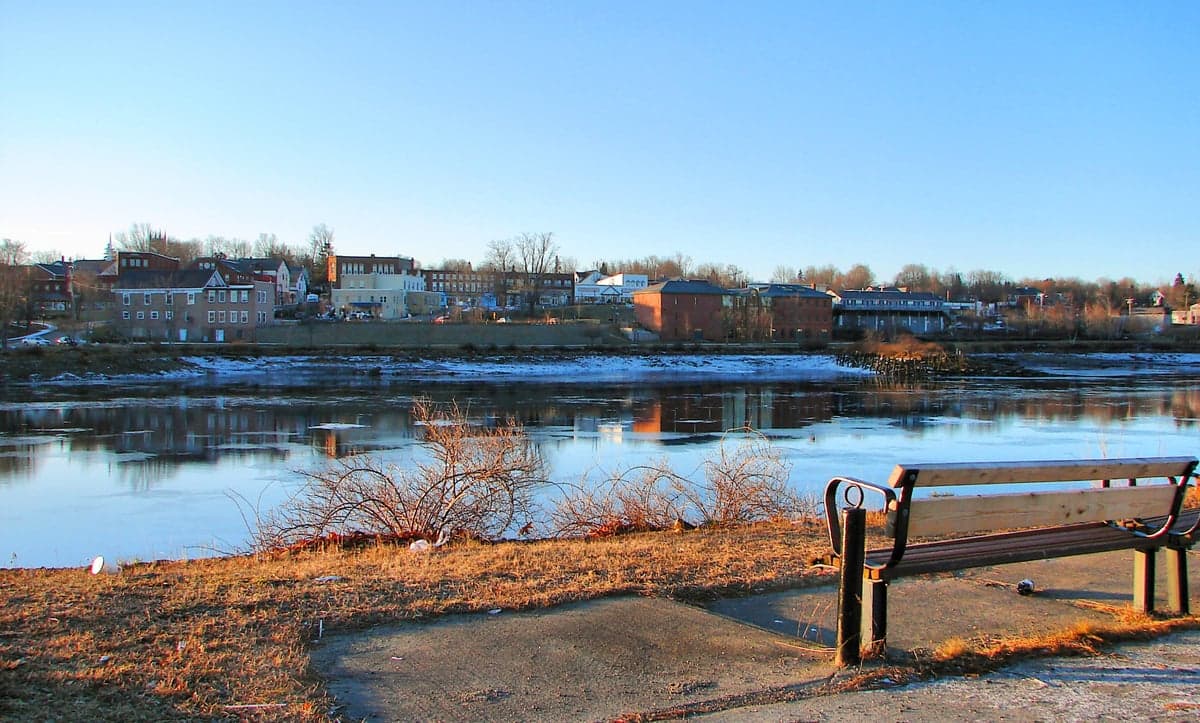
The 3,087 residents of Calais, Maine form one of the most ethnically homogeneous small cities in the state, with a population that is 94.1% white and only 3.9% foreign-born. This border city on the St. Croix River, directly across from St. Stephen, New Brunswick, has a distinctive character shaped by its role as a U.S.-Canada port of entry and its deep-rooted Franco-American and Anglo heritage. The population density is low—roughly 200 people per square mile—and the city retains a quiet, working-class identity tied to border services, retail, and the remnants of its maritime and lumber past.
How the city was settled and grew
Calais was first settled in the 1770s by English-speaking colonists from Massachusetts, who were granted land along the St. Croix River under the Plymouth Company. The original settlement clustered around what is now North Street and the waterfront, where the first sawmills and shipyards were built. By the early 1800s, the city became a major lumber and shipbuilding hub, drawing waves of Irish immigrants who settled in the South End near the mills and along the riverbank. The Irish built St. Joseph’s Catholic Church (1848) and formed the backbone of the city’s working class through the mid-19th century. A second major wave came after 1860, when French-Canadian families from Quebec crossed the border to work in the lumber mills and shoe factories. They concentrated in the North End and along Main Street, establishing the Franco-American identity that remains strong today. By 1900, Calais had grown to over 5,000 residents, with distinct ethnic neighborhoods: the Irish South End, the French North End, and a small Anglo-Protestant enclave around Church Street and the downtown commercial district. The city’s population peaked at 5,200 in 1910, then began a long decline as the lumber industry faded and the shoe factories moved south.
Modern era (post-1965)
After the 1965 Immigration and Nationality Act, Calais saw almost no new immigration. The foreign-born share today is just 3.9%, and nearly all of those are Canadian-born residents who cross the border for work or retirement. The city’s racial composition has remained overwhelmingly white—94.1%—with the only notable minority group being Black residents at 2.9%, a share that likely reflects a small number of African American families who moved in during the 1990s and 2000s, primarily for work at the local paper mill or in border security. These families settled mostly in the Red Beach neighborhood, a rural area south of downtown near the St. Croix River. East/Southeast Asian residents make up just 0.3% of the population, and Indian-subcontinent residents are effectively zero. The Hispanic share is 1.2%, a very recent and tiny influx, with no distinct neighborhood concentration. The city’s college-educated share is 26.1%, below the national average, reflecting a workforce that has historically relied on blue-collar and border-service jobs rather than professional employment. Suburbanization has not occurred in any meaningful way—Calais has no suburban subdivisions; new housing since 1970 has been scattered along the Baring Road and Pleasant Street corridors, where a few families have built single-family homes on large lots.
The future
Calais’s population is projected to continue its slow decline, driven by an aging white population and out-migration of young adults to Bangor or Portland. The median age is 47, well above the national average, and the birth rate is low. The city is not homogenizing further—it is already as homogeneous as a small border city can be—but it is also not tribalizing into new enclaves. The tiny Black and Hispanic populations are too small to form distinct neighborhoods; they are scattered across the existing housing stock. The Franco-American and Irish ethnic identities are fading as older generations pass away and younger residents intermarry. The only potential growth driver is cross-border migration: Canadians, particularly retirees from New Brunswick, may continue to move to Calais for lower property taxes and healthcare access. This could slowly increase the foreign-born share but will not change the city’s racial composition. The next 10-20 years will likely see the population stabilize around 2,800-3,000, with an even older age profile and a continued reliance on border services and tourism.
For someone moving in now, Calais is a stable, quiet, and deeply homogeneous community where the population is shrinking and aging in place. It offers low housing costs and a safe, slow-paced lifestyle, but little racial or ethnic diversity and limited economic opportunity outside of border-related work. The city is becoming a retirement and border-service hub rather than a growing or diversifying community.

* Values derived from national, state, county, city and local statistics and may differ in a specific area. Last updated: 2026-05-01T10:35:45.000Z
Narrative content on this page is AI-generated and may contain mistakes. Verify any details that matter before acting on them.
ReloMaps may earn a commission from affiliate links at no extra cost to you.

