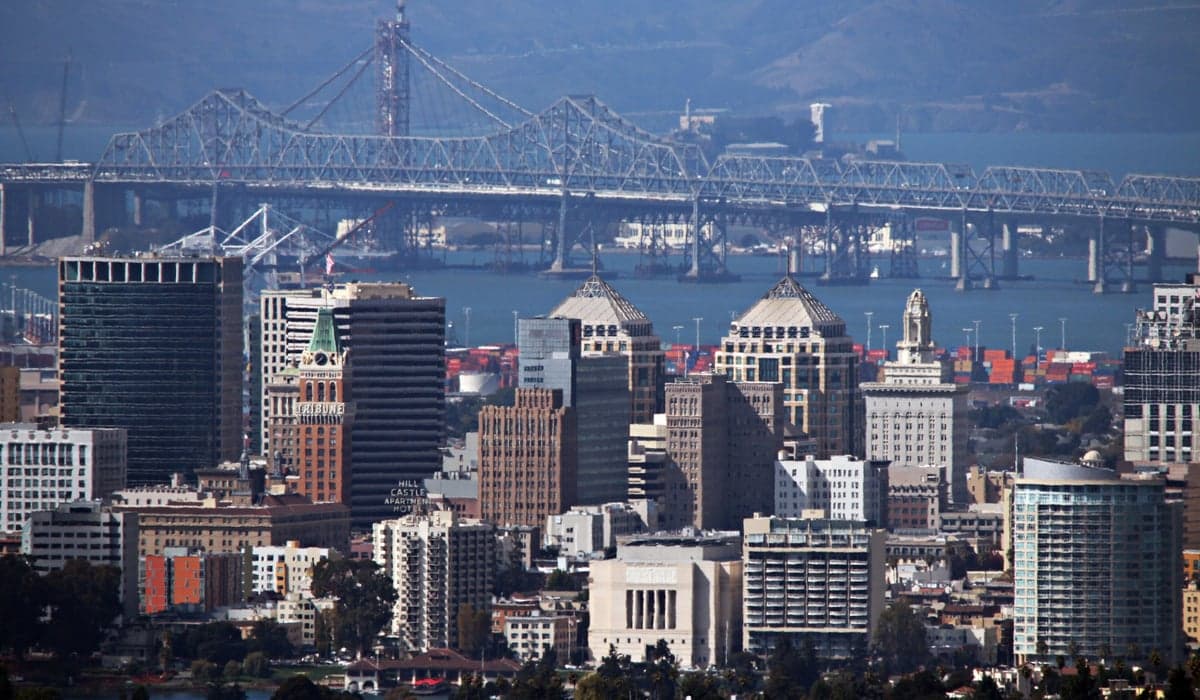
Photo: Wikipedia
Demographics of Alameda County
Affluence Level in Alameda County
An upper-middle-class area. Household wealth, education levels, and homeownership run ahead of national benchmarks.
People of Alameda County
Alameda County’s 1.65 million residents form one of the most ethnically diverse and densely populated counties in California, a place where no single racial or ethnic group holds a majority. The population is 28.2% White, 23.3% Hispanic, 22.3% East and Southeast Asian, 9.7% Indian (subcontinent), and 9.6% Black, with over half of adults holding a college degree. This is a county of distinct, self-contained communities—from the historic Black and Latino neighborhoods of Oakland to the sprawling South Asian and East Asian enclaves of Fremont and Pleasanton—shaped by successive waves of migration for agriculture, industry, and technology.
Settlement & growth (pre-1960)
Before European contact, the land now called Alameda County was home to the Ohlone people, who lived in dozens of independent villages along the San Francisco Bay shoreline and inland valleys for thousands of years. Spanish colonization began in the late 18th century with Mission San José (founded 1797 in what is now Fremont), which drew local Ohlone into labor through the mission system. After Mexican independence in 1821, large land grants—such as Rancho San Antonio (covering present-day Oakland and Berkeley) and Rancho San Lorenzo (Hayward and San Leandro)—were awarded to Mexican settlers, establishing a ranching economy that lasted until the U.S. takeover in 1848.
The California Gold Rush of 1849 transformed the region overnight. Oakland, founded in 1852, became a key port and rail terminus, drawing a flood of Anglo-American settlers from the East Coast and Midwest. By the 1860s, Chinese immigrants arrived in large numbers to build the transcontinental railroad, with many settling in Oakland’s Chinatown (one of the oldest in the U.S.) and later in San Leandro’s agricultural fields. The 1870s and 1880s saw waves of Portuguese immigrants from the Azores, who took up dairy farming in the Livermore Valley and around Hayward, leaving a lasting cultural imprint in places like the town of Sunol.
The early 20th century brought the Great Migration of Black Americans from the South, who moved to Oakland and Berkeley for industrial jobs in shipbuilding, railroads, and canneries. During World War II, the Kaiser Shipyards in Richmond employed tens of thousands of workers, including a massive influx of Black families from Louisiana, Texas, and Arkansas, making Richmond a majority-Black city by 1950. At the same time, Dust Bowl migrants from Oklahoma and Arkansas—often called “Okies”—settled in the flatlands of Livermore and the southern edges of the county, working in agriculture and the burgeoning defense industry at what is now Lawrence Livermore National Laboratory (founded 1952).
By 1960, Alameda County was a patchwork: Oakland and Berkeley were industrial and intellectual hubs with growing Black and White middle classes; Fremont and Hayward were still semi-rural agricultural towns; and Livermore was a small ranching and farming community. The county’s population had grown from 130,000 in 1900 to over 900,000 by 1960, driven by war industries and suburban expansion.
Modern era (post-1965)
The 1965 Hart-Cellar Immigration Act fundamentally reshaped Alameda County’s demographics. The law eliminated national-origin quotas, opening the door to large-scale immigration from Asia and Latin America. The most dramatic shift occurred in Fremont, which transformed from a predominantly White, middle-class suburb into a majority-Asian city by the 2000s. East and Southeast Asian immigrants—particularly Chinese, Taiwanese, and Filipino—began arriving in the 1970s and 1980s, drawn by the tech boom in nearby Silicon Valley and the availability of affordable housing in the Warm Springs and Irvington districts. Today, Fremont is 62% Asian (East/Southeast), with a large Indian subcontinent population as well, making it one of the most ethnically concentrated cities in the Bay Area.
Indian immigrants from the subcontinent began arriving in significant numbers after 1990, recruited for high-skilled tech jobs at companies like Intel, Oracle, and Lam Research in the Tri-Valley area. They concentrated heavily in Fremont (particularly the Mission San Jose neighborhood), Pleasanton, and Dublin, where they now form substantial communities with their own temples, grocery stores, and cultural organizations. The Indian population in Alameda County now stands at 9.7%, one of the highest shares of any county in the United States.
Hispanic migration accelerated after 1970, driven by both legal immigration and family reunification. Mexican and Central American immigrants settled in older, lower-cost neighborhoods in Oakland (Fruitvale, East Oakland), Hayward, and San Leandro, often working in construction, service industries, and landscaping. The Hispanic share of the county grew from roughly 10% in 1980 to 23.3% today, with Hayward becoming a majority-Hispanic city (over 50%) by 2020.
Domestic migration also reshaped the county. The 1980s and 1990s saw an exodus of Black families from Oakland to the inland suburbs of Antioch, Pittsburg, and Stockton (outside Alameda County) as housing costs rose and industrial jobs disappeared. Meanwhile, White flight from Oakland and Berkeley to the outer suburbs of Livermore, Pleasanton, and Dublin accelerated after the 1989 Loma Prieta earthquake, as families sought newer, larger homes and better schools. The Tri-Valley area—Pleasanton, Dublin, Livermore—became predominantly White and Asian, with high incomes and low crime, while Oakland and Richmond retained more diverse but economically strained populations.
The future
Alameda County is not homogenizing; it is tribalizing into distinct ethnic and economic enclaves. Fremont and the Tri-Valley are becoming increasingly Asian and Indian, with high home prices and top-ranked schools reinforcing those concentrations. Oakland is becoming more Hispanic and less Black, as gentrification pushes Black families to the outer East Bay and Central Valley. The White population, now 28.2%, is aging and concentrated in the Berkeley hills, Piedmont, and parts of Livermore, while younger White professionals are moving into Oakland’s revitalized downtown and Uptown districts.
Immigrant communities are growing but plateauing. The East/Southeast Asian share has stabilized as immigration from China and Taiwan slows, while the Indian population continues to grow through H-1B visa holders and their families. Hispanic growth is steady but slowing, driven more by births than new immigration. The county’s foreign-born share of 15.2% is lower than the Bay Area average (around 25%), reflecting the large native-born Black and Hispanic populations. In the next 10-20 years, Alameda County will likely become even more Asian and Indian in its eastern half, while Oakland and the western cities become more Hispanic and gentrified. The cultural identity is shifting from a historically Black-and-White industrial county to a multiethnic, tech-driven region where income inequality and housing costs will continue to sort people by zip code.
For someone moving in now, Alameda County offers a choice of distinct worlds: the dense, diverse, and expensive urban core of Oakland and Berkeley; the family-oriented, high-achieving Asian and Indian suburbs of Fremont and Pleasanton; or the more affordable, still-growing exurbs of Livermore and Dublin. The county’s future is one of deepening segregation by ethnicity and class, but also of remarkable opportunity for those who can afford to live in its most desirable enclaves.

* Values derived from national, state, county, city and local statistics and may differ in a specific area. Last updated: 2026-05-11T21:35:19.000Z
Narrative content on this page is AI-generated and may contain mistakes. Verify any details that matter before acting on them.
ReloMaps may earn a commission from affiliate links at no extra cost to you.

