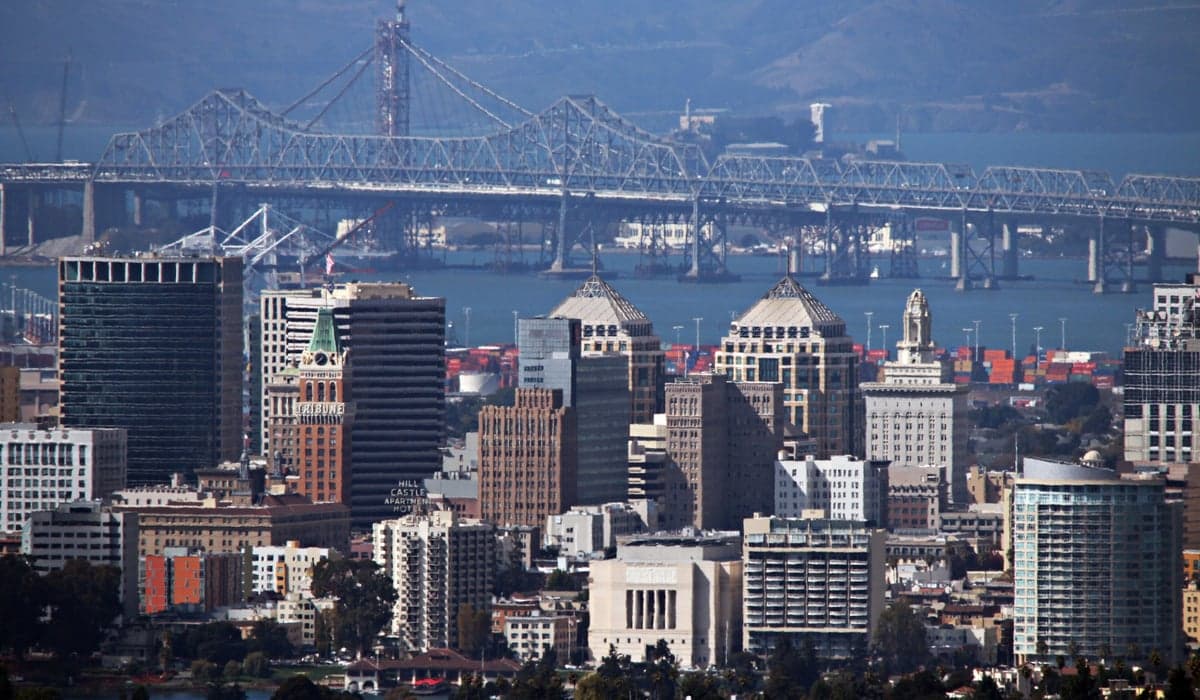
Photo: Wikipedia
Political ClimatePolitical Climate in Alameda County
Showing district-level results — no local-only data available.
Local Political AnalysisPolitical Analysis of Alameda County
Alameda County is one of the most reliably blue spots in the entire country, with a Cook PVI of D+20—that’s a full eight points more Democratic than the state of California as a whole, which sits at D+12. But if you’ve lived here as long as I have, you know that “blue” doesn’t tell the whole story. The county has been shifting further left for decades, and what was once a place with a healthy mix of moderate and conservative voices has become a one-party stronghold where progressive policies are pushed through with little real opposition. The trajectory is clear: more government, more regulation, and less room for anyone who questions the direction.
How it compares
Compared to the rest of California, Alameda County is a progressive engine. The state as a whole is already deep blue, but this county is the tip of the spear. In the 2024 presidential election, Kamala Harris carried Alameda County by over 50 points, while she won California by about 20. That gap tells you everything. The real contrast, though, is inside the county itself. Livermore and Pleasanton in the Tri-Valley still have a noticeable conservative streak—you’ll see Trump signs in some yards, and local city council races there can be competitive. Dublin is a bit of a swing precinct, with a mix of tech workers and more traditional families keeping things balanced. But head west to Oakland, Berkeley, or Albany, and you’re in deep-blue territory where progressive candidates routinely win with 80% or more of the vote. Fremont and Hayward lean blue but are more moderate, often voting for pragmatic Democrats over the far-left wing. The swing precincts are shrinking, though. As the Bay Area’s cost of living pushes out moderate and conservative families, the remaining population skews younger, wealthier, and more ideologically uniform.
What this means for residents
For anyone who values personal freedoms—especially the freedom to run a business, speak your mind, or push back against government overreach—this political climate is a growing concern. Berkeley and Oakland have led the charge on rent control, minimum wage hikes, and business regulations that make it nearly impossible for small shops to survive. The county’s Board of Supervisors has passed policies on everything from gas stove bans to mandatory affordable housing quotas that feel less like community choices and more like top-down mandates. If you’re a conservative or even a moderate, you’ll find yourself increasingly isolated at town halls, school board meetings, and neighborhood gatherings. The cultural pressure to conform is real, and it’s not just political—it’s social. I’ve seen longtime residents in Pleasanton and Livermore quietly sell their homes and move to places like Texas or Idaho just to feel like they can have a normal conversation about taxes or crime without being labeled a bigot.
The cultural and policy distinctions are stark. Alameda County has embraced “sanctuary” policies that limit cooperation with federal immigration enforcement, and it’s one of the first places in the state to experiment with decriminalizing certain drugs and reducing police funding. In Oakland, the school board has debated removing police officers from campuses entirely. Meanwhile, Livermore still funds its police force robustly and has resisted some of the more radical housing policies. But the county’s progressive majority means these outlier towns are fighting an uphill battle. Looking ahead, I expect the divide to widen: the urban core will keep pushing left, while the Tri-Valley and parts of Fremont will hold on to a more traditional, freedom-minded way of life—at least for now. If you’re thinking of moving here, just know that your vote will likely be drowned out, and your voice might feel like a whisper in a very loud room.

State Political ClimatePolitical Climate in California
State Political AnalysisPolitical Environment in the State
California is a deeply blue state with a Cook PVI of D+12, meaning Democrats hold a structural advantage of 12 points over the national average in statewide elections. Over the past 20 years, the state has shifted from a competitive purple state—where Republicans held the governor’s office as recently as 2011—to a solidly one-party-dominant system, driven largely by massive population growth in coastal metros and a steady exodus of conservative-leaning voters from rural and inland areas. The Democratic supermajority in the legislature now routinely passes bills that would be unthinkable in most other states, and the political culture has become increasingly hostile to traditional conservative values like fiscal restraint, parental authority, and Second Amendment rights.
Urban vs. rural divide
The political map of California is a tale of two worlds. The coastal urban crescent—Los Angeles, San Francisco, San Diego, and Oakland—generates roughly 70% of the state’s Democratic votes. These metros are home to the party’s activist base, with San Francisco’s Board of Supervisors often leading the charge on progressive policies like defunding police and sanctuary city ordinances. In contrast, the Central Valley and inland regions—Bakersfield, Fresno, Redding, and El Centro—remain reliably Republican, though their influence is diluted by lower population density. A notable shift occurred in 2020 when Orange County, once a GOP stronghold, flipped to Biden after decades of demographic change and suburban moderation. Even San Diego County, historically a purple bellwether, now leans consistently blue. The only remaining Republican-held congressional seats are in the Central Valley and far northern counties like Shasta and Tehama, where voters feel increasingly alienated from Sacramento’s one-party rule.
Policy environment
California’s policy environment is a cautionary tale for anyone considering a move. The state has the highest income tax rate in the nation (13.3% for top earners), a corporate tax rate of 8.84%, and a sales tax that can exceed 10% in some cities. Property taxes are capped at 1% of assessed value under Proposition 13, but reassessments upon sale can still sting. The regulatory posture is aggressive: California has its own environmental agency (CARB) that sets emissions standards stricter than federal law, and the California Environmental Quality Act (CEQA) is frequently weaponized to block housing and infrastructure projects. Education policy is dominated by teachers’ unions, with the state spending over $20,000 per pupil but ranking near the bottom in national test scores. Healthcare is heavily regulated, with a state-run exchange (Covered California) and mandates that drive up premiums. Election laws are among the most permissive in the country: universal mail-in voting, same-day registration, and no voter ID requirement—a system that critics argue undermines election integrity.
Trajectory & freedom
On the freedom index, California is moving in the wrong direction. Recent legislation has expanded government control over personal choices. Assembly Bill 5 (AB5) reclassified independent contractors as employees, crushing gig economy workers and freelancers. Senate Bill 9 (SB9) effectively eliminated single-family zoning in many areas, allowing duplexes and lot splits without local input. On gun rights, the state has some of the strictest laws in the nation: an assault weapons ban, a 10-day waiting period, and a "may-issue" concealed carry regime that was recently tightened further by SB 2, which restricts where licensed carriers can bring firearms. Parental rights have been under assault: Assembly Bill 1955 prohibits school districts from requiring parental notification when a child changes gender identity, and SB 107 allows minors 12 and older to consent to gender-affirming care without parental knowledge. Medical autonomy took a hit with SB 277, which eliminated personal belief exemptions for school vaccinations. Property rights are constrained by rent control laws (AB 1482) and a statewide cap on annual rent increases. The trajectory is clear: more mandates, less local control, and a shrinking sphere of personal liberty.
Civil unrest & political movements
California has been a flashpoint for civil unrest and political activism. The 2020 George Floyd protests in Los Angeles and Oakland saw widespread looting and property destruction, with some city councils later voting to defund police—though most reversed course after crime spikes. The state’s sanctuary law (SB 54) prohibits local law enforcement from cooperating with federal immigration authorities, creating tension with ICE and leading to high-profile standoffs in cities like San Francisco. On the right, the "California Exodus" movement has gained traction, with groups like the "California National Party" advocating for secession, though it remains fringe. Election integrity controversies have flared: in 2020, the state sent mail-in ballots to all registered voters, and subsequent audits revealed thousands of duplicate registrations and potential non-citizen voting, though no widespread fraud was proven. The recall election of Governor Gavin Newsom in 2021—which he survived by a 62-38 margin—showed the limits of Republican organizing in a state where Democrats outnumber Republicans 2-to-1. More recently, the "parental rights" movement has mobilized in suburbs like Orange County and San Diego, with school board meetings becoming battlegrounds over curriculum transparency and gender ideology.
Projection
Over the next 5-10 years, California’s political trajectory is likely to continue leftward, but with growing internal friction. Demographic trends favor Democrats: the state’s Latino population, while historically more moderate, is trending younger and more progressive, and Asian-American voters in suburbs like Irvine and Cupertino are shifting blue. However, the state is losing population for the first time in decades—over 800,000 residents left between 2020 and 2024—with many fleeing to Texas, Arizona, and Idaho. This out-migration is disproportionately conservative and middle-class, which further concentrates Democratic power. The legislature will likely pass even more progressive policies: a single-payer healthcare system (SB 770 is already being studied), a wealth tax (Assembly Bill 259), and stricter environmental mandates that could raise energy costs. The housing crisis will persist, with Sacramento overriding local zoning to force density, which may accelerate suburban flight. A new resident moving in now should expect to find a state where government involvement in daily life is high and growing, taxes are unlikely to decrease, and cultural battles over education and family policy will intensify. The one-party system shows no signs of cracking, but the exodus of conservative-leaning residents may eventually create a more homogeneous—and thus more extreme—political environment.
For a conservative-leaning individual or family considering California, the bottom line is sobering: you will be living under one-party rule with high taxes, heavy regulation, and a government that actively undermines parental authority and Second Amendment rights. The state’s natural beauty and economic opportunities are real, but they come with a political price tag that is only rising. If you value personal freedom, local control, and a government that stays out of your family’s decisions, California is likely a poor fit—unless you are willing to fight an uphill battle in a state that is increasingly hostile to your values. The best advice from a longtime resident: visit first, talk to locals in the inland counties, and be honest with yourself about whether you can tolerate the political climate long-term.
* Values derived from national, state, county, city and local statistics and may differ in a specific area. Last updated: 2026-05-11T21:35:19.000Z
Narrative content on this page is AI-generated and may contain mistakes. Verify any details that matter before acting on them.
ReloMaps may earn a commission from affiliate links at no extra cost to you.

