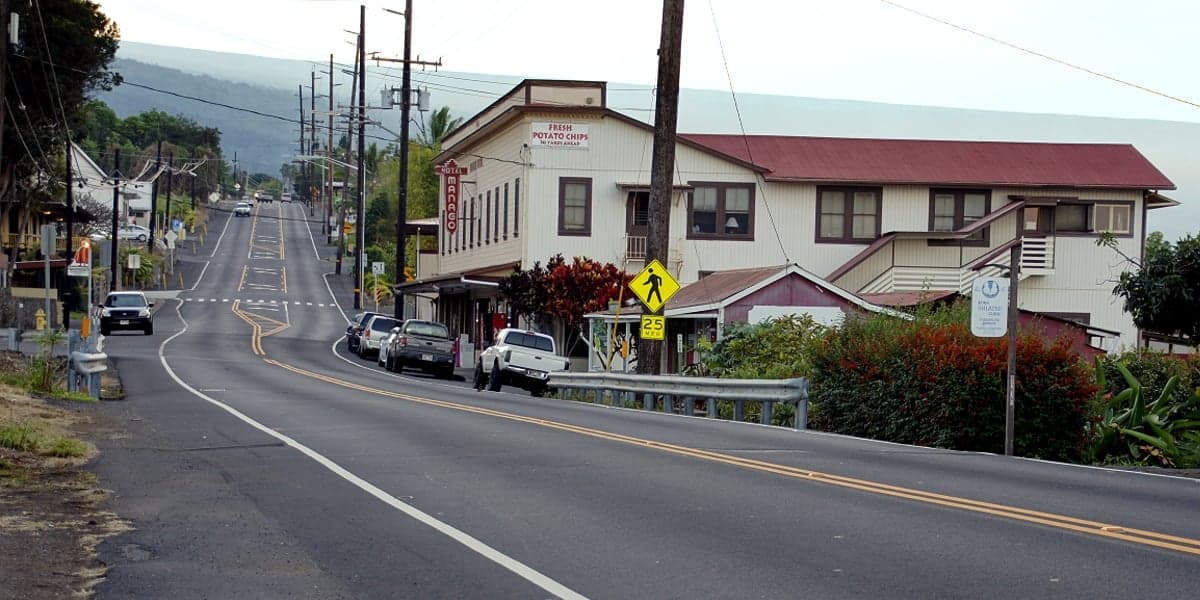
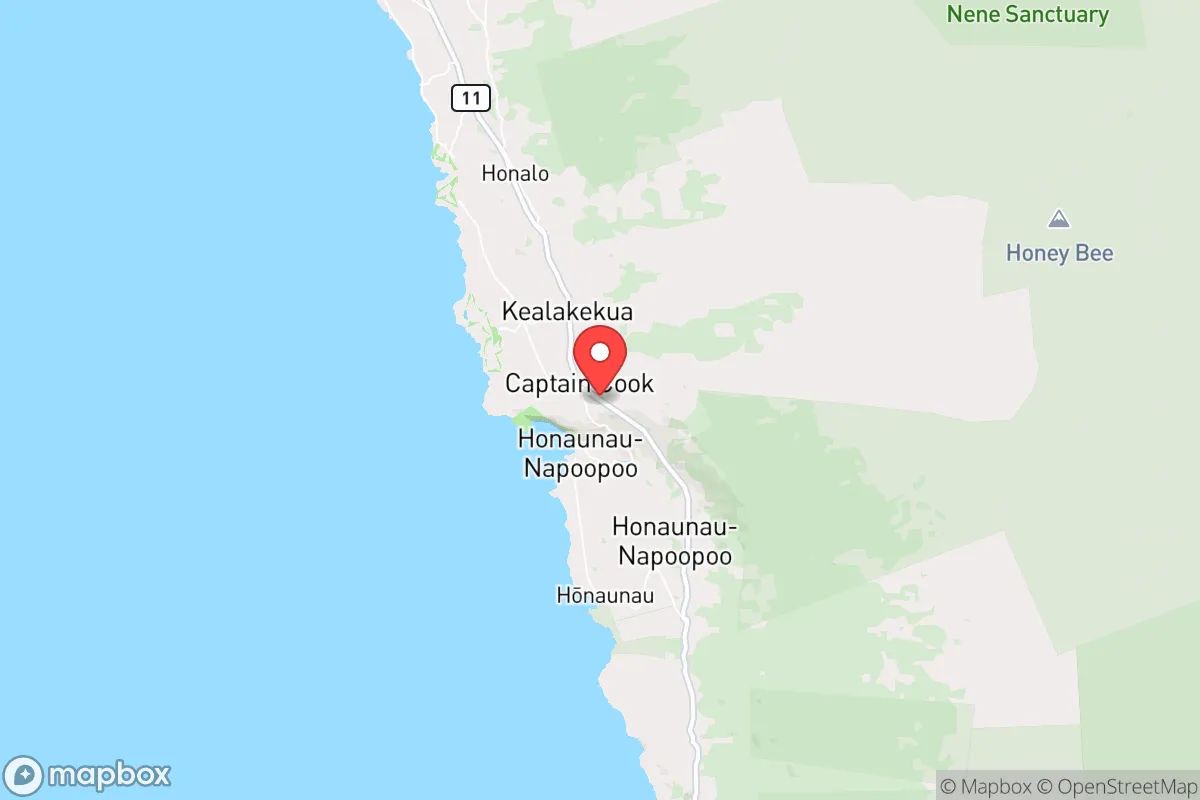
Photo: Wikipedia
Demographics of Captain Cook, HI
Affluence Level in Captain Cook, HI
A middle-class area roughly in line with national averages across income, home values, education, and employment.
People of Captain Cook, HI
The people of Captain Cook, Hawaii, today form a small, ethnically diverse community of 3,751 residents, characterized by a blend of Native Hawaiian, East/Southeast Asian, and White populations, with a growing Hispanic presence. The city’s identity is rooted in its agricultural past and its location along the Kona coast, where coffee farms and historic settlements shape daily life. Unlike many mainland towns, Captain Cook has a low foreign-born rate of 5.7% and a college-educated share of 26.6%, reflecting a mix of local families and in-migrants drawn to the area’s rural character. The population is notably multiracial, with 32.0% White, 19.6% Hispanic, and 17.5% East/Southeast Asian, while Black and Indian subcontinent residents are absent from the data.
How the city was settled and grew
Captain Cook’s human history begins with Native Hawaiians, who established coastal fishing villages and inland agricultural terraces long before Western contact. The area was named after Captain James Cook, who landed at nearby Kealakekua Bay in 1779, but permanent settlement accelerated in the 19th century with the rise of coffee and sugar plantations. The first major wave of non-Hawaiian immigrants arrived in the late 1800s: Japanese and Chinese laborers were brought in to work the sugar fields, settling in what is now the Kealakekua and Honaunau neighborhoods, where their descendants still maintain small farms and family plots. Portuguese and other European immigrants followed, often as plantation overseers or independent coffee growers, clustering in the Napoopoo area along the bay. By the mid-20th century, the population was a stable mix of Native Hawaiian, Japanese, Chinese, and White families, with the economy shifting from sugar to coffee and macadamia nuts after the 1950s.
Modern era (post-1965)
After the 1965 Immigration and Nationality Act, Captain Cook saw a modest influx of Filipino workers, who joined the agricultural labor force and settled in the Honalo and Keokea districts, where they remain a visible part of the community. Domestic in-migration from the U.S. mainland began in the 1970s and 1980s, driven by retirees and counterculture seekers attracted to the area’s affordable land and rural lifestyle. These new residents, predominantly White, bought former coffee lots in the Kainaliu and Captain Cook town center areas, often renovating old plantation homes. The Hispanic population, now 19.6%, grew primarily through intermarriage and second-generation families from the mainland, rather than direct immigration, and is concentrated in the Kealakekua and Honaunau neighborhoods alongside longer-established Asian and Native Hawaiian families. The East/Southeast Asian share (17.5%) remains stable, with Japanese and Filipino descendants still active in coffee farming and local businesses, while the White population (32.0%) includes both longtime residents and newer arrivals from the mainland.
The future
Captain Cook’s population is slowly homogenizing into a more multiracial, less ethnically distinct community, as intermarriage between Native Hawaiian, Asian, White, and Hispanic groups becomes common. The Hispanic share is likely to grow gradually through natural increase and continued in-migration from the mainland, but the foreign-born rate (5.7%) suggests limited new immigration from abroad. The East/Southeast Asian population is plateauing, as younger generations move to Hilo or Honolulu for education and jobs, while the White population may see modest growth from mainland retirees seeking a lower-cost, rural alternative to Kailua-Kona. The city is not tribalizing into separate enclaves; instead, neighborhoods like Kealakekua and Honalo are becoming more mixed, with no single group dominating any district. Over the next 10–20 years, Captain Cook will likely remain a small, stable, and increasingly blended community, with a character shaped by its agricultural roots and a slow pace of change.
For someone moving in now, Captain Cook offers a tight-knit, ethnically diverse rural community where Native Hawaiian traditions, coffee farming, and a mix of mainland transplants coexist. The population is not growing rapidly, and the demographic trend is toward integration rather than division, making it a place where newcomers can find a stable, if quiet, lifestyle. The low crime rate and strong sense of place appeal to families and retirees, though job opportunities remain limited to agriculture, tourism, and remote work.

* Values derived from national, state, county, city and local statistics and may differ in a specific area. Last updated: 2026-05-15T21:56:05.000Z
Narrative content on this page is AI-generated and may contain mistakes. Verify any details that matter before acting on them.
ReloMaps may earn a commission from affiliate links at no extra cost to you.

