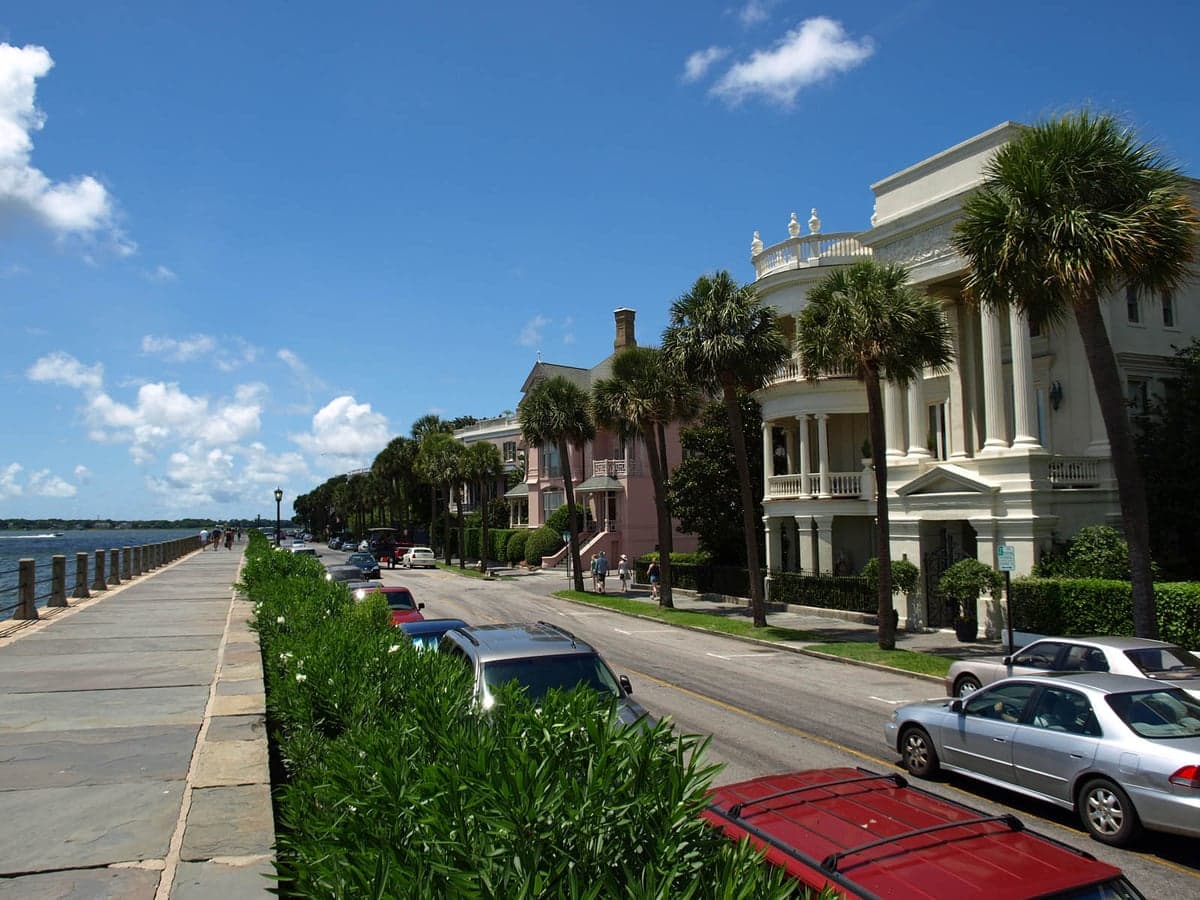
Photo: Wikipedia
Personal Sovereignty in Charleston, SC
Viable for self-reliance. Generally workable, though some barriers may limit total independence.
What does Personal Sovereignty tell us?
Personal Sovereignty measures your capacity for self-reliance and independence with minimal government friction. Higher scores mean fewer barriers between you and the way you want to live... but it assumes you have the space you need and good neighbors.
What does this tell us?
Personal Sovereignty measures your capacity for self-reliance and independence with minimal government friction. Higher scores mean fewer barriers between you and the way you want to live... but it assumes you have the space you need and good neighbors.
State Policy
Energy independence: Importer (25% of energy produced in-state)
Personal Liberty
Homesteading

Personal Liberty Analysis
Charleston, South Carolina, offers a mixed bag for those prioritizing personal sovereignty, where strong state-level protections on gun rights and parental authority clash with a local governance structure that can feel increasingly intrusive, particularly in the densely populated urban core. For the survivalist or prepper, the city itself presents challenges—tight zoning, HOA restrictions, and a tourist-driven economy that can feel disconnected from self-reliant values. However, the surrounding Lowcountry, with its rural pockets and a state government that generally resists federal overreach, provides a more viable foundation for an autonomous lifestyle, provided you navigate the local regulatory landscape carefully.
Tax burden and regulatory posture: how South Carolina compares to high-tax states
South Carolina’s tax structure is a clear advantage for anyone seeking to minimize government extraction from their income and property. The state levies a flat income tax rate of 6.4% (as of 2025), which is moderate but not the lowest in the Southeast—Florida and Tennessee have none. However, the lack of a state-level estate or inheritance tax is a significant win for generational wealth preservation. Property taxes in Charleston County are relatively low, averaging around 0.55% of assessed value, but this can be deceptive. The city of Charleston itself imposes a higher millage rate than surrounding areas, and recent reassessments have pushed tax bills upward, especially in gentrifying neighborhoods like West Ashley or James Island. The regulatory posture is a double-edged sword: the state has a right-to-work law and limited business licensing requirements, which supports economic freedom. But Charleston’s municipal government has a reputation for aggressive permitting processes, particularly for new construction or modifications to historic properties. For a prepper looking to build a secure, self-sufficient compound, the city’s strict building codes and environmental regulations on wetlands and floodplains can be a bureaucratic nightmare. The real value lies in the state’s overall resistance to federal mandates—South Carolina was an early adopter of Second Amendment Sanctuary status and has pushed back on EPA overreach in coastal development. This creates a buffer, but you’ll still need to fight local battles.
Self-defense and gun law specifics: what the Second Sanctuary status means for residents
South Carolina is a strong Second Amendment state, and Charleston residents benefit directly from this. The state has a permitless carry law (Constitutional Carry) effective since 2024, meaning any law-abiding adult can carry a concealed firearm without a permit. This is a non-negotiable for personal sovereignty. Additionally, South Carolina’s “Stand Your Ground” law is unambiguous—there is no duty to retreat in any place you have a legal right to be, and the Castle Doctrine extends to your vehicle and workplace. For preppers, this means your home, car, and bug-out location are legally defensible without fear of prosecution for using deadly force against an intruder. The state also has a robust preemption statute, which prevents local governments like Charleston City Council from enacting their own gun bans or magazine capacity limits. This is critical because Charleston’s city council has a history of progressive leanings—they’ve attempted symbolic resolutions on gun control in the past, but state law overrides them. The practical takeaway: you can own standard-capacity magazines, suppressors (with NFA paperwork), and any rifle or shotgun not banned by federal law. The only real friction is the 24-hour waiting period for handgun purchases, which is a minor inconvenience. For those considering a survivalist retreat, the rural counties surrounding Charleston—Berkeley, Dorchester, and Colleton—are even more gun-friendly, with sheriffs who openly refuse to enforce any future federal gun bans. This is a sovereignty stronghold.
Self-reliance and homesteading viability: lot sizes, zoning, and off-grid feasibility
This is where Charleston’s appeal diverges sharply depending on location. Inside the city limits, homesteading is nearly impossible. Lot sizes average 0.1 to 0.25 acres in historic districts, with HOA covenants that restrict chickens, goats, vegetable gardens, and even clotheslines. Zoning laws are heavily tilted toward preserving the “historic character,” which means no solar panels visible from the street, no rainwater collection systems that alter rooflines, and strict limits on outbuildings. Off-grid living is effectively banned—the city requires connection to municipal water and sewer, and any attempt to go solar-only or dig a well will be met with permit denials. However, drive 20 to 30 minutes outside the urban core—into areas like Ravenel, Hollywood, or the rural parts of Mount Pleasant—and the picture changes dramatically. Zoning in unincorporated Charleston County allows for 1- to 5-acre lots, with far fewer restrictions. You can keep livestock, install a septic system, drill a well, and set up a solar array without much hassle. The county’s building codes are still present but more lenient, and there are no HOA overlords. For a prepper, the ideal move is to buy land in the rural fringe, where you can establish a defensible, self-sufficient property with food production, water independence, and off-grid power. The climate is a bonus—long growing seasons allow for year-round gardening, and the coastal proximity means ample fishing and hunting opportunities in the Francis Marion National Forest. The trade-off is hurricane risk, which demands a robust storm shelter and redundant systems.
Personal liberties: parental rights, medical autonomy, speech, and property
South Carolina has been a battleground for parental rights, and the current legal environment is favorable. The state passed a Parents’ Bill of Rights in 2023, which gives parents explicit authority over their children’s education, medical decisions, and religious upbringing. This means you can opt your child out of any school curriculum you find objectionable, including sex education or critical race theory, without legal pushback. Medical autonomy is more complicated. The state has not expanded Medicaid and has limited vaccine mandates, which aligns with a sovereignty mindset, but it also has a restrictive medical marijuana program (only low-THC oil for specific conditions) and no legal framework for psilocybin or other alternative therapies. For those seeking full medical freedom, you’ll need to travel to a neighboring state or rely on private arrangements. Free speech is protected under the state constitution, and Charleston’s public forums—like Marion Square—are generally open for protest or assembly, though the city has a history of enforcing strict noise ordinances and permit requirements for large gatherings. Property rights are a bright spot: South Carolina has strong eminent domain protections, requiring “public use” (not just public benefit) for any taking, and the state’s homestead exemption protects up to $60,000 of your home’s value from creditors. However, Charleston’s historic preservation overlays can feel like a property rights infringement—you can’t paint your house a non-approved color or replace windows without a review board’s blessing. This is a direct limit on your autonomy over your own land, and it’s a reason many sovereignty-minded individuals avoid the historic districts entirely.
Overall, Charleston offers a fragmented sovereignty landscape. The state-level framework is solid—low taxes, strong gun laws, parental rights, and property protections—but the city itself is a regulatory maze that can erode those freedoms at the local level. For a single individual or family with a prepper mindset, the smart play is to live outside the city limits, in the rural or semi-rural areas of Charleston County or neighboring Berkeley County, where you can exercise maximum autonomy over your property, your defense, and your lifestyle. Compared to deep-blue coastal cities like San Francisco or Seattle, Charleston is a haven of personal sovereignty. But compared to rural Idaho or Montana, it’s still a place where you’ll have to fight for every inch of freedom against local bureaucracy. The key is choosing your specific location wisely—and being prepared to push back against the creeping regulations that come with urban growth.

* Values derived from national, state, county, city and local statistics and may differ in a specific area. Last updated: 2026-04-29T21:46:07.000Z
Narrative content on this page is AI-generated and may contain mistakes. Verify any details that matter before acting on them.
ReloMaps may earn a commission from affiliate links at no extra cost to you.

