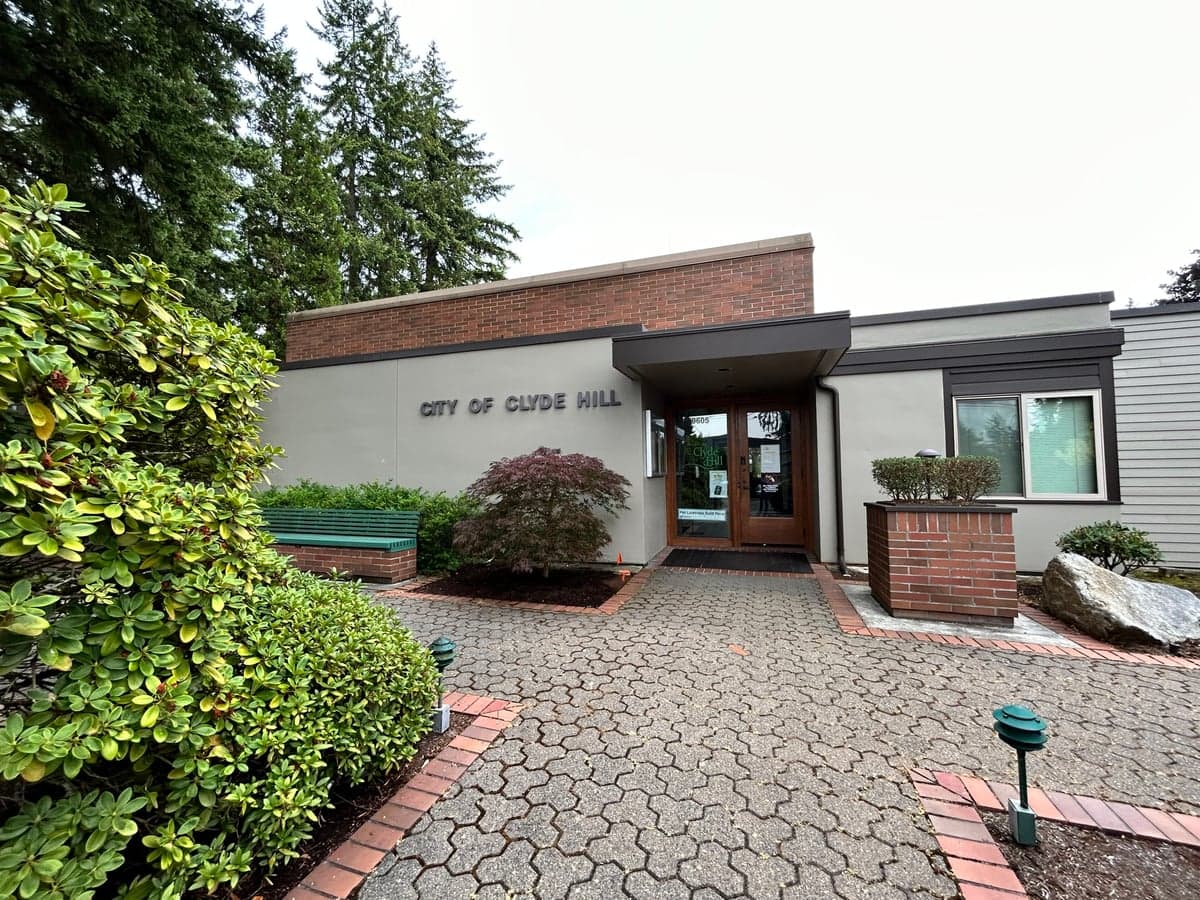
Photo: Wikipedia
Strategic Assessment of Clyde Hill, WA
High tactical risk. This location is likely close to major population centers, strategic targets, or sits in a high-disaster corridor. A retreat property and careful exit planning is required.
What does the Strategic Assessment tell us?
Our Strategic Assessment grades tactical survivability of an area. Major population centers, military targets, fallout zones, natural disasters, and border exposure all drive risk — lower exposure means a more defensible position in a crisis.
This is heavily inspired by Joel Skousen's Strategic Relocation book. Highly recommended you checkout the book ($)What does this tell us?
Our Strategic Assessment grades tactical survivability of an area. Major population centers, military targets, fallout zones, natural disasters, and border exposure all drive risk — lower exposure means a more defensible position in a crisis.
This is heavily inspired by Joel Skousen's Strategic Relocation book. Highly recommended you checkout the book ($)Strategic Pillars

Key Distances
Regional Safe Places
Below is our recommended "safe zones" in Washington and the surrounding area based on our strategic heuristics. For most people, it's unrealistic to live in a “safe zone” full-time due to work, family or other personal reasons. They tend to be more rural. However, many of these areas are perfect for second homes and retreat properties that double as a vacation home or even a short-term rental.
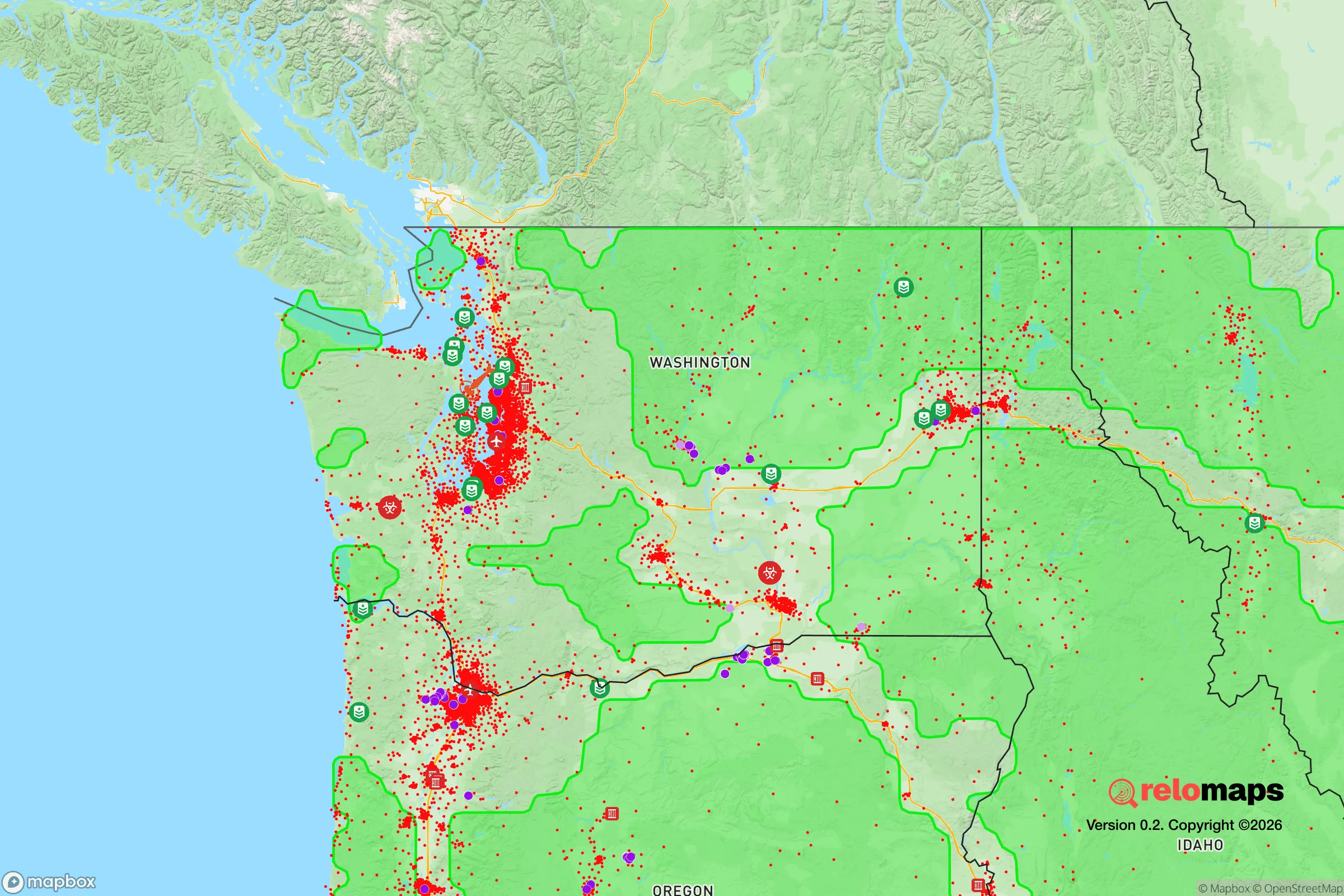
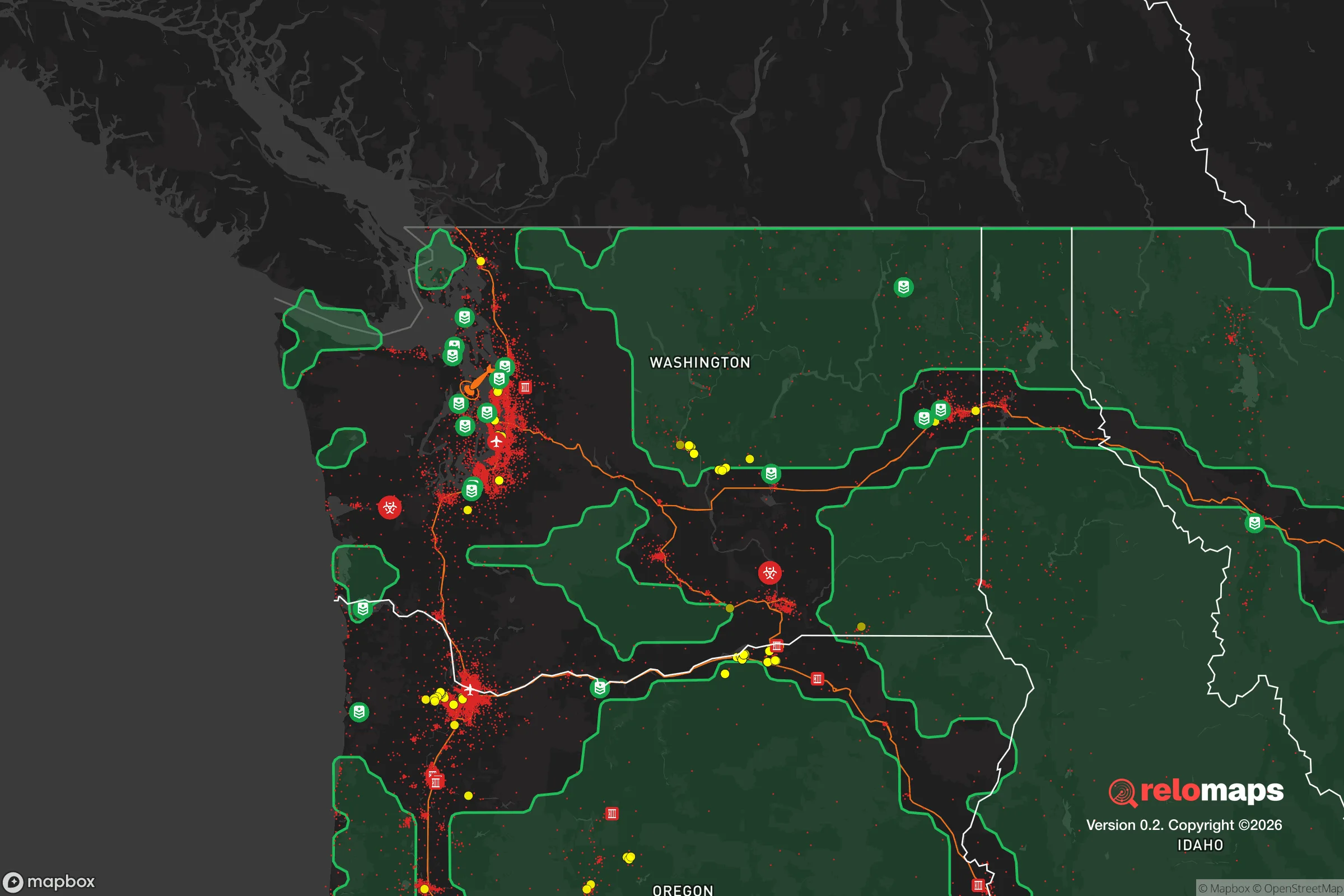


Important Note: For informational purposes only. This does not mean nothing bad ever happens in the green zones. Please use common sense. This is based on public data and modeled with AI. We tried to take a conservative approach but mistakes happen. We update this regularly as new information becomes available.
Solar Generator Recommendations
Backup power matters more here than in safer locations. We've picked three solar generators across budgets and capacity tiers — start with the budget unit if you only need a few essentials, or step up if you want to run a fridge and HVAC for days at a time.

Jackery Portable Power Station Explorer 300
Budget OptionPower on the Go: Weighing only 11 lbs, it's convenient to set up and store with book-sized foldable solar panels

BLUETTI Portable Power Station AC180
Designed for both indoor and outdoor scenarios, AC180 is highly capable as it has a robost capacity and continuous output power.

EF ECOFLOW DELTA Pro Ultra Power Station
Upgraded PickEcoFlow DELTA Pro Ultra is a whole-home energy system designed to grow with your family. Integrated with the Smart Home Panel 2, it scales to meet your evolving energy needs — keeping your home powered, intelligent, and secure through every stage of life.
We earn a commission, at no additional cost to you.
Strategic Assessment Analysis
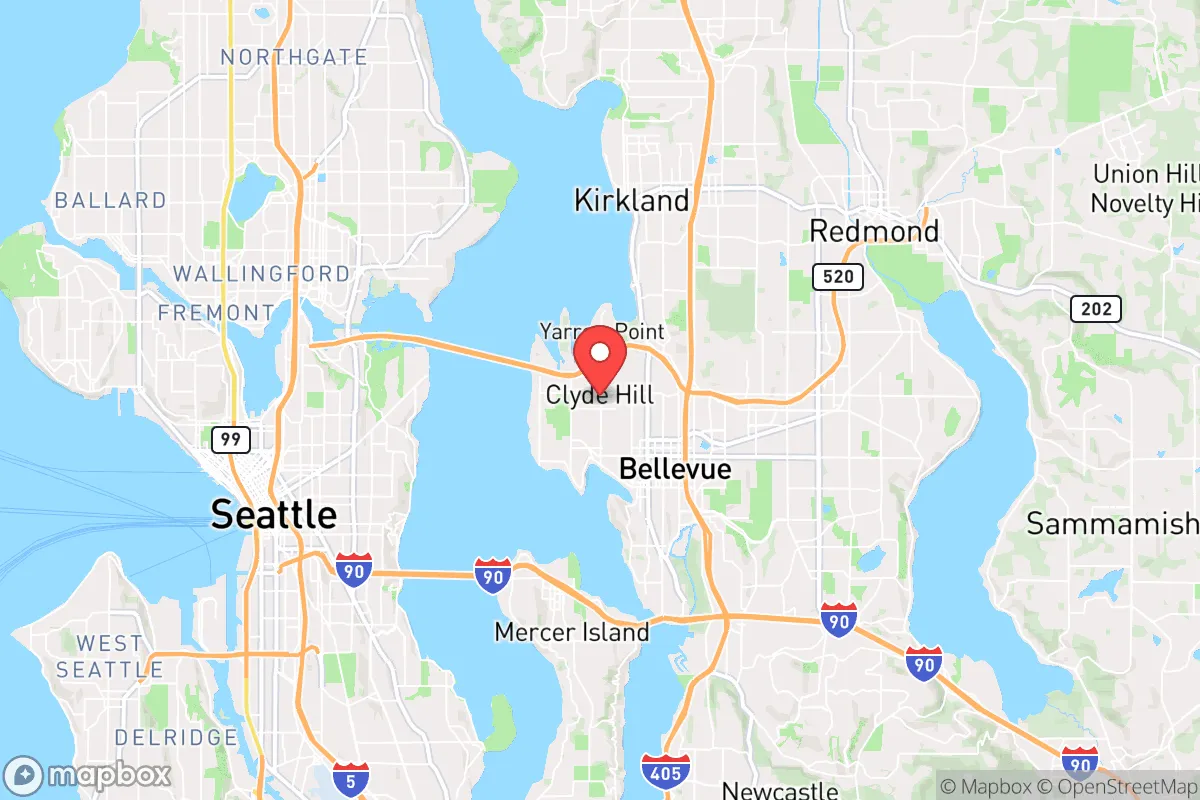
Clyde Hill, Washington, presents a paradox for the strategic relocator: it offers exceptional natural resilience and defensible geography, yet sits within the blast radius of one of the nation’s most critical economic and military targets. For the conservative-minded prepper, this isn’t a relocation destination for long-term survival—it’s a high-value, high-risk staging ground for those who must remain tethered to the Puget Sound region for work or family. The calculus here is about proximity to resources versus proximity to danger, and the margin for error is razor-thin.
Geographic position and natural advantages for a prepared household
Clyde Hill’s primary strategic asset is its position atop a glacial plateau on the eastern shore of Lake Washington. This elevation—roughly 200 to 300 feet above the lake—provides natural drainage, reduced flood risk, and clear sightlines across the water toward Seattle and the Olympic Mountains. The city is part of the Eastside corridor, a belt of affluent suburbs that includes Medina, Bellevue, and Hunts Point. For a prepper, the key advantage is defensible terrain: the neighborhood is a peninsula-like enclave with limited road access. Only a handful of arterial roads—primarily 84th Avenue NE and points connecting to NE 24th Street—link Clyde Hill to the broader Eastside. In a gridlock or civil unrest scenario, this chokepoint geometry works in favor of residents who know the back routes. The area’s mature tree canopy and large lots (many exceeding one acre) offer natural concealment and reduce the risk of fire spread compared to denser suburbs. Water access is another plus: Lake Washington is a massive freshwater reservoir, and while direct lakefront properties are rare, the city’s proximity means a prepared household could secure water via filtration from the lake or from the region’s robust groundwater aquifer. The Cascade Range to the east provides a rain shadow effect that keeps Clyde Hill’s annual precipitation around 35 inches—less than Seattle’s 38—but still ample for rainwater catchment systems.
Risks, exposures, and proximity to fallout-relevant landmarks
The sobering reality is that Clyde Hill sits within the immediate blast and fallout zone of multiple high-value targets. The city is roughly 8 miles east of downtown Seattle, home to Amazon’s headquarters, the Port of Seattle, and the Federal Reserve Bank of San Francisco’s Seattle branch. More critically, it’s 12 miles from Naval Base Kitsap-Bangor, one of the U.S. Navy’s two nuclear weapons storage facilities and homeport for Trident submarines. In a major conflict scenario, Bangor is a top-tier target. Clyde Hill’s location on the I-90 and SR-520 corridors means it lies directly in the path of any evacuation flow from Seattle, which would become a death trap of gridlocked vehicles. The city itself is not a primary target, but its proximity to Bellevue’s tech campuses (Microsoft, T-Mobile) and the Evergreen Point Floating Bridge makes it a secondary risk zone for fallout and secondary attacks. Earthquake risk is also non-trivial: the Seattle Fault runs roughly 10 miles south, and a Cascadia subduction zone event would liquefy much of the low-lying areas around Lake Washington. Clyde Hill’s glacial till soils are more stable than the fill soils of downtown, but the floating bridges—the only direct routes to Seattle—would likely fail. For the prepper, the takeaway is that this is not a bug-out location; it’s a location to bug-in only if you can secure your perimeter and have a secondary retreat east of the Cascades.
Practical resilience for a relocator: food, water, energy, and defensibility
For a single individual or family willing to invest heavily in hardening, Clyde Hill offers a workable but expensive resilience profile. Food security is a major weakness: the city has no agricultural land, no community gardens, and the nearest farmable soil is 20 miles east in the Snoqualmie Valley. Grocery supply lines depend on the I-90 and SR-520 bridges, which are single points of failure. A prepared household would need at least a six-month supply of non-perishables, plus a plan for barter goods. Water is more promising: a deep well on a large lot is feasible, though permitting is strict. Rainwater catchment is legal in Washington for outdoor use, but indoor use requires a permit. The city’s water utility (supplied by the City of Bellevue) draws from the Tolt and Cedar River watersheds, which are vulnerable to earthquake damage. A backup well or cistern is non-negotiable. Energy resilience is mixed: Puget Sound Energy’s grid is aging and prone to outages during windstorms (common in fall and winter). Solar is viable—Clyde Hill gets about 1,200 peak sun hours per year—but tree cover limits rooftop potential. A propane generator with buried tank is the standard solution, but noise discipline is poor in a grid-down scenario. Defensibility is the strongest card: the city’s low population density (roughly 3,000 residents in 1.5 square miles) and high property values mean that most neighbors are not desperate looters. The police force is small (contracted through Bellevue), but the community’s wealth means private security is common. For a prepper, the ideal setup is a home with a reinforced perimeter, a well, solar with battery backup, and a cache of firearms—all of which are legal and socially acceptable in this conservative-leaning enclave (King County as a whole votes blue, but Clyde Hill’s precincts consistently vote Republican).
The overall strategic picture for Clyde Hill is one of high potential reward paired with existential risk. It is a defensible, resource-rich enclave for those who can afford to harden it, but it is not a retreat—it is a forward operating base. The prudent relocator will treat Clyde Hill as a temporary haven for the first 72 hours of a crisis, with a pre-planned exfil route east over Snoqualmie Pass to a secondary property in central Washington. For the single professional or family who must remain in the Puget Sound region for income or family ties, Clyde Hill is arguably the best-option suburb for resilience—but only if you accept that you are living in the shadow of a target. The conservative prepper’s calculus here is simple: you are betting that the disaster is localized and short-lived, not a full-scale collapse. If that bet holds, Clyde Hill’s natural advantages and community cohesion will serve you well. If it doesn’t, you’ll need a plan B that’s already in motion before the first bridge goes down.

* Values derived from national, state, county, city and local statistics and may differ in a specific area. Last updated: 2026-04-27T14:15:19.000Z
Narrative content on this page is AI-generated and may contain mistakes. Verify any details that matter before acting on them.
ReloMaps may earn a commission from affiliate links at no extra cost to you.

