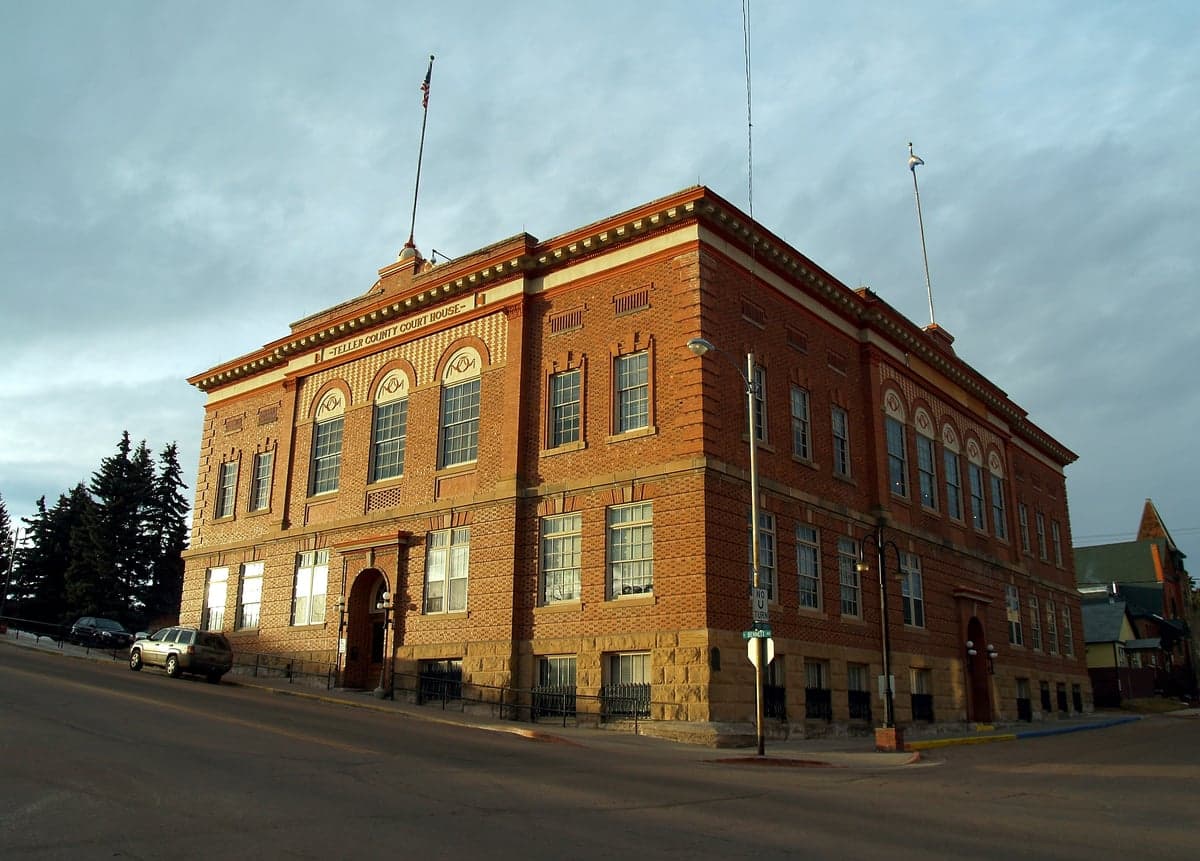
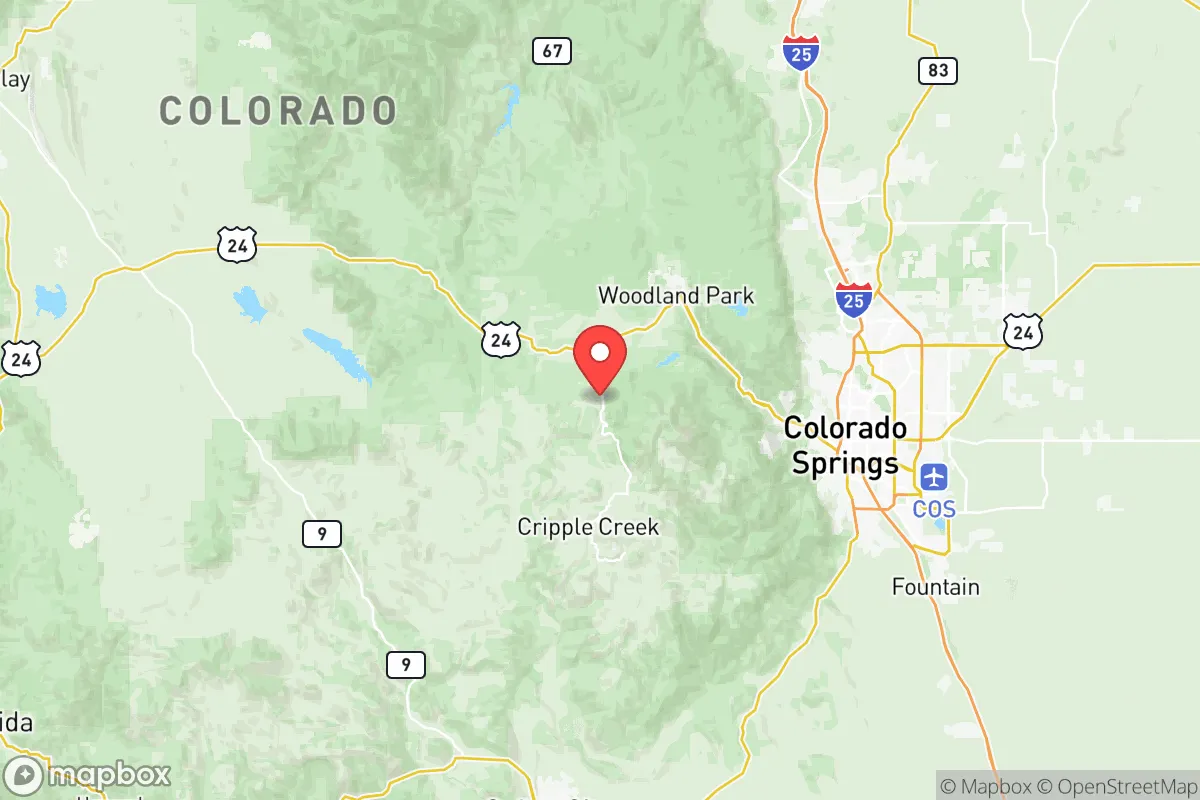
Photo: Wikipedia
Demographics of Teller County
Affluence Level in Teller County
A middle-class area roughly in line with national averages across income, home values, education, and employment.
People of Teller County
Teller County, Colorado, is home to roughly 24,774 residents, a population that is notably older, more white, and more politically conservative than the state average, with a distinctive character shaped by its history as a rugged mining frontier and its modern role as a quiet, mountainous retreat. The county’s population density is low, with most people clustered in the historic towns of Woodland Park and Cripple Creek, and the unincorporated communities of Divide and Florissant. Its identity is defined by a strong libertarian streak, a deep connection to outdoor recreation, and a demographic profile that remains overwhelmingly white (84.5%) with a very small foreign-born population (0.9%), making it one of the least ethnically diverse counties in Colorado.
Settlement & growth (pre-1960)
Before European settlement, the Ute people—specifically the Tabeguache and Muache bands—used the high mountain valleys of what is now Teller County as seasonal hunting and gathering grounds, particularly for elk and deer. The Ute Trail, a major east-west route, crossed through the area near modern-day Florissant and Divide. Spanish exploration in the 17th and 18th centuries left little permanent mark, as the rugged terrain and harsh winters discouraged settlement. The region remained largely untouched by non-Native people until the Pike’s Peak Gold Rush of 1858-1859, which brought the first major wave of Anglo-American prospectors, mostly from the Midwest and Appalachia, into the Colorado Front Range.
The defining event for Teller County’s population history was the 1891 discovery of gold in the Cripple Creek district, which sparked one of the last great gold rushes in the American West. Between 1891 and 1900, the population of the area exploded from a few hundred to over 50,000, with Cripple Creek and its satellite towns—Victor, Goldfield, Independence, and Altman—becoming bustling, multi-ethnic mining camps. The workforce was overwhelmingly American-born, but significant numbers of immigrants arrived: Cornish miners (known as "Cousin Jacks") from England, Irish laborers, Italian stonecutters, and a smaller number of German and Scandinavian immigrants. These groups concentrated in specific neighborhoods within Cripple Creek and Victor, with the Cornish dominating the deep-shaft mining work and the Irish often working as teamsters and railroad laborers. The Chinese population, common in other Colorado mining towns, was notably small in Teller County due to early exclusionary practices.
The boom was short-lived. By 1910, the gold mines began to decline, and the population plummeted. The 1920 census recorded just 6,000 residents in the county, a drop of nearly 90% from the peak. The Great Depression accelerated the exodus, and by 1940, Teller County’s population had fallen to around 4,000. The post-World War II era saw a modest revival, driven not by mining but by tourism and the growing appeal of the area as a summer retreat. Woodland Park, originally a small lumber town, began to attract retirees and second-home buyers from Colorado Springs and Denver, drawn by the cooler climate and pine forests. The county was officially created in 1899 from parts of El Paso and Fremont counties, but its modern population base was still tiny—just 2,800 residents in 1950—as the mining-era towns of Cripple Creek and Victor became near-ghost towns.
Modern era (post-1965)
The 1965 Hart-Cellar Act had almost no direct effect on Teller County, as the county’s foreign-born population remains minuscule (0.9%) and its immigrant communities are virtually nonexistent. Instead, the county’s modern demographic story is one of domestic migration—specifically, the steady influx of white, middle-class and upper-middle-class households from the Colorado Front Range urban corridor. The key driver was the legalization of limited-stakes gambling in Cripple Creek in 1991, which revived the town’s economy and spurred a wave of new housing construction. Between 1990 and 2000, the county’s population grew by 50%, from 12,000 to 18,000, as casino workers, retirees, and commuters moved into Woodland Park and the unincorporated areas around Divide and Florissant.
The Hispanic population, now at 7.4%, is the largest minority group, but it is not a recent immigrant wave. Most Hispanic residents are multi-generational Coloradans, many with roots in the Spanish-speaking settlements of the San Luis Valley to the south, who moved to Teller County for construction and service jobs during the 1990s and 2000s. They are dispersed throughout the county, with small clusters in Woodland Park and Cripple Creek, but have not formed a distinct ethnic enclave. The Black population (1.0%) and East/Southeast Asian population (0.4%) are tiny and largely concentrated in Woodland Park, often as professionals or military retirees drawn by the proximity to Fort Carson and Peterson Space Force Base in El Paso County. The Indian subcontinent population is statistically zero, reflecting the county’s lack of high-tech or academic employment that typically attracts that demographic.
Suburbanization has been the dominant force since 2000. Woodland Park has transformed from a small mountain town into a bedroom community for Colorado Springs, with new subdivisions sprawling along Highway 24. The county’s population is now older than the state median (median age 48.5 vs. Colorado’s 37.0), driven by an influx of retirees and the out-migration of younger adults seeking jobs and urban amenities. The college-educated share (37.8%) is above the national average, reflecting the county’s appeal to professionals who work remotely or commute to Colorado Springs. Politically, the county has become more conservative over time, with a strong Republican lean in every election since 2000, as new arrivals tend to be culturally conservative and fiscally libertarian.
The future
Teller County’s population is likely to continue growing slowly, reaching perhaps 30,000 by 2040, driven by continued in-migration of retirees and remote workers from the Front Range. The county is homogenizing rather than diversifying: the white share is projected to remain above 80%, with Hispanic growth plateauing as younger Hispanic residents move to more diverse urban areas. The foreign-born population will likely stay below 2%, as the county lacks the industries—agriculture, meatpacking, high-tech—that attract immigrants. The cultural identity is being reinforced, not diluted, by in-migration: new arrivals are overwhelmingly white, conservative, and drawn to the county’s low taxes, gun-friendly culture, and mountain lifestyle. The next 10-20 years will likely see continued suburban sprawl in Woodland Park and along the Highway 24 corridor, while Cripple Creek and Victor remain small, tourism-dependent towns with aging populations.
For someone moving in now, Teller County is becoming a more settled, older, and culturally homogeneous place—a conservative mountain enclave where the mining-era diversity is a distant memory and the future looks much like the present. The county offers stability, natural beauty, and a like-minded community for those who fit its demographic profile, but it offers little for those seeking ethnic diversity, a youthful population, or a dynamic urban environment.

* Values derived from national, state, county, city and local statistics and may differ in a specific area. Last updated: 2026-05-24T13:22:03.000Z
Narrative content on this page is AI-generated and may contain mistakes. Verify any details that matter before acting on them.
ReloMaps may earn a commission from affiliate links at no extra cost to you.

