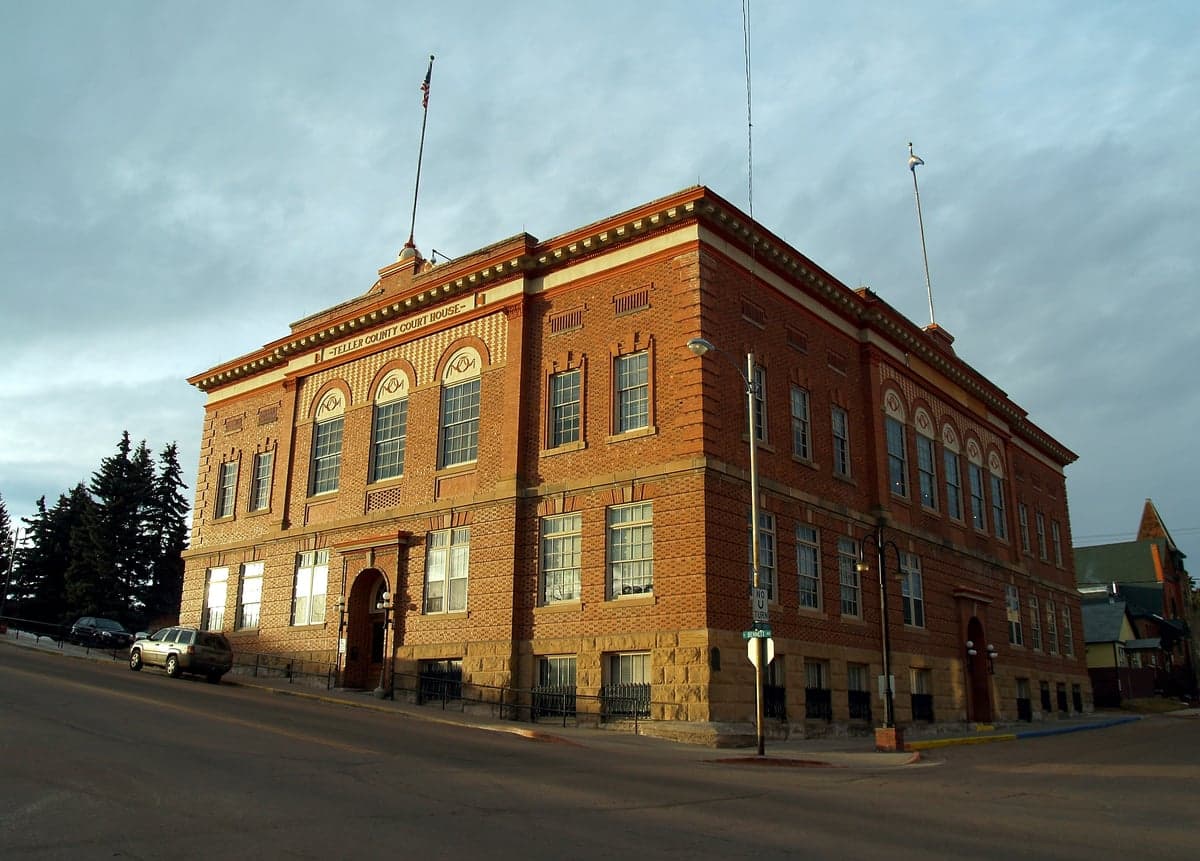
Photo: Wikipedia
Personal Sovereignty in Teller County
Viable for self-reliance. Generally workable, though some barriers may limit total independence.
What does Personal Sovereignty tell us?
Personal Sovereignty measures your capacity for self-reliance and independence with minimal government friction. Higher scores mean fewer barriers between you and the way you want to live... but it assumes you have the space you need and good neighbors.
What does this tell us?
Personal Sovereignty measures your capacity for self-reliance and independence with minimal government friction. Higher scores mean fewer barriers between you and the way you want to live... but it assumes you have the space you need and good neighbors.
State Policy
Energy independence: Net exporter (110% of energy produced in-state)
Personal Liberty
Homesteading

Personal Liberty Analysis
Teller County, Colorado, offers one of the strongest environments for personal sovereignty in the Front Range region, where the balance between individual autonomy and government oversight tilts decisively toward the citizen. Unlike the increasingly restrictive urban corridors of Denver or Boulder, this high-altitude county—home to the historic mining towns of Cripple Creek, Victor, and Woodland Park—operates with a cultural and legal framework that prioritizes self-reliance, minimal interference, and a deep-seated distrust of centralized authority. For single individuals and parents seeking a location where personal decisions about health, education, property, and defense remain largely their own, Teller County stands as a strategic outlier in a state that has seen significant regulatory expansion elsewhere.
Tax burden and regulatory posture: How Teller County compares to the Denver metro
Teller County’s tax structure and regulatory environment are markedly more favorable to personal sovereignty than those found in Colorado’s urban centers. The county’s property tax rate is among the lowest in the state, with a residential assessment rate of 6.95% and a mill levy that typically hovers around 30-40 mills, resulting in annual taxes on a $400,000 home often under $1,200—roughly half of what a comparable property in Jefferson County would incur. There is no county-level income tax, and sales tax sits at a modest 2.9%, though individual towns like Woodland Park add their own (3.0%), bringing the combined rate to about 7.9%. Critically, Teller County has resisted the kind of land-use and zoning overreach seen in places like Boulder County or Larimer County. Building permits are straightforward, and there are no countywide growth caps or urban growth boundaries. The county’s planning department operates with a presumption of approval for most residential and agricultural uses, and variances for things like accessory dwelling units, workshops, or home-based businesses are routinely granted. This regulatory posture means that a parent wanting to run a small trade from their property or a single individual seeking to build a self-sufficient homestead faces far fewer bureaucratic hurdles than they would in more populated jurisdictions.
Self-defense and gun law specifics: What the Second Sanctuary status means for residents
Teller County is a certified Second Amendment Sanctuary, a designation that carries real weight in daily life. In 2019, the Board of County Commissioners passed a resolution declaring that county resources would not be used to enforce any state or federal laws that infringe on the right to keep and bear arms—a direct response to Colorado’s red-flag law (HB19-1177) and subsequent magazine capacity restrictions. This means that in practice, law enforcement in Teller County does not proactively enforce the state’s 15-round magazine limit or assist in extreme risk protection order (ERPO) seizures unless a federal warrant is involved. Open carry is common and uncontroversial in unincorporated areas and in towns like Victor and Cripple Creek, though Woodland Park has a local ordinance prohibiting open carry within city limits (concealed carry remains legal with a permit). The county sheriff, Jason Mikesell, has publicly stated that his office will not serve as an enforcement arm for what he considers unconstitutional state mandates. For a survivalist or prepper, this means that building a defensive firearms cache—including standard-capacity magazines and certain NFA items like suppressors—is not subject to local harassment. The nearest gun-friendly ranges and training facilities, such as the Pikes Peak Gun Club in nearby Colorado Springs, are a 30-minute drive, and private land shooting is legal on parcels of 35 acres or more outside city limits.
Self-reliance and homesteading viability: Lot sizes, zoning, and off-grid feasibility
For those serious about self-reliance, Teller County offers some of the most permissive homesteading conditions in Colorado, but the terrain and climate demand careful planning. Unincorporated areas allow for parcels as small as 1 acre for residential use, but the county’s zoning code permits agricultural exemptions on lots of 5 acres or more, which can include livestock, poultry, and small-scale crop production. The towns of Divide and Florissant are particularly attractive for off-grid living: both sit at elevations above 8,500 feet and have large tracts of undeveloped land where well water, septic systems, and solar arrays are standard. The county does not require connection to municipal water or sewer, and off-grid power systems—solar with battery backup or propane generators—are common. However, the county does enforce building codes for habitable structures (IRC 2018), so a yurt or shipping container home requires a permit and inspection, though the process is far less onerous than in more regulated counties. The growing season is short (typically 60-90 days), so food production leans toward cold-hardy crops, greenhouses, and livestock like goats or chickens. For a single individual or family, the ability to drill a well (average depth 300-500 feet, cost $15,000-$25,000) and install a septic system (around $8,000-$12,000) means true independence from municipal infrastructure. The town of Cripple Creek, while more developed, still allows for small-scale homesteading on its outskirts, and its historic mining claims sometimes come with water rights—a significant asset for long-term self-sufficiency.
Personal liberties: Parental rights, medical autonomy, speech, and property
Teller County’s culture of personal sovereignty extends into the realms of parental rights, medical choice, and property use. The county’s school districts—primarily Woodland Park RE-2 and Cripple Creek-Victor RE-1—have maintained a strong parental-involvement ethos, with school boards that have resisted state-level mandates on curriculum transparency and health policies. Homeschooling is common and well-supported, with several local co-ops and a robust network of families who share resources. Medical autonomy is respected in practice: the county has no local mask or vaccine mandates, and the sheriff’s office has stated it will not enforce any future state-level public health orders that it deems unconstitutional. For those concerned about medical freedom, the nearby city of Colorado Springs offers a range of alternative and functional medicine providers, but within Teller County itself, the small hospitals (UCHealth in Woodland Park and the Pikes Peak Regional Hospital in Victor) operate with a general deference to patient choice. Property rights are vigorously defended: the county’s planning department has a reputation for approving reasonable requests for fences, outbuildings, and even small-scale commercial operations on residential land. There are no countywide noise ordinances that would restrict generator use or target practice on private property, and the county’s code enforcement is complaint-driven rather than proactive. Free speech is protected by the same Second Sanctuary ethos—public meetings are often lively, and residents are not shy about confronting elected officials on issues of overreach.
Overall, Teller County ranks among the top five Colorado counties for personal sovereignty, alongside similarly rural and conservative jurisdictions like Elbert, Park, and Fremont counties. Its combination of low taxes, permissive gun laws, off-grid feasibility, and a culture that actively resists state-level encroachment makes it a strategic relocation target for those who view government overreach as a primary threat to their way of life. For a single individual or parent looking to build a life where personal decisions remain personal, Teller County offers a rare alignment of legal, cultural, and practical conditions that are increasingly difficult to find in the modern United States.

* Values derived from national, state, county, city and local statistics and may differ in a specific area. Last updated: 2026-05-24T13:22:03.000Z
Narrative content on this page is AI-generated and may contain mistakes. Verify any details that matter before acting on them.
ReloMaps may earn a commission from affiliate links at no extra cost to you.

