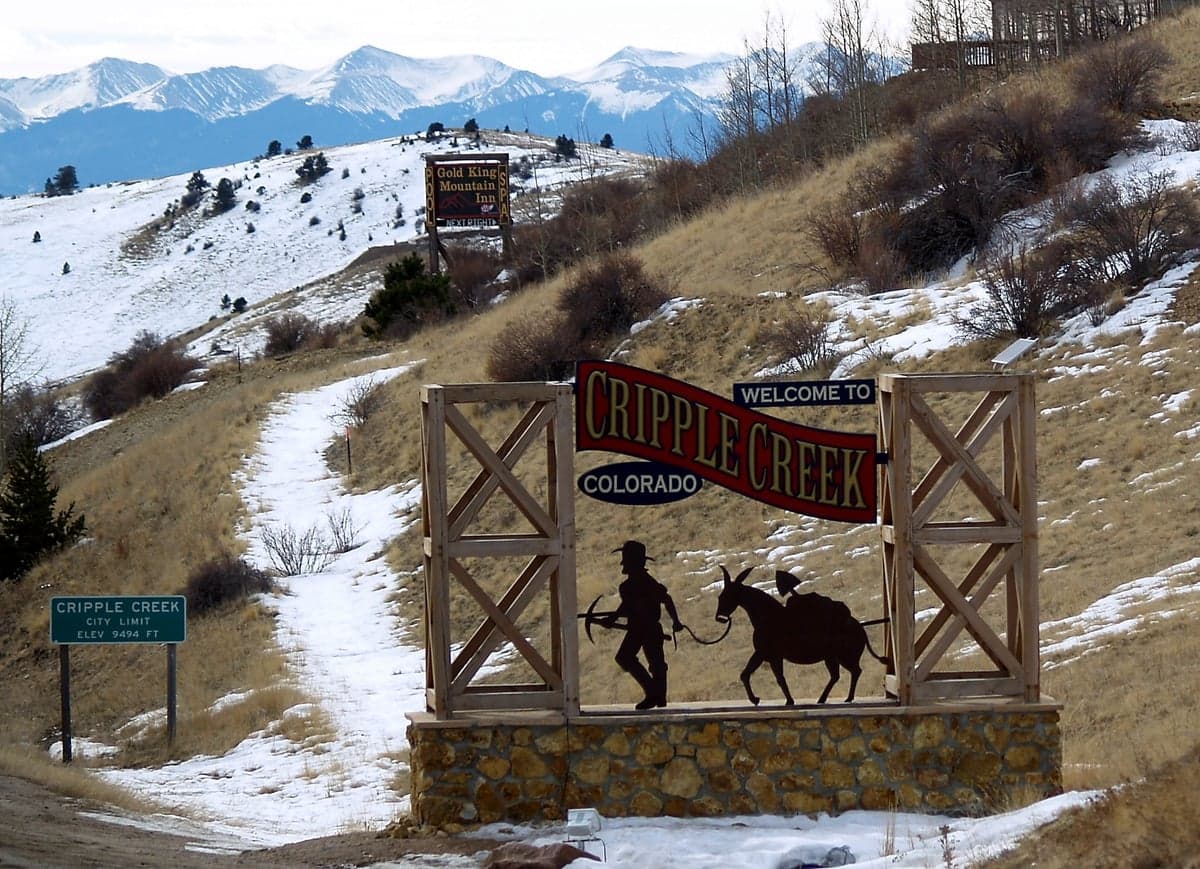
Photo: Wikipedia
Personal Sovereignty in Cripple Creek, CO
Viable for self-reliance. Generally workable, though some barriers may limit total independence.
What does Personal Sovereignty tell us?
Personal Sovereignty measures your capacity for self-reliance and independence with minimal government friction. Higher scores mean fewer barriers between you and the way you want to live... but it assumes you have the space you need and good neighbors.
What does this tell us?
Personal Sovereignty measures your capacity for self-reliance and independence with minimal government friction. Higher scores mean fewer barriers between you and the way you want to live... but it assumes you have the space you need and good neighbors.
State Policy
Energy independence: Net exporter (110% of energy produced in-state)
Personal Liberty
Homesteading

Personal Liberty Analysis
Cripple Creek, Colorado, offers a unique environment for personal sovereignty that balances the rugged individualism of the Old West with the practical realities of modern state governance. For those prioritizing autonomy—whether as a survivalist, prepper, or conservative seeking to minimize government overreach—this historic mining town presents a mixed but generally favorable picture. While Colorado’s state-level policies on taxes, gun laws, and land use impose some constraints, Cripple Creek’s remote location, small population (around 1,200 residents), and local culture of self-reliance create a buffer against the more intrusive trends seen in Front Range cities like Denver or Boulder. The key is understanding where state mandates end and local discretion begins, particularly for single individuals and parents who value the right to live, defend, and provide for themselves without excessive interference.
Tax burden and regulatory posture in Teller County
Colorado’s state income tax is a flat 4.4% as of 2025, which is moderate compared to high-tax states like California or New York, but still a cut from the state’s own revenue. For a prepper or conservative, the more critical factor is property tax: Teller County levies a relatively low rate of about 0.5% of actual value, meaning a $300,000 home in Cripple Creek would incur roughly $1,500 annually. This is a fraction of what you’d pay in, say, Illinois or New Jersey. Sales tax in Cripple Creek is 8.5% (state + local), but the town’s limited commercial footprint means most major purchases are made in Woodland Park or Colorado Springs, where rates are similar. The regulatory posture is generally light at the county level—Teller County has no building codes for unincorporated areas, and Cripple Creek itself has minimal zoning enforcement outside the historic district. However, Colorado’s state-level environmental regulations, particularly on water rights and mining reclamation, can be a headache for anyone looking to develop raw land. The state also mandates renewable energy standards for new construction, which adds cost but doesn’t outright ban off-grid setups. Overall, the tax burden is manageable, and the regulatory environment favors those who want to be left alone, provided you stay out of the state’s crosshairs on water and environmental issues.
Self-defense and gun law specifics in Cripple Creek
Colorado is a “shall-issue” state for concealed carry permits, and Teller County’s sheriff’s office processes applications efficiently—typically within 30 days. For a prepper, this is a solid baseline: you can carry a firearm for self-defense without arbitrary delays. Open carry is legal without a permit in Cripple Creek, though local ordinances prohibit it in bars and government buildings. The state does have a magazine capacity limit of 15 rounds (passed in 2013), which is a sore point for many conservatives, but it’s rarely enforced in rural areas like Cripple Creek, where law enforcement focuses on property crimes and DUIs rather than magazine counts. Stand-your-ground laws apply statewide, meaning no duty to retreat in any place you have a legal right to be. Castle doctrine is also in effect, protecting homeowners who use force against intruders. For parents, this means you can legally defend your family on your property without fear of prosecution, provided the threat is reasonable. The biggest concern is Colorado’s “red flag” law (Extreme Risk Protection Orders), which allows law enforcement or family members to petition for temporary firearm removal. In a small town like Cripple Creek, this is rarely invoked, but it’s a tool that could be abused by overzealous officials. For maximum sovereignty, consider keeping a low profile and avoiding any behavior that might trigger a complaint.
Self-reliance and homesteading viability: lot sizes, zoning, and off-grid feasibility
Cripple Creek sits at 9,500 feet elevation, which imposes natural limits on homesteading—short growing seasons, heavy snow, and rocky soil—but for those committed to self-reliance, the area offers real opportunities. Zoning in the town itself is mixed, with residential lots typically ranging from 5,000 to 10,000 square feet, but outside city limits in Teller County, you can find parcels of 5 to 40 acres with minimal restrictions. Off-grid living is feasible: many residents use solar panels (though winter sun is limited), propane for heating, and well water. The county does not require grid connection, and composting toilets are legal. However, Colorado’s water rights system is strict—you cannot simply dig a well without a permit, and surface water collection (rain barrels) is limited to 110 gallons per property under state law. For a prepper, this means you need to secure a legal water source before building. Livestock is allowed on parcels over 2 acres in the county, and chickens are permitted within city limits with a permit. The biggest hurdle is altitude: temperatures can drop to -20°F in winter, so any homestead must be built for extreme cold. For single individuals or families willing to invest in infrastructure, Cripple Creek offers a genuine off-grid lifestyle, but it’s not a place for casual homesteading—it demands serious preparation and capital.
Personal liberties: parental rights, medical autonomy, speech, and property
Colorado’s state constitution protects free speech, but local dynamics in Cripple Creek are more conservative than the state average. Political expression, including open display of firearms or religious symbols, is generally tolerated without pushback. Parental rights are a mixed bag: Colorado has mandatory vaccination requirements for school attendance (with medical and religious exemptions), and the state’s child welfare system is active, meaning parents who homeschool or refuse medical treatment for children may face scrutiny. However, Teller County’s small school district (Cripple Creek-Victor RE-1) is more accommodating of parental choices than urban districts, and homeschooling is common among the local mining and ranching families. Medical autonomy is limited by state licensing—you cannot practice medicine without a license, and alternative treatments like ivermectin or off-label use are not protected. For a prepper, this means stocking your own medical supplies and relying on telemedicine or out-of-state providers for controversial treatments. Property rights are strong in Teller County: no county-level rent control, no inclusionary zoning, and no restrictions on short-term rentals (though Cripple Creek’s casino-driven tourism means STRs are common). The biggest threat to property sovereignty is Colorado’s conservation easement programs, which can restrict land use in perpetuity if you sign one—so avoid those. Overall, personal liberties are robust for a blue state, but you must navigate state-level mandates carefully.
In the broader context of the United States, Cripple Creek ranks as a strong contender for personal sovereignty, especially when compared to the Pacific Northwest or Northeast, where taxes, gun laws, and land-use restrictions are far more oppressive. The town’s isolation, low population density, and conservative local culture create a buffer against the worst of Colorado’s state-level overreach. For a survivalist or prepper, the main trade-offs are the high altitude and cold climate versus the freedom to own firearms, build off-grid, and live without constant government interference. Parents will find a community that respects traditional values, though state mandates on education and healthcare require vigilance. If you’re looking for a place where you can be left alone to prepare for whatever comes—economic collapse, natural disaster, or government overreach—Cripple Creek offers a viable base camp, provided you’re willing to work within the constraints of a state that still believes it knows best. It’s not libertarian paradise, but it’s a damn sight closer than most places in America today.

* Values derived from national, state, county, city and local statistics and may differ in a specific area. Last updated: 2026-04-29T01:05:29.000Z
Narrative content on this page is AI-generated and may contain mistakes. Verify any details that matter before acting on them.
ReloMaps may earn a commission from affiliate links at no extra cost to you.

