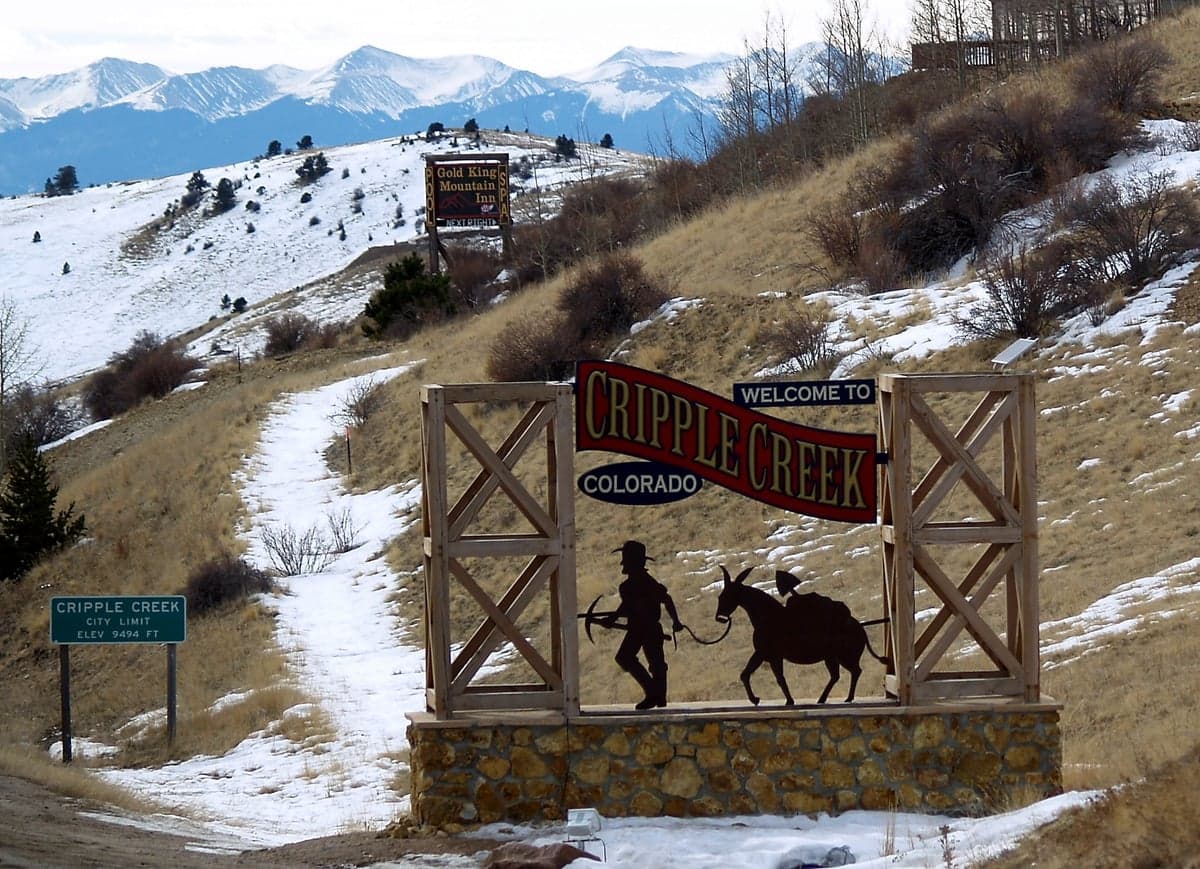
Photo: Wikipedia
Political ClimatePolitical Climate in Cripple Creek, CO
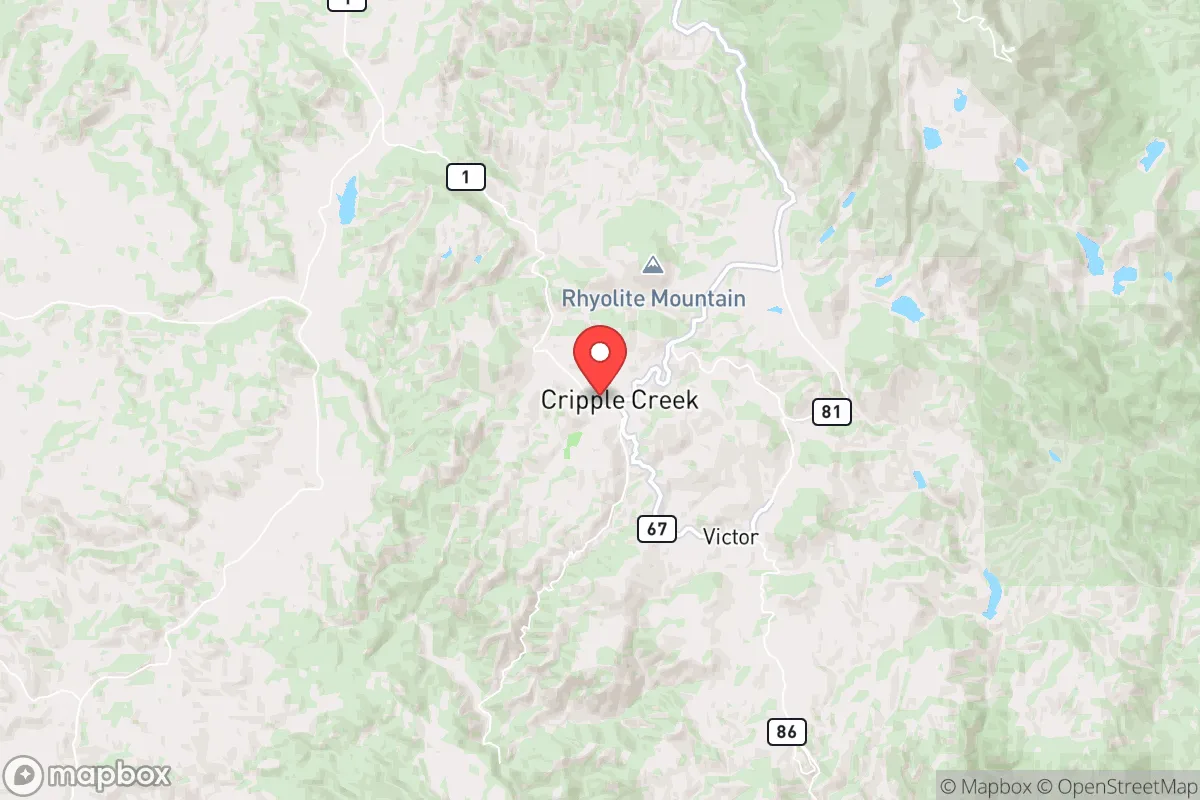
District shown is the primary district for this city’s centroid. Cities may span multiple districts.
Local Political AnalysisPolitical Analysis of Cripple Creek, CO
Cripple Creek, Colorado, has a political climate that’s shifting in ways that would make a long-time resident’s head spin. While the town itself has deep roots in mining and a libertarian-leaning, live-and-let-live culture, the surrounding Teller County is still a conservative stronghold. But the city proper now carries a Cook PVI of D+8, meaning it votes about 8 points more Democratic than the national average. That’s a stark change from even a decade ago, driven largely by an influx of newcomers from the Front Range who bring a more progressive, government-friendly mindset. If you’ve been here since the 90s, you’ve watched the local elections get tighter and the conversations at the coffee shop get a lot more tense.
How it compares
To understand Cripple Creek’s political drift, you have to look at its neighbors. Head 20 miles east to Woodland Park, and you’re in a town that still leans reliably Republican, with a strong “don’t tread on me” streak. Drive 30 miles north to Divide, and you’ll find a community that votes red by a wide margin. Even Victor, just a few miles away, is more conservative than Cripple Creek. The contrast is sharp: Cripple Creek’s casino-driven economy and tourism base attract a transient workforce and second-home owners from Denver and Colorado Springs, many of whom bring big-city voting habits. Meanwhile, the surrounding unincorporated areas of Teller County remain solidly conservative, creating a political island in the middle of a red sea. That D+8 rating isn’t just a number—it’s a daily reality when you see local ordinances and school board races start to mirror the policies of Boulder or Denver.
What this means for residents
For folks who value personal freedoms and limited government, the shift is concerning. The most visible impact is on local governance: zoning and land-use regulations have gotten stricter, with more hoops to jump through for building a shed or running a small business from your property. There’s also been a push for “equity” initiatives in the local school district, which has sparked heated school board meetings. Property taxes have crept up, and there’s chatter about adopting more county-level environmental regulations that could affect mining and off-road recreation. The casino industry, which is the lifeblood of the local economy, has faced increased pressure from state-level gambling oversight and labor groups. For a town that used to pride itself on being a place where you could do your own thing without a permit, the creeping bureaucracy feels like a slow erosion of the very independence that made Cripple Creek unique.
On the cultural side, you’ll notice a split in the community. The old-timers and ranching families still wave the Gadsden flag and talk about the Second Amendment at the hardware store. But the newer residents are more likely to post about climate change and social justice on the town’s Facebook page. The annual Donkey Derby Days still draws a crowd, but the political undercurrents are impossible to ignore. If the trend continues, expect more ballot measures on tax increases, more restrictions on short-term rentals, and a continued push to align Cripple Creek with the progressive policies of the Front Range. For anyone who moved here to escape that exact kind of overreach, it’s a bitter pill to swallow.

State Political ClimatePolitical Climate in Colorado
State Political AnalysisPolitical Environment in the State
Colorado has shifted from a classic purple swing state to a reliably blue stronghold over the past two decades, with Democrats now controlling the governorship, both U.S. Senate seats, and both chambers of the state legislature. The state voted for Hillary Clinton by 5 points in 2016, Joe Biden by 13 points in 2020, and Kamala Harris by roughly 11 points in 2024, reflecting a durable leftward trend driven primarily by explosive growth in the Denver-Boulder-Aurora metroplex. For a conservative considering relocation, the state’s political trajectory is a cautionary tale of how rapid in-migration from blue states and aggressive progressive policymaking can transform a once-balanced state into a one-party dominant environment.
Urban vs. rural divide
The political map of Colorado is a textbook case of urban-rural polarization. The Denver metro area, including Denver, Aurora, Boulder, and Lakewood, accounts for roughly 60% of the state’s population and votes overwhelmingly Democratic — Boulder County gave Biden 80% of the vote in 2020. The I-25 corridor from Fort Collins through Denver to Colorado Springs is the state’s political spine, with Colorado Springs being the notable conservative outlier in that corridor, though even El Paso County has been trending purple. The Western Slope, including Grand Junction and Montrose, remains reliably Republican, as do the Eastern Plains counties like Yuma and Kit Carson. However, rural Colorado’s population is shrinking relative to the Front Range, meaning its electoral influence continues to wane. The 2020 census cost rural counties a congressional seat, while the Denver metro gained one.
Policy environment
Colorado’s policy environment has become increasingly progressive across nearly every domain. The state income tax rate is a flat 4.4%, but voters rejected a 2023 measure to lower it further, and the legislature has shown appetite for progressive tax restructuring. Property taxes are relatively low compared to Texas, but recent legislative changes have allowed local governments to increase them more easily. The regulatory posture is heavy: Colorado has some of the nation’s strictest environmental regulations, including a 2024 law requiring all new buildings to be “electric-ready” and phasing out natural gas hookups in new construction. Education policy is dominated by the teachers’ unions, with school choice limited compared to states like Florida or Arizona — Colorado’s charter school law is moderate, but funding disparities persist. Healthcare is heavily regulated, with a state-run reinsurance program that has stabilized premiums but at the cost of provider networks. Election laws are among the most accessible in the nation: universal mail-in ballots, same-day registration, and no voter ID requirement for mail ballots, which has fueled ongoing concerns about election integrity among conservatives.
Trajectory & freedom
Colorado’s trajectory on personal freedom is decidedly mixed, with a clear pattern of expanding government control in some areas while contracting it in others. On the positive side for conservatives, Colorado has a strong constitutional protection for property rights under the Takings Clause (Article II, Section 15), and the state’s Taxpayer’s Bill of Rights (TABOR) remains in effect, requiring voter approval for tax increases — though the legislature has found creative workarounds. On the negative side, the state has aggressively expanded gun control: the 2024 legislative session passed a ban on so-called “assault weapons” (SB24-131), a 10-day waiting period for all firearm purchases, and a requirement that gun owners report lost or stolen firearms within 48 hours. Parental rights have been eroded by a 2023 law that allows minors 12 and older to consent to gender-affirming care without parental notification, and a 2024 law that prohibits schools from notifying parents if a child changes their gender identity or pronouns. Medical autonomy has been curtailed by strict abortion access laws that go beyond Roe, including a 2024 law that prohibits local governments from restricting abortion access. Free speech on campus has been chilled by a 2024 law that expands the definition of discriminatory harassment to include “misgendering” and “deadnaming” in public accommodations, including businesses and schools.
Civil unrest & political movements
Colorado has seen significant civil unrest and political activism in recent years. The 2020 George Floyd protests in Denver turned violent, with property damage and looting that led to a controversial police response and subsequent defunding efforts. The state has a well-organized progressive activist infrastructure, including the Colorado Immigrant Rights Coalition and the ACLU of Colorado, which successfully pushed for the 2023 “Protect Our Neighbors” law that limits local law enforcement cooperation with federal immigration authorities — effectively a sanctuary state policy. On the right, the Colorado Republican Party has been fractured between establishment and populist factions, with the 2024 state convention devolving into a credentialing dispute that led to a competing convention. The Douglas County secession movement — an attempt to form a new state called “Colorado 51” — fizzled after the 2013 vote but reflected deep frustration among conservatives in the Denver suburbs. Election integrity remains a flashpoint: the 2020 election saw a lawsuit over Dominion voting machines in Mesa County, and the 2024 election saw a controversy over ballot drop box security in Pueblo County. Immigration politics are increasingly visible, with the 2023 surge of migrants bused from Texas to Denver straining city resources and creating visible encampments.
Projection
Over the next 5-10 years, Colorado is likely to continue its leftward drift, though perhaps at a slower pace than the last decade. Demographic trends favor Democrats: the state’s fastest-growing populations are in the Denver metro and along the Front Range, with in-migration from California, Texas, and the Midwest bringing a mix of progressive and moderate voters. The rural population will continue to shrink, and the state’s electoral map will become even more dominated by the Denver-Boulder-Aurora corridor. However, there are countervailing forces: the 2024 election saw a slight rightward shift in some suburban counties like Arapahoe and Jefferson, suggesting that the progressive agenda may have reached a ceiling with moderate voters. The TABOR amendment remains a structural constraint on tax increases, though the legislature will continue to find loopholes. A conservative moving to Colorado now should expect to live in a state where Democrats control all levers of power, where gun rights are increasingly restricted, where parental rights are under assault, and where the cost of living — driven by housing and energy regulations — will continue to rise. The state is not likely to flip back to purple in the next decade, but the pace of progressive change may moderate as the political costs become apparent.
For a conservative considering Colorado, the bottom line is this: you can still find like-minded communities in Colorado Springs, Douglas County, the Western Slope, and the Eastern Plains, but you will be living under a state government that is actively hostile to your values on guns, education, and parental rights. The state’s natural beauty and outdoor lifestyle are undeniable, but the political climate is increasingly restrictive for those who value limited government and personal freedom. If you’re willing to fight for your rights at the local level and accept that state-level elections will be an uphill battle, Colorado can still work — but it’s no longer the libertarian-leaning swing state it was 20 years ago.
* Values derived from national, state, county, city and local statistics and may differ in a specific area. Last updated: 2026-04-29T01:05:29.000Z
Narrative content on this page is AI-generated and may contain mistakes. Verify any details that matter before acting on them.
ReloMaps may earn a commission from affiliate links at no extra cost to you.

