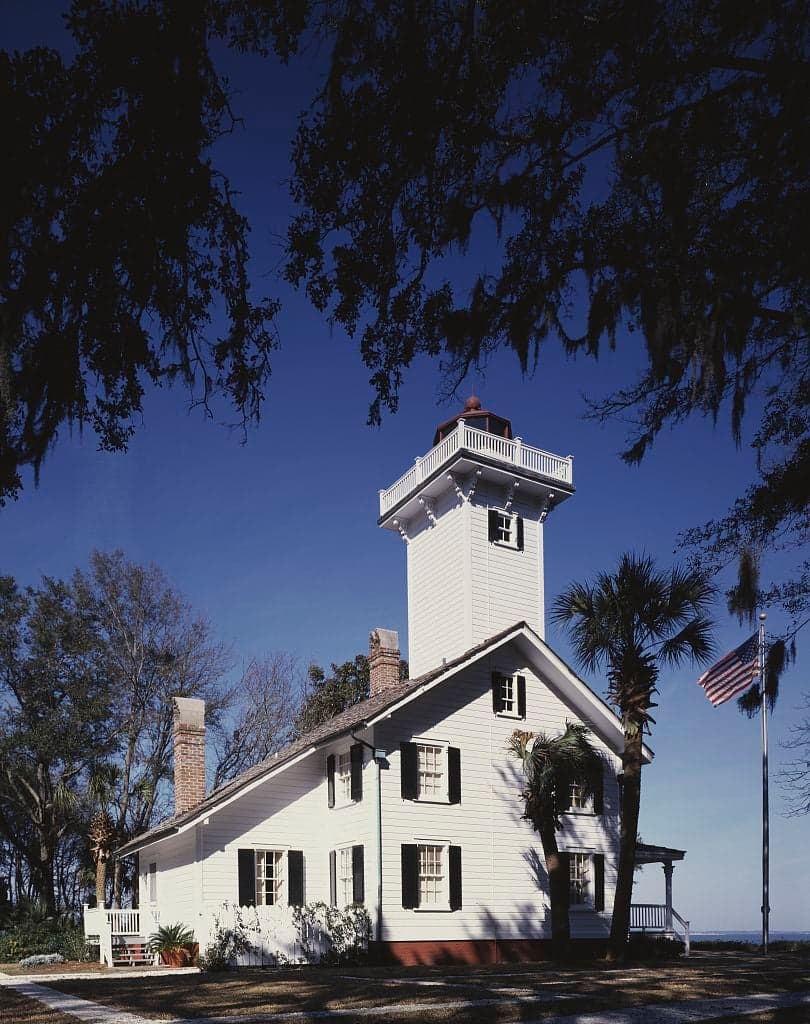
Photo: Wikipedia
Strategic Assessment of Daufuskie Island, SC
Workable tactical position. Some exposure to population density or targets, but generally defensible in a crisis.
What does the Strategic Assessment tell us?
Our Strategic Assessment grades tactical survivability of an area. Major population centers, military targets, fallout zones, natural disasters, and border exposure all drive risk — lower exposure means a more defensible position in a crisis.
This is heavily inspired by Joel Skousen's Strategic Relocation book. Highly recommended you checkout the book ($)What does this tell us?
Our Strategic Assessment grades tactical survivability of an area. Major population centers, military targets, fallout zones, natural disasters, and border exposure all drive risk — lower exposure means a more defensible position in a crisis.
This is heavily inspired by Joel Skousen's Strategic Relocation book. Highly recommended you checkout the book ($)Strategic Pillars

Key Distances
Regional Safe Places
Below is our recommended "safe zones" in South Carolina and the surrounding area based on our strategic heuristics. For most people, it's unrealistic to live in a “safe zone” full-time due to work, family or other personal reasons. They tend to be more rural. However, many of these areas are perfect for second homes and retreat properties that double as a vacation home or even a short-term rental.
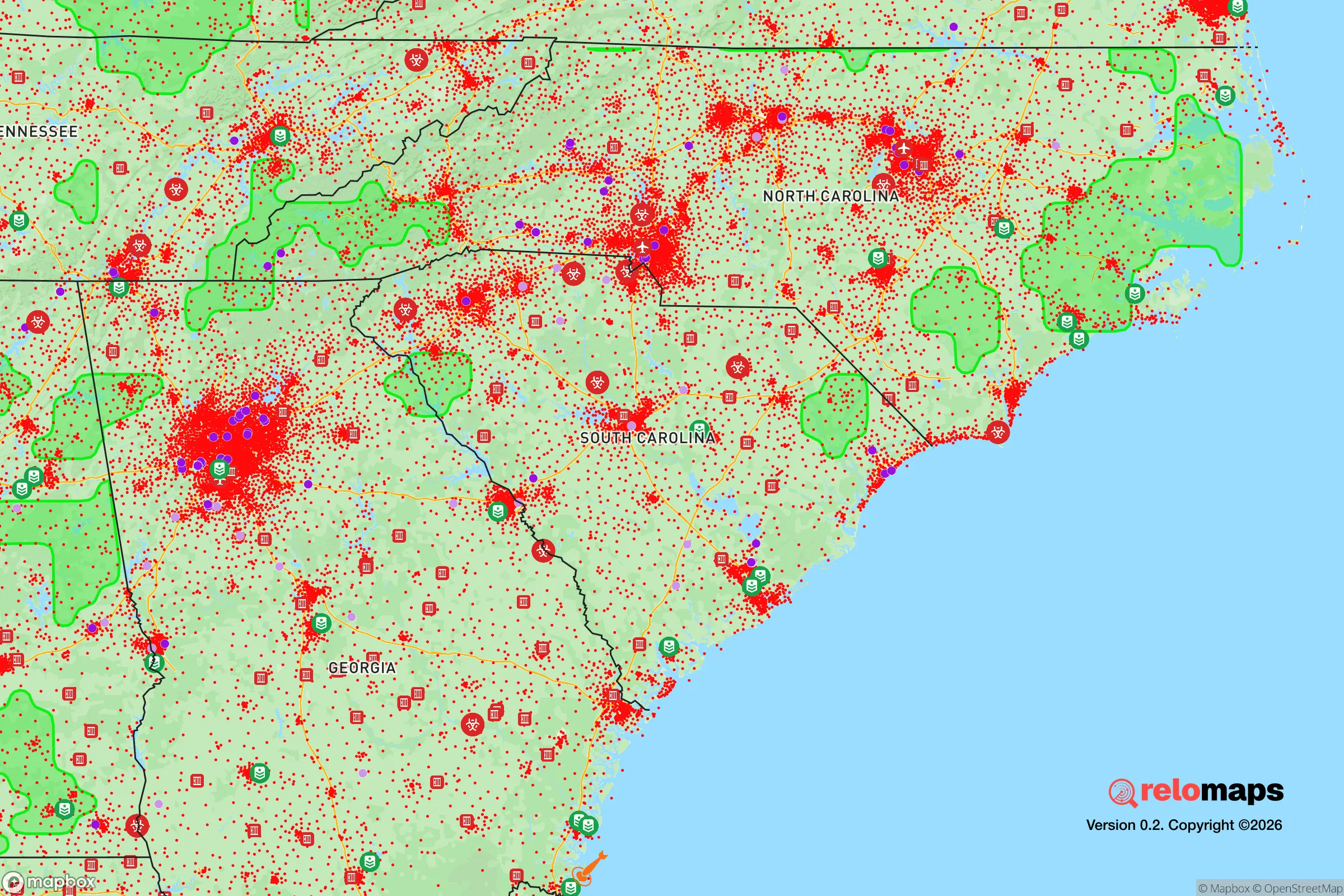
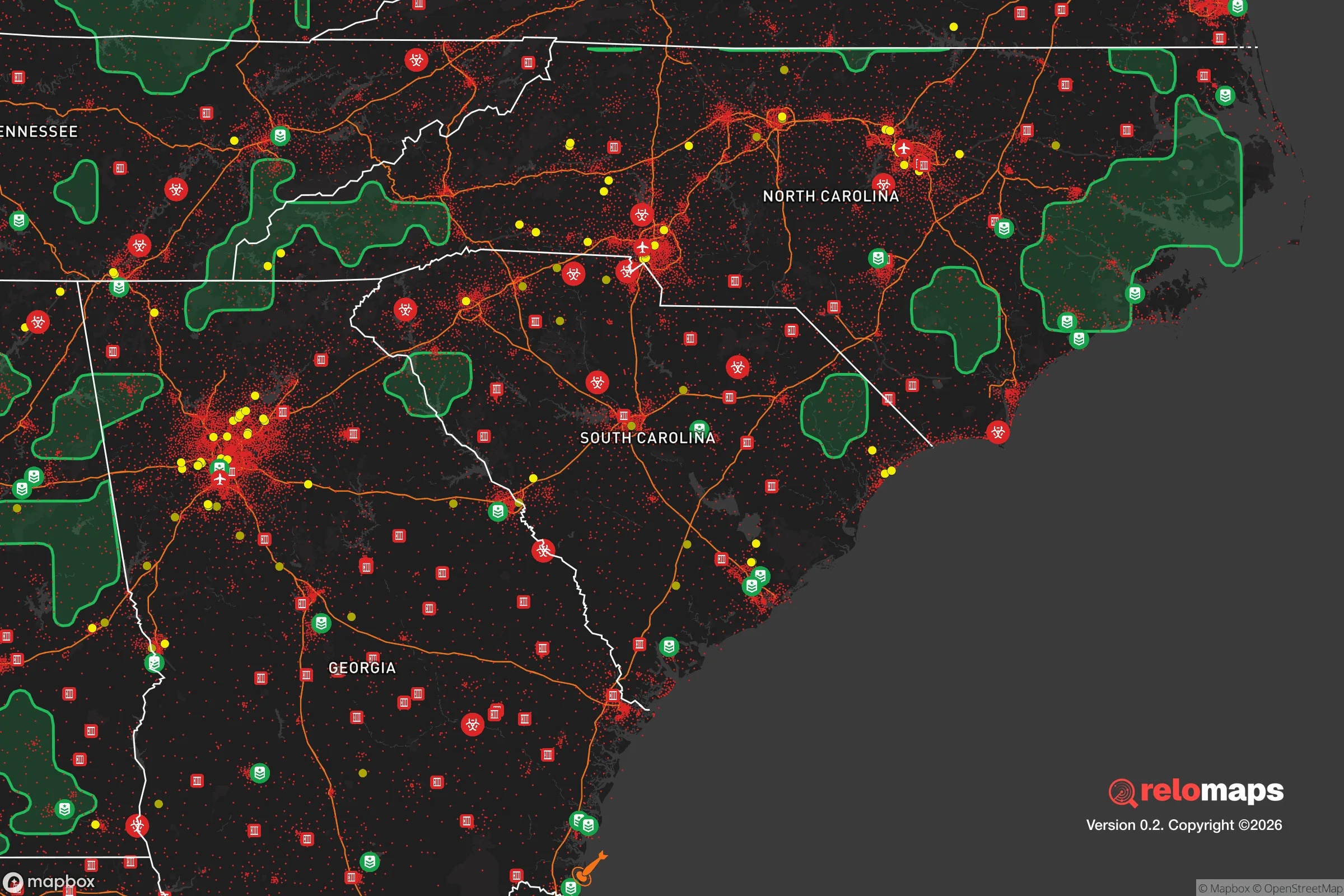


Important Note: For informational purposes only. This does not mean nothing bad ever happens in the green zones. Please use common sense. This is based on public data and modeled with AI. We tried to take a conservative approach but mistakes happen. We update this regularly as new information becomes available.
Solar Generator Recommendations
Backup power matters more here than in safer locations. We've picked three solar generators across budgets and capacity tiers — start with the budget unit if you only need a few essentials, or step up if you want to run a fridge and HVAC for days at a time.

Jackery Portable Power Station Explorer 300
Budget OptionPower on the Go: Weighing only 11 lbs, it's convenient to set up and store with book-sized foldable solar panels

BLUETTI Portable Power Station AC180
Designed for both indoor and outdoor scenarios, AC180 is highly capable as it has a robost capacity and continuous output power.

EF ECOFLOW DELTA Pro Ultra Power Station
Upgraded PickEcoFlow DELTA Pro Ultra is a whole-home energy system designed to grow with your family. Integrated with the Smart Home Panel 2, it scales to meet your evolving energy needs — keeping your home powered, intelligent, and secure through every stage of life.
We earn a commission, at no additional cost to you.
Strategic Assessment Analysis
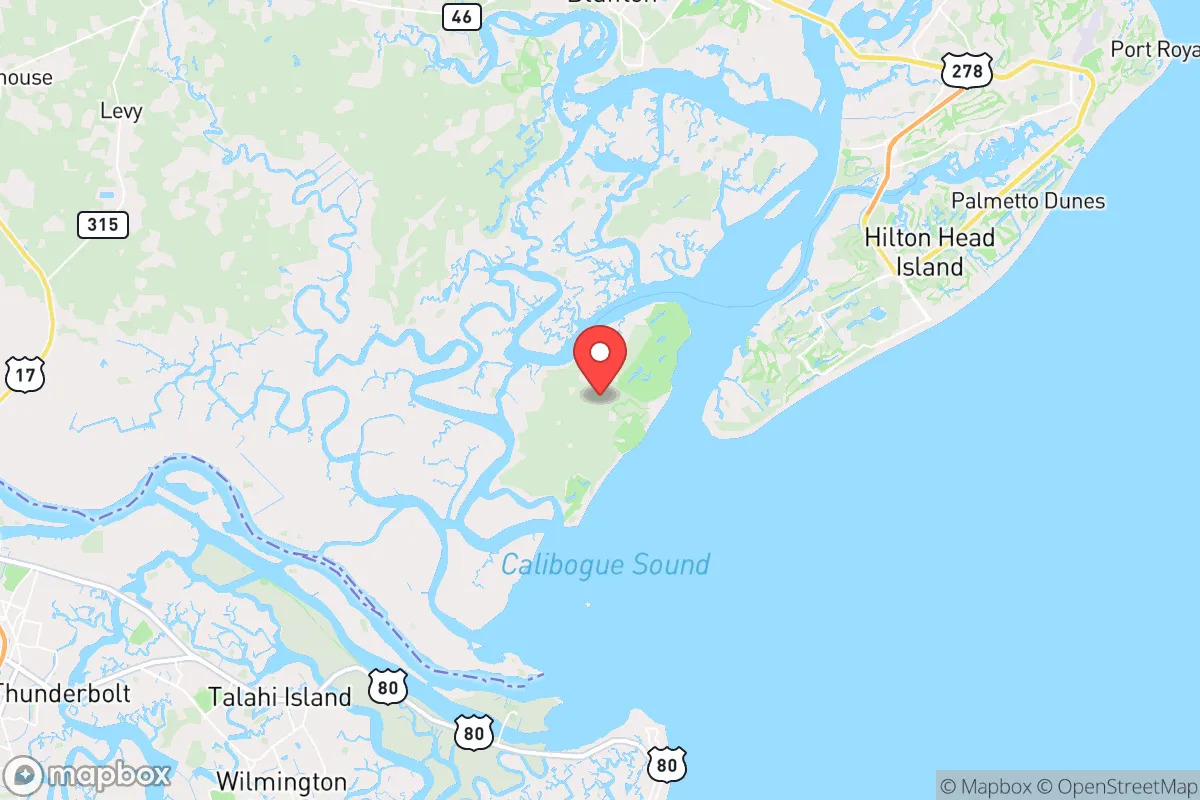
Daufuskie Island, South Carolina, offers a rare combination of geographic isolation and strategic resilience that makes it a compelling option for those prioritizing self-sufficiency and security in an uncertain future. Accessible only by boat or private ferry, this 8-square-mile barrier island sits between Savannah, Georgia, and Hilton Head Island, South Carolina, yet feels worlds apart from the vulnerabilities of mainland life. For a conservative-leaning individual or family focused on prepping for civic unrest, mass casualty events, or natural disasters, Daufuskie’s low population density—roughly 300 year-round residents—and limited infrastructure create a natural buffer against the chaos that often follows societal breakdown. The island’s lack of a bridge to the mainland is not an inconvenience but a deliberate feature of its defensive posture, making it a hard target for opportunistic threats while preserving a quiet, self-reliant lifestyle.
Geographic position and natural advantages for long-term security
Daufuskie Island’s location in the Lowcountry of South Carolina places it within a temperate climate zone that supports year-round subsistence agriculture, hunting, and fishing—critical factors for long-term food security. The island is surrounded by the Calibogue Sound and the Atlantic Ocean, providing abundant seafood resources like oysters, shrimp, and fish that can be harvested without reliance on supply chains. Its maritime forest and salt marshes offer cover and natural barriers against intrusion, while the island’s elevation—averaging 10 to 15 feet above sea level—reduces flood risk compared to other coastal areas. The absence of a bridge means that any approach by land is impossible, forcing potential threats to navigate by water, which is easily monitored and defended. For a relocator, this geographic isolation translates into a strategic advantage: the island is a natural fortress where community cohesion and local knowledge matter more than external resources. The nearest major city, Savannah, is roughly 20 miles away by water, but the psychological and physical distance from urban centers like Charleston (90 miles north) or Jacksonville (120 miles south) means that fallout from civil unrest or mass casualty events in those areas is unlikely to reach Daufuskie quickly, if at all.
Risks, exposures, and proximity to fallout-relevant landmarks
No location is without vulnerabilities, and Daufuskie Island has specific exposures that a prepper must weigh carefully. The island’s reliance on ferry service for supplies, medical evacuation, and emergency response is its most significant weakness—if the mainland experiences a breakdown in law and order or a major disaster, the ferry system could be disrupted or commandeered. The nearest hospital is in Savannah, roughly a 45-minute boat ride plus drive, which is a liability for medical emergencies during a crisis. Proximity to Savannah’s port—a major shipping hub and potential target for terrorist attacks or supply chain disruptions—introduces a moderate risk of fallout from a mass casualty event, though the island’s isolation mitigates direct exposure. Additionally, Daufuskie lies within the hurricane belt, with the Atlantic hurricane season (June through November) posing a real threat of storm surge and wind damage. The island’s low population also means limited law enforcement presence—the Beaufort County Sheriff’s Office provides coverage, but response times can be hours. For a conservative-minded relocator, these risks are manageable with proper planning: stockpiling supplies, maintaining a private boat, and building a resilient community network. The key is that Daufuskie’s risks are natural and logistical, not the man-made chaos of urban centers, and they can be mitigated through preparation rather than avoided entirely.
Practical resilience for a relocator: food, water, energy, and defensibility
For a single individual or family serious about self-sufficiency, Daufuskie Island offers a foundation that can be built upon with moderate effort. Freshwater is a critical concern—the island relies on groundwater wells and rainwater collection, but the shallow aquifer is susceptible to saltwater intrusion during droughts or storms. Installing a rainwater catchment system with UV filtration is a practical first step, and many existing homes already have cisterns. Food production is viable: the island’s sandy soil supports raised-bed gardening for vegetables, and the surrounding waters provide year-round protein. Hunting for deer and feral hogs is permitted with a license, adding a reliable meat source. Energy independence is achievable through solar panels, which are common on the island due to the lack of a mainland power grid connection—most homes use solar with battery backup or propane generators. Defensibility is Daufuskie’s standout feature: the island’s single ferry landing and limited docks create chokepoints that can be monitored by a small group. The dense maritime forest and winding dirt roads make it easy to set up observation posts and hard for outsiders to navigate. For a prepper, the island’s small community—many of whom are like-minded retirees, veterans, or off-grid enthusiasts—offers a social fabric that can organize for mutual defense without the anonymity of a city. The trade-off is that daily life requires more effort: groceries, medical care, and even mail require a boat trip, so a relocator must be comfortable with a slower pace and a higher degree of self-reliance.
In the broader strategic picture, Daufuskie Island represents a calculated trade-off between security and convenience that aligns well with a conservative, preparedness-minded worldview. It is not a bug-out location for a weekend—it is a permanent base where the isolation that protects you also demands that you bring your own resources and skills. The island’s lack of connection to the mainland is its greatest strength in a world where urban centers are increasingly vulnerable to civil unrest, supply chain failures, and mass casualty events. For a single individual or family willing to invest in solar power, water storage, and a reliable boat, Daufuskie offers a defensible, self-sustaining environment that few other locations in the Southeast can match. The risks—hurricanes, ferry dependency, and limited medical access—are real but manageable with foresight. Ultimately, Daufuskie is a place where you can live on your own terms, insulated from the chaos of the mainland, while still being close enough to engage with the outside world when necessary. It is a strategic choice for those who see the writing on the wall and want a home that can weather the storm, whatever form it takes.

* Values derived from national, state, county, city and local statistics and may differ in a specific area. Last updated: 2026-05-11T15:12:29.000Z
Narrative content on this page is AI-generated and may contain mistakes. Verify any details that matter before acting on them.
ReloMaps may earn a commission from affiliate links at no extra cost to you.

