 Popular
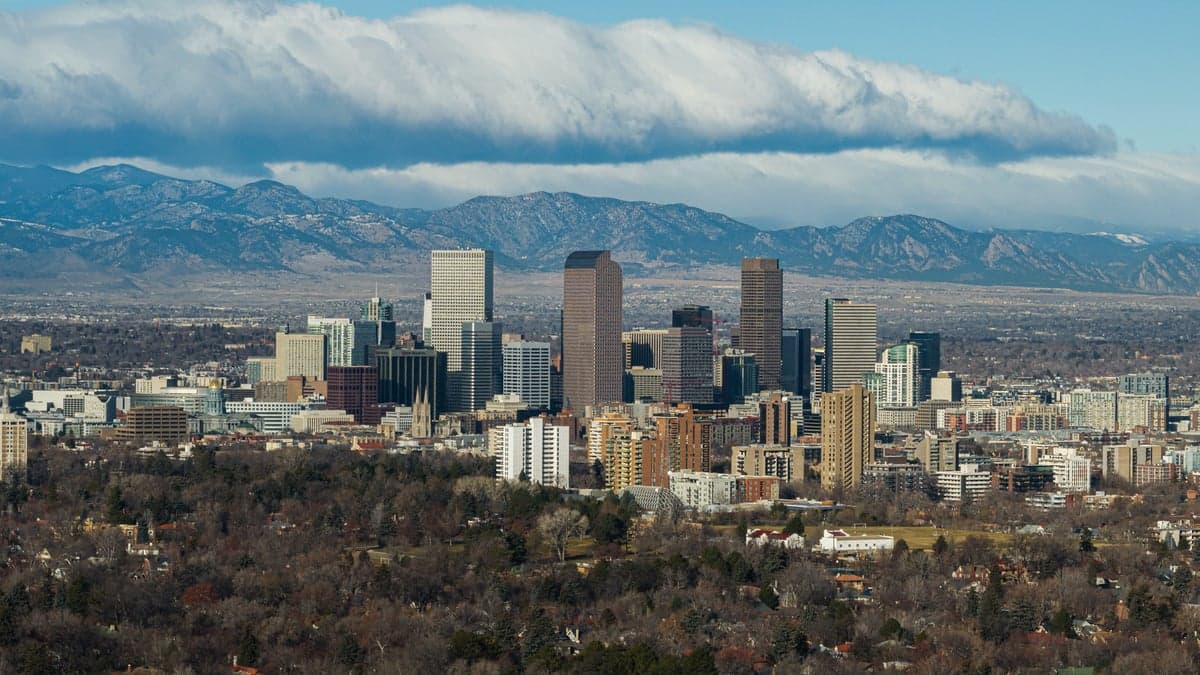
Photo: Wikipedia
Demographics of Denver, CO
Affluence Level in Denver, CO
An upper-middle-class area. Household wealth, education levels, and homeownership run ahead of national benchmarks.
People of Denver, CO
Denver’s 713,734 residents today form a predominantly white (54.6%), college-educated (55.6%) city with a substantial Hispanic minority (27.9%) and smaller Black (8.5%) and East/Southeast Asian (2.9%) communities. The city’s character is defined by a relatively low foreign-born share (7.4%) compared to other major U.S. metros, reflecting a population shaped more by domestic migration than international immigration. Denverites are notably young, active, and politically moderate-to-liberal, with a strong outdoor-recreation culture and a growing tech and healthcare economy that has attracted newcomers from across the country.
How the city was settled and grew
Denver was founded in 1858 during the Pike’s Peak Gold Rush, drawing a wave of fortune seekers—overwhelmingly white American men from the Midwest and East Coast—who established a rough mining supply camp. The city’s first permanent neighborhoods emerged around the original Auraria settlement (now Auraria Campus) and the competing Denver City plat across Cherry Creek. By the 1870s, the railroad arrived, transforming Denver into a regional trade and processing hub for agriculture, mining, and livestock. This era attracted a significant Hispanic population, many of whom were descendants of Spanish and Mexican settlers from New Mexico and southern Colorado, who settled in the Westside and Sun Valley neighborhoods. A smaller wave of Black migrants, mostly from the South, arrived after the Civil War and concentrated in the Five Points district, which became a thriving cultural and business center by the early 1900s. European immigrants—Germans, Irish, Italians, and Scandinavians—also arrived during this period, settling in neighborhoods like Globeville and Baker, where they worked in smelters, stockyards, and railroads. The city’s population grew steadily, reaching 322,000 by 1930, but remained overwhelmingly white and native-born.
Modern era (post-1965)
The post-1965 era brought significant demographic shifts, though Denver’s foreign-born share remained low compared to coastal cities. The 1965 Hart-Cellar Act opened immigration from Asia and Latin America, but Denver’s primary growth driver was domestic in-migration from the Rust Belt and California, attracted by energy booms (1970s-80s) and later the tech and healthcare sectors. The Hispanic population expanded rapidly through both immigration and higher birth rates, spreading beyond the historic Westside into Southwest Denver and Montbello. The Black population, which peaked at around 12% in the 1970s, has since declined to 8.5% as many families moved to suburban Aurora and Douglas County. East/Southeast Asian communities (2.9%) are relatively small and dispersed, with no single dominant enclave, though South Federal Boulevard has a visible Vietnamese and Chinese business corridor. The Indian-subcontinent population (0.7%) is even smaller and highly educated, concentrated in the tech-heavy Stapleton (now Central Park) neighborhood. The most dramatic modern shift has been the influx of young, white, college-educated professionals since 2010, driving gentrification in neighborhoods like RiNo (River North) and Highland, displacing long-standing Hispanic and working-class communities. This wave has pushed Denver’s college-educated share to 55.6%—well above the national average—and made the city whiter than it was in 1990.
The future
Denver’s population is likely to continue growing, but at a slower pace, driven primarily by domestic migration from high-cost states like California and New York. The city is becoming more economically stratified: affluent, educated newcomers concentrate in redeveloped neighborhoods like Central Park and RiNo, while lower-income Hispanic and Black residents are pushed to the outskirts or into suburban Adams and Arapahoe counties. The foreign-born share (7.4%) is unlikely to rise dramatically, as Denver lacks the established immigrant networks and entry-level job base of gateway cities. The Hispanic population will continue to grow through natural increase, but may become more suburbanized. East/Southeast Asian and Indian communities are expected to remain small but professional, clustering near employment hubs. The city is not homogenizing into a single identity; rather, it is tribalizing into distinct enclaves by income and education, with the urban core becoming younger, whiter, and wealthier, while the periphery diversifies.
For someone moving to Denver now, the city offers a dynamic, opportunity-rich environment with a strong economy and outdoor lifestyle, but newcomers should expect high housing costs and a population that is increasingly divided by education and income. The city’s future is one of managed growth and demographic sorting, where the choice of neighborhood will largely determine one’s social and economic experience.

* Values derived from national, state, county, city and local statistics and may differ in a specific area. Last updated: 2026-04-20T08:04:19.000Z
Narrative content on this page is AI-generated and may contain mistakes. Verify any details that matter before acting on them.
ReloMaps may earn a commission from affiliate links at no extra cost to you.

