
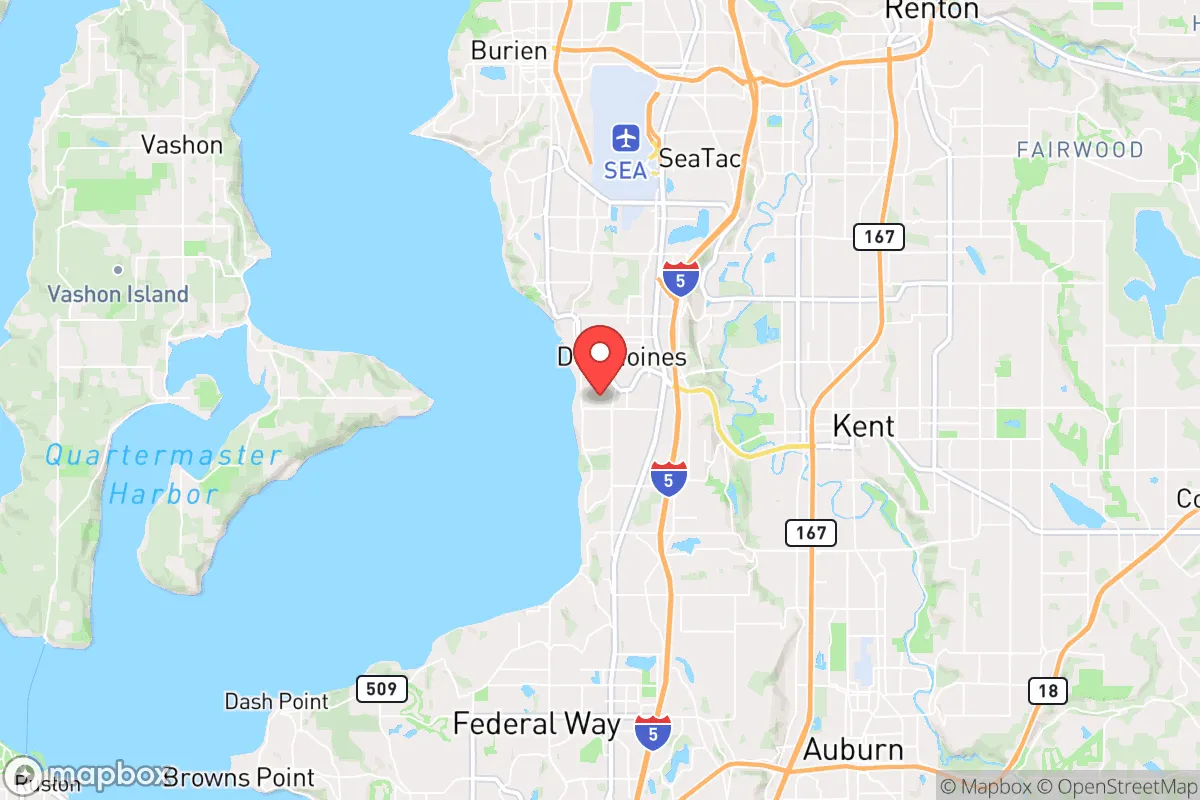
Photo: Wikipedia
Personal Sovereignty in Des Moines, WA
Viable for self-reliance. Generally workable, though some barriers may limit total independence.
What does Personal Sovereignty tell us?
Personal Sovereignty measures your capacity for self-reliance and independence with minimal government friction. Higher scores mean fewer barriers between you and the way you want to live... but it assumes you have the space you need and good neighbors.
What does this tell us?
Personal Sovereignty measures your capacity for self-reliance and independence with minimal government friction. Higher scores mean fewer barriers between you and the way you want to live... but it assumes you have the space you need and good neighbors.
State Policy
Energy independence: Importer (55% of energy produced in-state)
Personal Liberty
Homesteading

Personal Liberty Analysis
Des Moines, Washington, sits within a state that exerts significant control over personal autonomy, making it a challenging environment for those prioritizing individual sovereignty. As a conservative-leaning strategic advisor, you need to understand that Washington State’s regulatory and tax framework actively limits self-reliance, from firearm ownership to property use. While the city itself has a modest small-town feel, it is firmly under the thumb of King County and state-level policies that prioritize collective mandates over personal freedoms. For single individuals and parents seeking to maximize personal sovereignty, Des Moines requires careful navigation of a system that often views self-sufficiency as a threat.
How the tax burden and regulatory climate affect personal autonomy
Washington State has no personal income tax, which is a notable advantage for preserving earnings, but this is offset by a heavy reliance on regressive sales taxes and high property taxes. King County’s property tax rates are among the highest in the state, with effective rates often exceeding 1.1% of assessed value, and annual increases are capped at 1% plus new construction—but reassessments can still drive up bills significantly. For a survivalist mindset, this means every dollar earned is taxed at the point of purchase, and owning land or a home carries a recurring cost that can strain budgets. The regulatory posture is even more restrictive: Washington’s State Environmental Policy Act (SEPA) and Growth Management Act (GMA) impose strict land-use controls, limiting what you can build, where you can build, and how you can use your property. Permitting for anything beyond a basic shed can take months, and the state’s energy code mandates efficiency standards that increase construction costs. For those wanting to build a self-sufficient homestead or workshop, the bureaucratic hurdles are a direct infringement on property rights.
Self-defense rights and gun law specifics in Des Moines
Washington State has become increasingly hostile to the Second Amendment, and Des Moines residents must comply with some of the strictest gun laws in the nation. The state bans so-called "assault weapons" (semi-automatic rifles with certain features), requires a 10-day waiting period for all firearm purchases, and mandates a background check for every sale, including private transfers. Magazine capacity is capped at 10 rounds for rifles and 17 for handguns. For a prepper, this means building a defensive arsenal is legally constrained, and the state’s red flag law allows authorities to confiscate firearms based on a court order without a criminal conviction. Open carry is legal but practically discouraged in urban areas, and concealed carry requires a permit with a training course. Parents should know that safe storage laws require firearms to be locked away if a minor could access them, adding another layer of government oversight in the home. While Des Moines itself has a relatively low violent crime rate (about 2.5 per 1,000 residents), the legal environment means self-defense options are limited compared to states like Idaho or Texas.
Self-reliance and homesteading viability: lot sizes, zoning, and off-grid feasibility
Des Moines is a suburban city with small lot sizes—typically 5,000 to 7,000 square feet—and zoning that heavily restricts agricultural and off-grid activities. Most residential zones prohibit livestock, and keeping chickens is allowed only with a permit and strict coop regulations. The city’s zoning code limits accessory dwelling units (ADUs) to one per lot, and building a detached workshop or garage requires permits that often trigger environmental review. Off-grid living is effectively illegal: Washington State requires connection to the electrical grid for new construction, and rainwater collection is regulated (though allowed for non-potable uses). Septic systems are rare in the city limits, as most homes are tied to municipal sewer. For a survivalist seeking self-reliance, Des Moines offers little room for gardening beyond a small vegetable plot, and the maritime climate (40+ inches of rain annually) makes year-round outdoor growing challenging without a greenhouse. The nearest rural areas with larger parcels (e.g., 1+ acres) are 20-30 minutes south in Pierce County or east toward Enumclaw, but those areas come with their own zoning restrictions and commute trade-offs.
Personal liberties: parental rights, medical autonomy, speech, and property
Washington State has a strong record of limiting parental rights in education and healthcare. The state mandates comprehensive sex education in public schools, and parents cannot opt their children out of lessons on sexual orientation or gender identity. Medical autonomy for minors is also restricted: the state allows minors 13 and older to consent to mental health and substance abuse treatment without parental knowledge, and gender-affirming care is protected by law, overriding parental objections. For parents, this means the public school system actively teaches values that may conflict with conservative beliefs, and homeschooling is regulated with annual notification and assessment requirements. Medical freedom for adults is similarly constrained: Washington has a state-run health insurance exchange, mandates vaccination for school attendance (with limited exemptions), and has a strict prescription drug monitoring program. Free speech is protected under the First Amendment, but the state’s hate crime laws and public accommodation statutes can be used to penalize certain expressions, particularly around gender and sexuality. Property rights are the weakest link: the state’s Growth Management Act allows for eminent domain for public projects, and environmental regulations can restrict timber harvest, water use, and development on private land.
Overall, Des Moines offers a moderate level of personal sovereignty compared to other parts of the Pacific Northwest, but it falls far short of the autonomy found in states like Idaho, Montana, or Texas. The lack of income tax is a genuine benefit, but it is outweighed by high property taxes, restrictive gun laws, and pervasive state control over education, healthcare, and land use. For a single individual or parent with a survivalist mindset, Des Moines is a place to live if you are willing to comply with a system that prioritizes collective safety over individual liberty. If you value maximum self-reliance—owning firearms without magazine limits, building an off-grid homestead, or raising children without state interference in their education—you will find Des Moines a frustrating compromise. It is a decent option for those who can work within the system, but it is not a sanctuary for those seeking to escape government overreach.

* Values derived from national, state, county, city and local statistics and may differ in a specific area. Last updated: 2026-04-21T11:06:47.000Z
Narrative content on this page is AI-generated and may contain mistakes. Verify any details that matter before acting on them.
ReloMaps may earn a commission from affiliate links at no extra cost to you.

