Photo: Wikipedia
Demographics of Des Moines, WA
Affluence Level in Des Moines, WA
A middle-class area roughly in line with national averages across income, home values, education, and employment.
People of Des Moines, WA
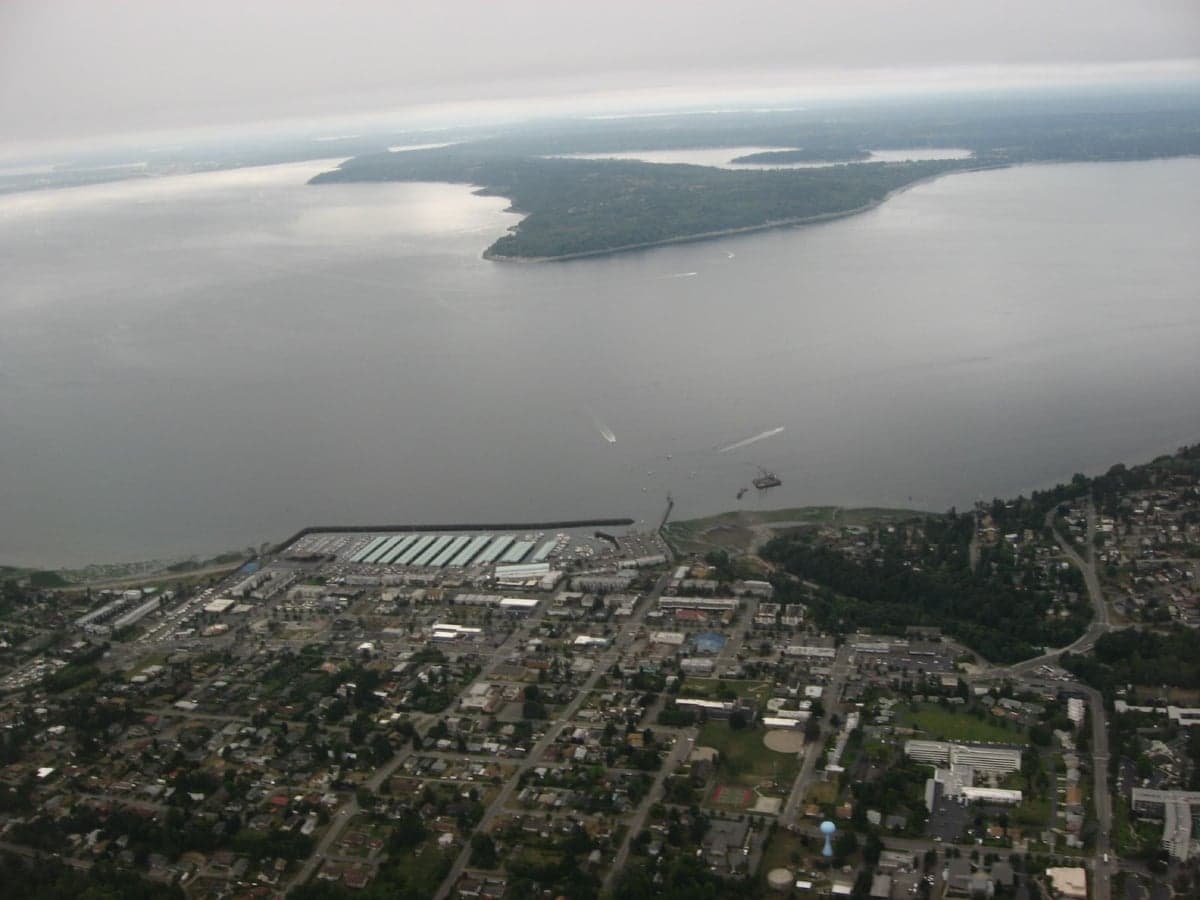
The people of Des Moines, Washington today form a dense, racially diverse working- and middle-class city of 32,545, distinct from its more affluent neighbors to the north and east. With a foreign-born population of 14.5%, the city is a notable landing point for immigrants and domestic migrants alike, creating a community where no single ethnic group holds a majority. This demographic character—rooted in a history of industrial labor, suburban expansion, and recent immigration—makes Des Moines one of the most ethnically varied cities in King County, a place where old fishing families, new Asian and Hispanic arrivals, and long-time white residents share a compact, waterfront-oriented town.
How the city was settled and grew
Des Moines was originally inhabited by the Duwamish and Muckleshoot peoples, but the city's recorded human history begins with American settlement in the 1860s, when homesteaders were drawn by the deep-water shoreline and abundant timber. The town was platted in 1889 and incorporated in 1959, growing slowly as a fishing and resort community through the early 20th century. The first major population wave came with the construction of the Des Moines Marina and the expansion of the fishing fleet, which attracted Scandinavian and Northern European immigrants—primarily Norwegian and Swedish families—who settled in the Marina District and along the Redondo Beach area. These groups built the city's early commercial core along Pacific Highway South and established the fishing cooperatives that defined the local economy into the 1960s. A second wave arrived during World War II, when the nearby Boeing plant in Renton and the Naval Air Station at Sand Point drew workers to the region; many of these workers, largely white Midwesterners and Southerners, settled in the Woodmont and North Hill neighborhoods, where modest single-family homes were built on former farmland.
Modern era (post-1965)
The 1965 Hart-Cellar Act and the subsequent diversification of immigration patterns reshaped Des Moines dramatically. Starting in the 1970s, the city became a destination for Southeast Asian refugees—Vietnamese, Cambodian, and Laotian families—fleeing the aftermath of the Vietnam War. These groups concentrated in the Midway and Kent-Des Moines Road corridor, where affordable apartment complexes and duplexes provided entry-level housing. By the 1990s, a second Asian wave brought Filipino and Korean immigrants, many working in healthcare and hospitality, who settled in the Marine View area near the waterfront. Simultaneously, Hispanic immigration—primarily from Mexico and Central America—accelerated after 2000, driven by construction and service-sector jobs in the broader Seattle-Tacoma metro. These families established a strong presence in the Pacific Ridge neighborhood and along the 216th Street corridor. Domestic in-migration also continued: white retirees from the Midwest and younger families priced out of Seattle moved into the Des Moines Creek area, drawn by lower home prices and proximity to Puget Sound. The result is a city where the white share fell from roughly 80% in 1980 to 45.9% today, while Hispanic (20.9%), Black (10.8%), and East/Southeast Asian (10.7%) populations grew substantially. The Indian subcontinent population remains small at 1.4%, concentrated in newer apartment developments near the transit center.
The future
The population of Des Moines is likely to continue diversifying, but at a slower pace than in the 1990s and 2000s. The city is approaching a demographic plateau: the foreign-born share (14.5%) is stable, and the Hispanic and Asian populations are growing primarily through births rather than new immigration. The city is not tribalizing into distinct enclaves—neighborhoods like Midway and Marine View are increasingly mixed, with Hispanic, Asian, and white families living side by side. However, economic stratification is emerging: the college-educated share (33.2%) is rising as new condos and townhomes near the marina attract professionals, while older single-family areas in North Hill and Woodmont remain more working-class. Over the next 10–20 years, Des Moines will likely become slightly more affluent and more educated, but will retain its multiethnic character as long as housing remains relatively affordable compared to Seattle and Bellevue. The biggest wildcard is redevelopment along the Kent-Des Moines Road corridor, where planned mixed-use projects could accelerate gentrification and shift the demographic balance toward younger, whiter, and more Asian professional households.
For a new resident, Des Moines offers a genuinely integrated, middle-class urban environment that is rare in the Puget Sound region. It is not a homogenizing suburb nor a segregated city—it is a place where multiple waves of settlement have layered on top of each other, creating a dense, walkable, and ethnically diverse community. The trade-off is that this diversity comes with modest public services and an older housing stock; the city is becoming more stable and slightly more upscale, but it remains a working-to-middle-class town at heart. For those seeking a racially and economically mixed community with direct waterfront access and a strong sense of local history, Des Moines is a compelling choice.

* Values derived from national, state, county, city and local statistics and may differ in a specific area. Last updated: 2026-04-21T11:06:47.000Z
Narrative content on this page is AI-generated and may contain mistakes. Verify any details that matter before acting on them.
ReloMaps may earn a commission from affiliate links at no extra cost to you.

