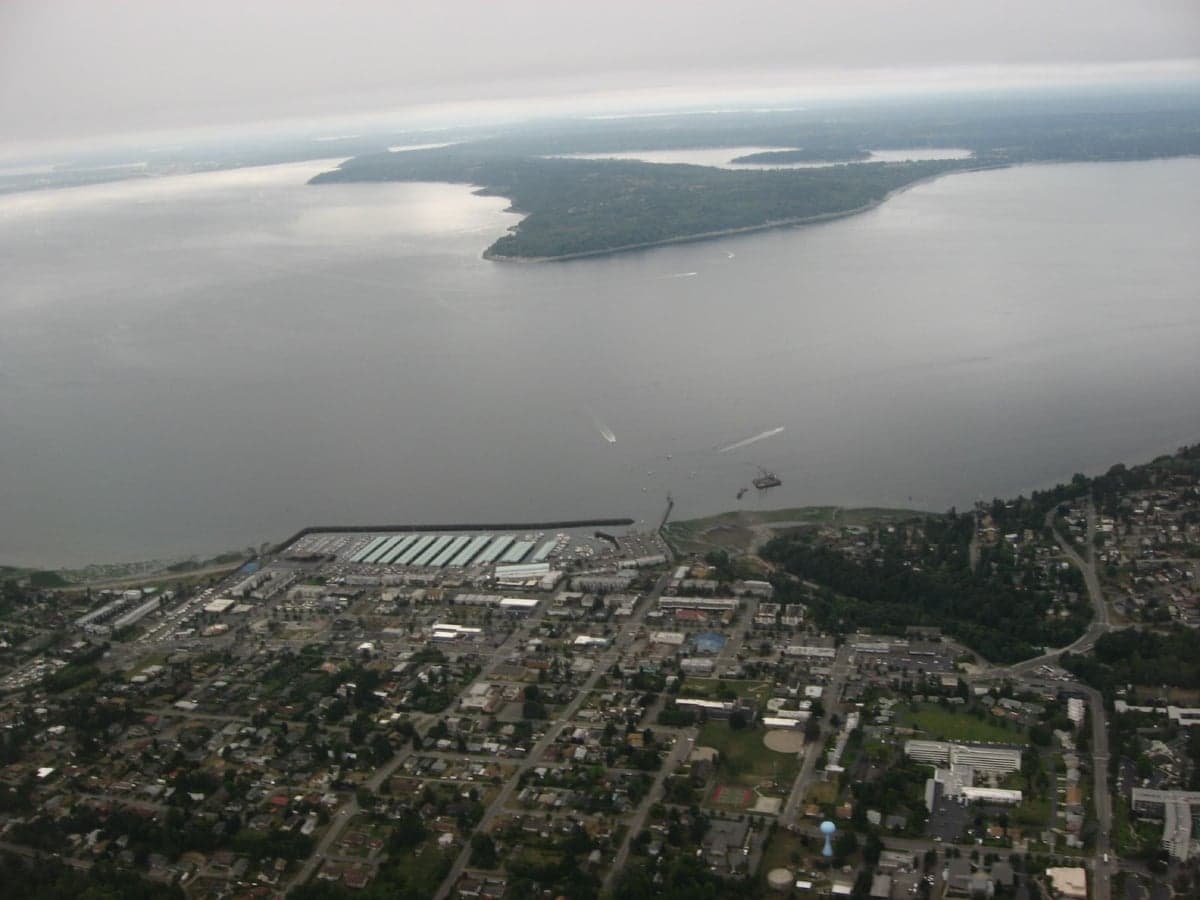
Photo: Wikipedia
Political ClimatePolitical Climate in Des Moines, WA
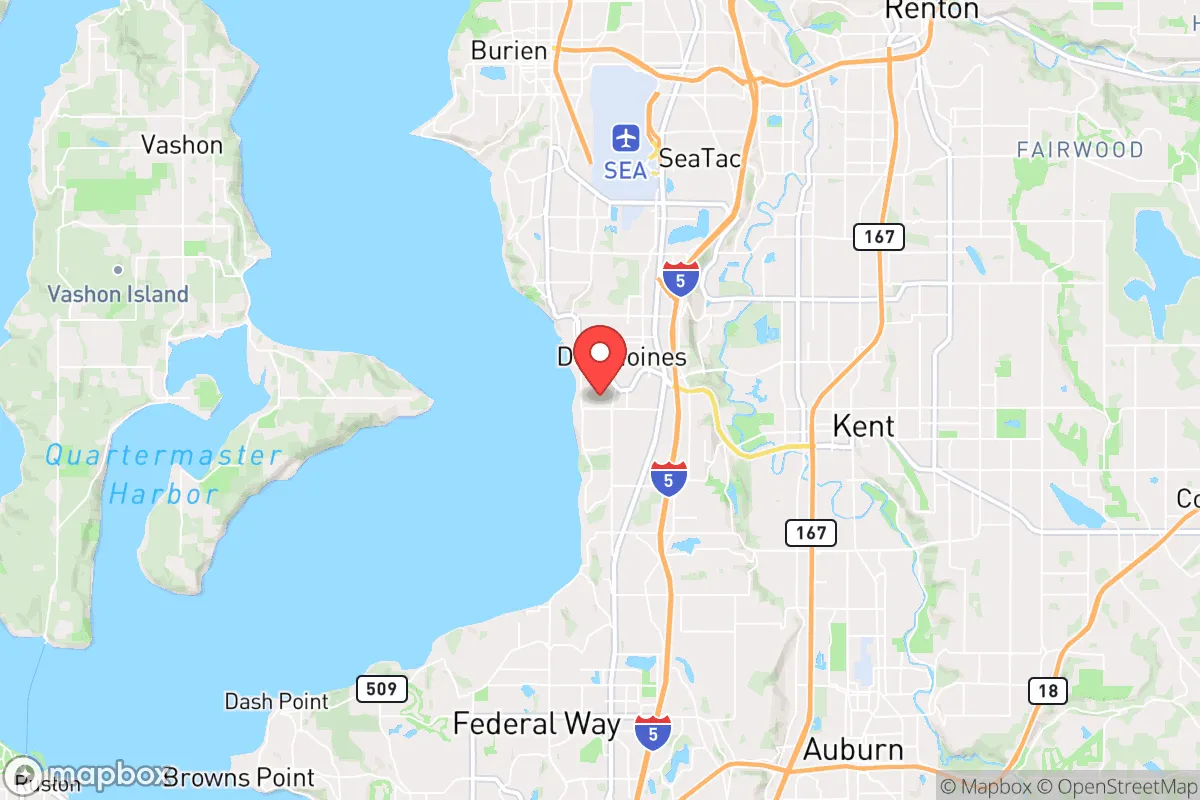
District shown is the primary district for this city’s centroid. Cities may span multiple districts.
Local Political AnalysisPolitical Analysis of Des Moines, WA
Des Moines, Washington, sits solidly in the blue column, with a Cook PVI of D+22 that tells you pretty much everything you need to know about the local voting patterns. This isn't a recent shift either—the city has been reliably Democratic for decades, but the intensity of that lean has cranked up noticeably since the early 2010s. If you're looking at a map of King County, Des Moines is part of that deep-blue coastal corridor that stretches from Seattle down through Tacoma, and the politics here reflect that regional identity more than any local independence.
How it compares
Drive 15 minutes east to Covington or Maple Valley, and you'll hit areas that are much more purple, sometimes even leaning red in local races. Head south another 10 miles to Federal Way, and you'll find a similar Democratic tilt but with a more moderate, working-class flavor. Des Moines itself has gotten noticeably more progressive over the last decade—what used to be a quiet, middle-class suburb with a mix of political views has become a place where city council meetings and school board decisions feel increasingly driven by activist priorities. The old-timers I know remember when local elections were about potholes and park maintenance; now it's all about equity initiatives and climate resolutions that seem to come straight from a Seattle playbook.
What this means for residents
For someone who values personal freedoms and limited government, living in Des Moines means watching your local government get more involved in your daily life every year. The city has adopted some of the most restrictive land-use and rental regulations in the region, making it harder for small landlords to operate and driving up costs for everyone. There's a growing push for police oversight boards and defunding certain public safety programs, which has made some longtime residents uneasy about response times and neighborhood safety. The school district has embraced progressive curriculum changes that prioritize social-emotional learning and critical race theory frameworks over traditional academics—something that's caused a quiet exodus of families to private schools or districts further east. Taxes and fees keep creeping up too, with new utility taxes and transportation levies that hit homeowners and small businesses hardest.
If you're considering a move here, you need to be honest with yourself about whether you're comfortable with a local government that sees its role as actively reshaping community values rather than just providing basic services. The political climate isn't hostile in a confrontational way—people are generally polite—but there's a cultural pressure to conform to progressive orthodoxy that can feel suffocating if you hold traditional views. I've seen neighbors stop putting up American flags or political yard signs because they don't want the hassle. The trajectory is clear: Des Moines is following Seattle's path, just a few years behind. For now, it's still a decent place to live if you keep your head down and focus on the waterfront and the parks, but don't expect the political winds to shift back anytime soon.

State Political ClimatePolitical Climate in Washington
State Political AnalysisPolitical Environment in the State
Washington State has shifted from a purple battleground to a solidly Democratic stronghold over the past two decades, with Democrats controlling the governorship, both legislative chambers, and both U.S. Senate seats since 2013. The state’s overall partisan lean is roughly D+8 to D+10 in presidential elections, but that top-line number hides a deeply fractured political geography. The real story is the accelerating divergence between the Seattle metroplex and the rest of the state, with King County alone casting about 30% of all votes and delivering margins of 70-80% for Democrats. For a conservative considering relocation, the key question isn’t whether Washington is liberal—it’s whether you can find a pocket where your values still have breathing room.
Urban vs. rural divide
The political map of Washington is essentially a tale of three regions. The Seattle-Tacoma-Bellevue corridor, anchored by King County, is the Democratic engine room—Seattle itself votes about 85% Democratic, while suburban Bellevue and Redmond have flipped from moderate Republican to solidly blue over the past decade as tech workers flooded in. The I-5 corridor south to Olympia and north to Everett follows suit, with Snohomish and Pierce counties trending leftward. Meanwhile, Eastern Washington—cities like Spokane, Yakima, and Tri-Cities (Kennewick, Pasco, Richland)—votes reliably Republican, often by 60-70% margins. The rural counties in the center and northeast, like Ferry and Stevens, are deep red, but their populations are tiny. The real battleground is the suburban ring around Seattle: King County’s Eastside (Issaquah, Sammamish) and Pierce County (Puyallup, Graham) used to be competitive but have shifted left as tech-adjacent professionals replace older farming and manufacturing communities. The 2022 gubernatorial race saw Democrat Jay Inslee win by 13 points, but Republican Loren Culp carried 32 of 39 counties—a stark illustration of the urban-rural chasm.
Policy environment
Washington’s policy landscape is a cautionary tale for conservatives. The state has no personal income tax, which sounds great, but it’s replaced by some of the highest sales taxes in the nation (state rate 6.5%, but local add-ons push it to 10%+ in Seattle) and a business gross receipts tax (B&O) that hits small businesses hard. Property taxes are moderate but rising fast due to levy lid lifts. The regulatory environment is aggressive: the state has a cap-and-trade program (Climate Commitment Act) that adds hidden costs to gas and energy, a long-term care payroll tax (WA Cares) that you can’t opt out of unless you have private insurance, and a strict gun control regime including a ban on standard-capacity magazines (10+ rounds) and an assault weapons ban passed in 2023. Education policy is dominated by teachers unions, with no school choice beyond a weak charter school law that was gutted by the state Supreme Court. Healthcare is heavily regulated, with a state-based insurance exchange and Medicaid expansion. Election laws are among the most liberal: universal mail-in voting (no ID required to register, but you do need to provide a signature), same-day registration, and no voter ID law—a system that conservatives view as ripe for fraud, though the state defends it as secure.
Trajectory & freedom
Washington is on a clear trajectory of expanding government control over personal freedoms. The 2023 legislative session was a watershed: the assault weapons ban (HB 1240) and magazine capacity limit (SB 5078) effectively ended legal purchase of many semi-automatic rifles for self-defense. The My Health My Data Act (2023) created new privacy protections but also gave the state attorney general broad enforcement powers over health data—including reproductive health data—that critics say could be used to track firearm purchases or religious exemptions. Parental rights took a hit with the 2023 “shield law” that protects providers performing gender-affirming care for minors from out-of-state legal action, effectively overriding parental consent laws from other states. On the economic freedom front, the 2024 minimum wage increase to $16.28/hour (Seattle’s is $19.97) and the paid family leave program (up to 12 weeks at 90% wage replacement) add costs for small businesses. The 2021 capital gains tax (7% on gains over $250,000) was upheld by the state Supreme Court in 2023, marking the first income tax in state history—a slippery slope conservatives fear will expand. Property rights are under pressure from the Growth Management Act, which forces cities to upzone for density, reducing single-family zoning in many suburbs.
Civil unrest & political movements
Washington has a history of visible political conflict. The 2020 CHOP/CHAZ occupation in Seattle’s Capitol Hill neighborhood—where protesters took over six city blocks for weeks, with police largely withdrawing—became a national symbol of progressive governance gone awry. The 2021-2022 “defund the police” movement saw Seattle cut police funding by 14%, though it was partially restored after crime spikes. On the right, the Washington State Republican Party has been fractured between moderates and Trump-aligned populists, with the 2022 gubernatorial candidate Loren Culp refusing to concede after losing by 13 points. The “sanctuary state” law (2019) limits local law enforcement cooperation with ICE, and the 2023 “Keep Washington Working” act further restricts immigration enforcement. Election integrity remains a flashpoint: the 2020 election saw King County initially report a 19% overvote in one precinct (later corrected), and the 2022 midterms had a ballot harvesting scandal in Spokane where a Republican operative was charged with illegally collecting ballots. The secession movement for a “Liberty State” in Eastern Washington has gained some traction but remains a fringe idea—the 2022 “State of Liberty” initiative got only 1% of signatures needed for the ballot.
Projection
Over the next 5-10 years, expect Washington to continue its leftward drift, driven by in-migration from California (the largest source of new residents) and the tech sector’s expansion into Spokane and Tri-Cities. The 2024 election saw Democrats hold the governorship (Bob Ferguson) and expand their legislative majorities, suggesting no course correction. The capital gains tax will likely expand to a broader income tax, and the cap-and-trade program will push energy costs higher. Gun control will tighten further—a permit-to-purchase law is on the horizon. The Growth Management Act will force more density in suburbs, reducing the appeal of places like Issaquah and Sammamish for families seeking space. The rural-urban divide will widen, with Eastern Washington becoming more politically isolated but also more economically tied to the state through renewable energy projects (wind, solar, and the Columbia River hydro system). For a conservative, the realistic outlook is that Washington will become less hospitable to traditional values, with the best bet being to find a red county (like Stevens or Ferry) or a purple suburb (like Puyallup or Bonney Lake) that still offers some buffer from Seattle’s policy reach.
Bottom line: Washington is a beautiful state with a strong economy, but it’s a high-control environment for conservatives. If you value low taxes, gun rights, school choice, and local control, you’ll find yourself swimming against a strong tide. The best strategy is to target a county like Spokane or Yakima where the local culture still leans red, but be prepared for state-level policies that will feel increasingly intrusive. It’s not impossible to live here as a conservative—many do—but it requires constant vigilance and a willingness to engage politically to slow the erosion of freedom.
* Values derived from national, state, county, city and local statistics and may differ in a specific area. Last updated: 2026-04-21T11:06:47.000Z
Narrative content on this page is AI-generated and may contain mistakes. Verify any details that matter before acting on them.
ReloMaps may earn a commission from affiliate links at no extra cost to you.

