

Photo: Wikipedia
Political ClimatePolitical Climate in Euclid, OH
District shown is the primary district for this city’s centroid. Cities may span multiple districts.
Local Political AnalysisPolitical Analysis of Euclid, OH
Look, I’ve lived in Euclid my whole life, and I’ll tell you straight: this city is about as blue as Lake Erie in a storm. The Cook PVI sits at D+28, which means Democrats hold a massive 28-point advantage over Republicans in presidential elections. That’s not just a lean—it’s a lock. And it’s been that way for decades, but the kind of blue has shifted. It used to be the old-school, union-card-carrying, “keep the government out of my garage” kind of Democrat. Now? It’s trending hard toward the progressive wing, and that’s got a lot of us long-timers worried about where our personal freedoms are headed.
How it compares
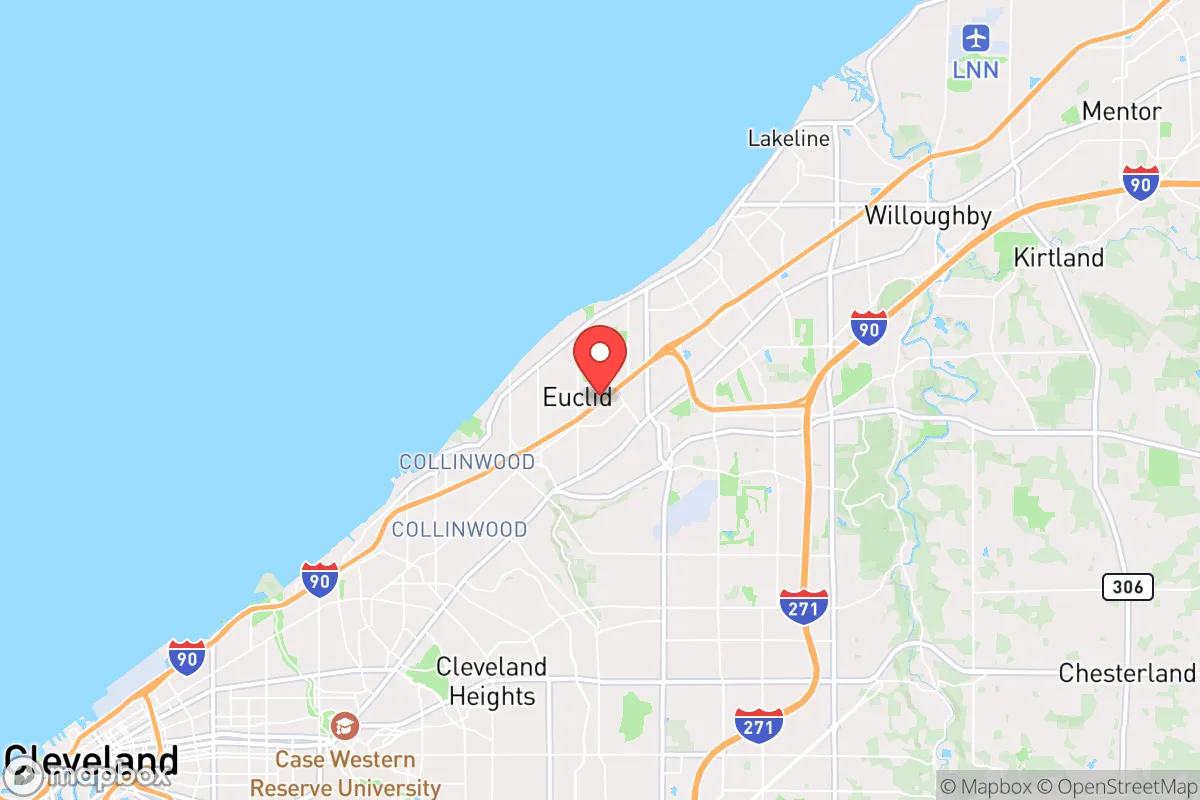
If you drive ten miles south to Mentor or Willoughby, you’ll hit a completely different political planet. Those Lake County suburbs lean Republican—Mentor’s Cook PVI is around R+8—and you can feel it in the lower taxes and the way the local government keeps its nose out of your business. Euclid, by contrast, is surrounded by Cleveland’s Cuyahoga County machine. Cleveland Heights and Shaker Heights are even further left than we are, with PVIs in the D+30 range. So Euclid sits in a weird spot: we’re the more “moderate” blue in a sea of deep blue, but that’s not saying much when your own PVI is D+28. The contrast with Mentor is stark—same region, same weather, but one place still believes in letting you keep more of your paycheck and run your life without a permit for everything.
What this means for residents
Practically speaking, that D+28 lock means you’re going to see a lot of one-party rule. And when one party runs the show for generations, you get policies that creep into your daily life. Property taxes here are among the highest in the county—we’re talking around 2.5% of assessed value—because the city keeps adding programs and services that sound good on paper but hit your wallet hard. There’s also been a push for more zoning regulations and business licensing requirements that make it harder to start a small side hustle or run a home-based business without jumping through hoops. The school board and city council have been leaning into progressive social policies, too, which is fine if you agree with them, but if you don’t, you’ve got no real opposition at the ballot box. Voter turnout in local primaries is often below 20%, so the loudest activist voices end up shaping policy for everyone else.
In the near term, I see Euclid staying deep blue—demographics and the Cleveland spillover guarantee that. But the long-term trend is worrying: more mandates, more fees, and less room for the kind of live-and-let-live attitude that made this a great place to raise a family in the ’80s and ’90s. If you value low taxes, minimal government interference, and a city that trusts you to make your own choices, you might want to look east toward Mentor or even south to Solon, where the PVI is more balanced (D+5) and the local government still remembers what “limited” means. Euclid’s a good town with good people, but the political machine here is grinding in a direction that’s hard to reverse.

State Political ClimatePolitical Climate in Ohio
State Political AnalysisPolitical Environment in the State
Ohio is a classic purple state with a recent red shift, having voted for Donald Trump by 8 points in both 2020 and 2024 after twice backing Barack Obama by small margins. The state’s political center of gravity has moved rightward over the past 15 years, driven by deindustrialization in the northeast and a growing cultural conservatism in rural and exurban areas. Today, Ohio’s Republican trifecta — a GOP governor, supermajority legislature, and conservative supreme court — reflects a state that is culturally Midwestern traditionalist but still contains deep blue urban pockets that keep it from being a deep red lock.
Urban vs. rural divide
The political map of Ohio is a study in stark contrasts. The three Cs — Cleveland, Columbus, and Cincinnati — are Democratic strongholds, with Cuyahoga County (Cleveland) delivering 66% for Biden in 2020 and Franklin County (Columbus) hitting 62%. But the rest of the state is overwhelmingly red. The rural southeast, along the Appalachian foothills, is deeply conservative, while the northwest farm counties like Mercer and Auglaize routinely vote 75-80% Republican. The real battlegrounds are the suburbs: Delaware County (north of Columbus) flipped from purple to solid red in 2020, while Hamilton County (Cincinnati) has trended blue as the city’s suburbs like Madeira and Montgomery have become more educated and affluent. The Mahoning Valley (Youngstown area) is a bellwether — it voted for Trump twice after supporting Obama twice, signaling the region’s complete realignment from union Democrat to populist Republican.
Policy environment
Ohio’s policy environment is broadly conservative but with notable exceptions. The state has a flat income tax of 3.5% (down from 4.8% in 2020), with a phaseout to 2.75% by 2026 — a clear win for fiscal conservatives. Property taxes are moderate, averaging 1.5% of home value, but local school levies can push them higher. The regulatory climate is business-friendly, with right-to-work laws (though not a full right-to-work state) and minimal zoning restrictions outside major cities. On education, Ohio has a robust school choice program: the EdChoice scholarship allows students in underperforming districts to attend private or charter schools, and the state’s voucher program is one of the most expansive in the Midwest. However, the state also has a high sales tax (5.75% state plus local add-ons, often exceeding 8% in cities) and a Medicaid expansion under the Affordable Care Act that remains in place despite GOP control. Election laws have tightened: voter ID is now required (photo ID only, no utility bills), and drop boxes are limited to one per county — a change that passed along party lines in 2023.
Trajectory & freedom
Ohio’s trajectory on personal freedom is mixed but trending positive for conservatives. The biggest win was the 2022 passage of constitutional carry (permitless carry of a concealed handgun), making Ohio the 23rd state to adopt the policy. The Parental Bill of Rights (HB 8, signed in 2023) requires schools to notify parents of any curriculum involving sexuality or gender identity and gives parents the right to opt their children out. On medical freedom, Ohio banned COVID-19 vaccine mandates for state employees and contractors in 2023, and the state’s Health Care Freedom Amendment (passed in 2011) prohibits any law forcing individuals to participate in a health care system. However, the 2023 ballot issue enshrining abortion access in the state constitution (Issue 1, passed with 57%) was a major setback for pro-life advocates, and the state’s smoking ban (2006) and mask mandates during COVID remain points of contention. Property rights are strong: Ohio has no statewide rent control, and the Stand Your Ground law (2021) expanded self-defense protections. The state’s Right to Farm law (2018) protects agricultural operations from nuisance lawsuits, a boon for rural landowners.
Civil unrest & political movements
Ohio has seen its share of political flashpoints. The 2020 protests in Columbus and Cincinnati after George Floyd’s death were large but largely peaceful, though the Columbus protests saw property damage and a heavy police response. The East Palestine train derailment in 2023 became a national political flashpoint, with local residents furious at both the railroad company and the federal response — a sentiment that fueled anti-establishment anger across the state. The Ohio Statehouse in Columbus has been a site of recurring protests, from the 2023 abortion rights rallies to the 2024 “Parents’ Rights” rallies against school curriculum. Immigration politics are less heated than in border states, but the Springfield area (Clark County) saw a surge of Haitian migrants in 2023-2024, leading to local tensions and a state-level push for stricter enforcement. Election integrity remains a live issue: the 2020 election in Ohio was smooth, but the 2023 special election on Issue 1 (which would have raised the threshold for constitutional amendments to 60%) was seen by conservatives as a necessary safeguard and by progressives as a power grab. The measure failed, but the debate exposed deep distrust in the process.
Projection
Over the next 5-10 years, Ohio is likely to become more Republican, but not overwhelmingly so. In-migration from blue states (especially California and Illinois) is modest but growing, with Columbus and Cincinnati suburbs absorbing most of it. These newcomers tend to be moderate to conservative on economics but socially liberal, which could soften the state’s edge on cultural issues. The rural population is aging and shrinking, while the urban cores are growing slowly. The big unknown is the Mahoning Valley and Youngstown — if the region’s Trump-era realignment holds, the state’s red lean will solidify. If it reverts, Ohio could become a true swing state again. The state’s fiscal health is strong (a $3 billion surplus in 2024), which will likely fund further tax cuts. Expect continued fights over school funding (the state’s system was ruled unconstitutional in 2023) and abortion access (a 2024 ballot initiative to ban abortion at 15 weeks failed, but the issue is not settled). The parental rights movement will likely push for further restrictions on classroom content, and gun rights are unlikely to be rolled back.
For a conservative moving to Ohio, the bottom line is this: you’ll find a state that respects your gun rights, keeps taxes low, and gives you control over your kids’ education. The cities are blue but manageable, the suburbs are purple-to-red, and the countryside is deep red. You’ll have to deal with a state income tax (for now) and a sales tax that bites, but the cost of living is low and the regulatory environment is light. The political fights are real — especially around abortion and school curriculum — but Ohio is a place where conservatives can win and where your vote actually counts. If you’re looking for a state that’s trending in the right direction without being a culture war battlefield every day, Ohio is a solid bet.
* Values derived from national, state, county, city and local statistics and may differ in a specific area. Last updated: 2026-04-21T20:19:19.000Z
Narrative content on this page is AI-generated and may contain mistakes. Verify any details that matter before acting on them.
ReloMaps may earn a commission from affiliate links at no extra cost to you.

