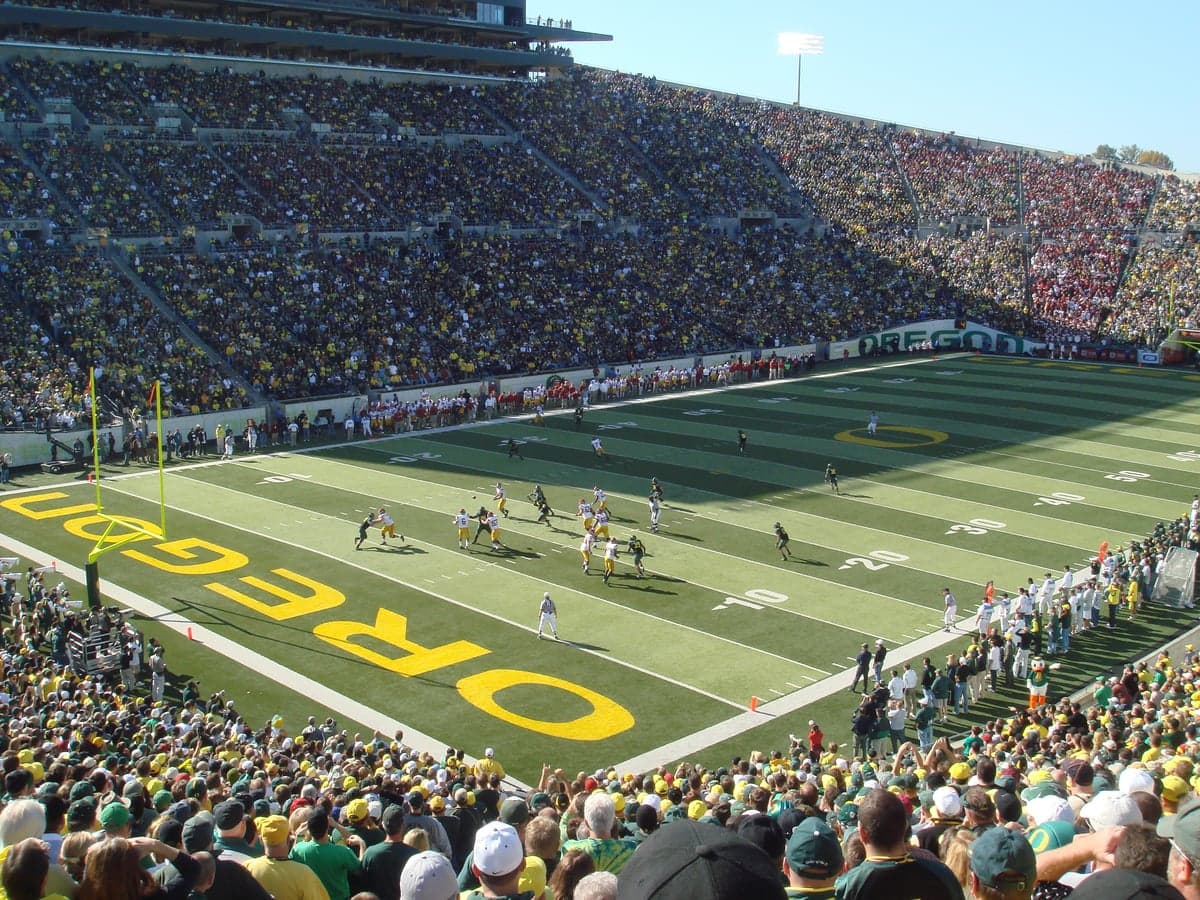
Photo: Wikipedia
Political ClimatePolitical Climate in Eugene, OR
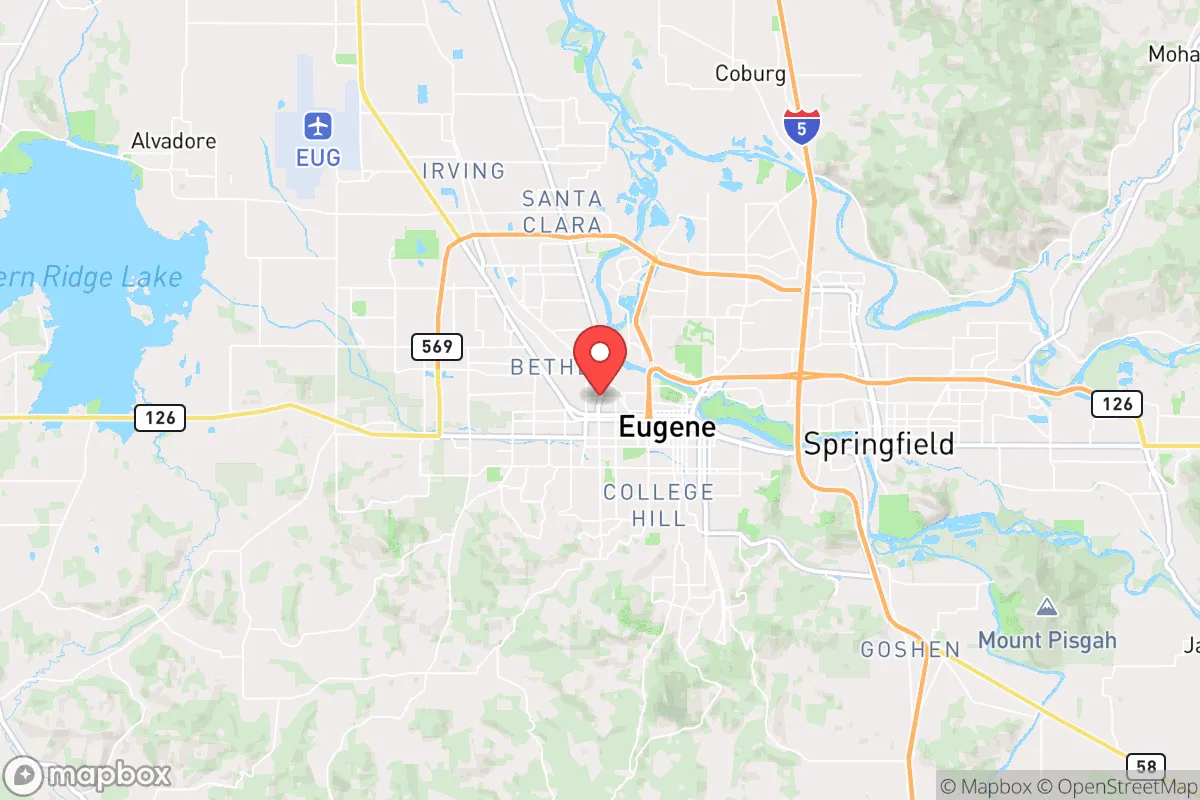
District shown is the primary district for this city’s centroid. Cities may span multiple districts.
Local Political AnalysisPolitical Analysis of Eugene, OR
Eugene, Oregon, is a place where the political pendulum has swung hard to the left, and it keeps going. The Cook PVI rating of D+6 tells you the baseline, but it doesn't capture the full story. This town has shifted from a quirky, live-and-let-live community into a place where progressive orthodoxy feels less like a choice and more like a requirement. If you value personal freedoms, especially the kind that don't align with the current political agenda, you'll want to pay close attention to how things have changed and where they're headed.
How it compares
Drive just 20 miles north to Springfield, and you'll find a different world. While Eugene is solidly blue, Springfield has held onto a more balanced, independent streak—it's not a conservative stronghold, but it's far less likely to impose the same level of ideological conformity. Head east into the Willamette Valley's rural towns like Creswell or Cottage Grove, and you'll find communities that still value self-reliance and are deeply skeptical of the kind of top-down governance Eugene embraces. Even within Lane County, the contrast is stark: Eugene's city council and county commission are dominated by progressive voices, while the outlying areas often feel like they're fighting a rearguard action against policies that prioritize social engineering over practical outcomes. The difference isn't just political—it's cultural. In Eugene, you're expected to signal the right values; in the surrounding towns, people are more concerned with whether you can fix your own fence.
What this means for residents
For a long-time resident like me, the most concerning shift is how government overreach has become normalized. It started with small things—bans on plastic bags, then on natural gas in new homes, then on certain types of leaf blowers. Now, it's a full-blown regulatory machine. The city has aggressively pursued zoning changes that make it harder to own a single-family home without jumping through bureaucratic hoops. There's a constant push for "equity" policies that often translate into preferential treatment for certain groups, which feels a lot like the government picking winners and losers. Property taxes have climbed steadily, and new fees pop up for everything from stormwater to transportation. The idea that your home is your castle? That's fading fast. You're increasingly expected to conform to a collective vision, and if you don't, you're seen as part of the problem. The local school board and city council are full of people who see their role as reshaping society, not just managing services.
Looking ahead, I don't see this trend reversing. The next few years will likely bring more restrictions on how you can use your land, what you can drive, and even what you can say if it doesn't fit the approved narrative. The city's push for "sanctuary" policies and its willingness to defy state and federal laws on issues like drug decriminalization show a pattern of prioritizing ideology over public safety and personal accountability. If you're considering a move here, ask yourself: are you comfortable with a government that sees your personal choices—from your energy source to your lawn care—as matters for public debate and regulation? Because that's the reality in Eugene today. It's a beautiful place with a strong sense of community, but that community comes with a price tag on your freedom.

State Political ClimatePolitical Climate in Oregon
State Political AnalysisPolitical Environment in the State
Oregon has shifted from a purple swing state to a reliably blue stronghold over the past two decades, with Democrats controlling every statewide office and both legislative chambers since 2018. The state’s overall partisan lean is now roughly D+10 in presidential elections, but that number hides a brutal urban-rural civil war that makes living here feel like two different countries. For a conservative-leaning individual or family, the trajectory is concerning: Portland and the Willamette Valley drive the state’s politics, while eastern and southern Oregon counties vote red but have almost no statewide power.
Urban vs. rural divide
The political map of Oregon is a tale of two landscapes. The I-5 corridor from Portland down through Salem and Eugene is the Democratic engine, with Multnomah County (Portland) alone delivering a 40-point margin for Biden in 2020. Meanwhile, rural counties like Lake, Harney, and Malheur routinely vote 70-80% Republican. The real battlegrounds are the suburban and exurban counties that have flipped blue in recent cycles: Washington County (suburban Portland) went from purple to solid blue, and Deschutes County (Bend) flipped from red to blue in 2020 after decades of GOP dominance. Clackamas County, once a conservative stronghold, now votes Democratic in statewide races. The only reliably red metro area is Medford in Jackson County, but even there, Ashland (home of Southern Oregon University) pulls the county leftward. If you’re looking for a conservative community, your best bets are the rural towns of Grants Pass, Roseburg, Pendleton, and Baker City — but be prepared for long drives to any major services.
Policy environment
Oregon’s policy environment is a case study in progressive governance that many conservatives find alarming. The state has no sales tax, but income taxes are among the highest in the nation — top marginal rate hits 9.9% for individuals, and property taxes are moderate but rising. The regulatory climate is hostile to business: Portland’s urban growth boundary restricts development, and the state’s land-use planning system (SB 100) gives the government near-total control over where you can build. Education policy is dominated by teachers’ unions, with Portland Public Schools spending over $20,000 per student but producing mediocre outcomes. Healthcare is heavily regulated, with a state-run insurance exchange and Medicaid expansion that covers nearly 30% of residents. Election laws are among the most liberal: Oregon was the first state to vote entirely by mail, and automatic voter registration is the norm. There’s no voter ID requirement, which conservatives view as a vulnerability. The state also has a “sanctuary” law (ORS 181A.820) that prohibits local law enforcement from cooperating with federal immigration authorities — a flashpoint for many.
Trajectory & freedom
Oregon is becoming less free by almost any conservative measure. The 2021 legislative session was a disaster for personal liberty: the state passed a law (HB 2002) that effectively decriminalized drug possession for personal use, though it was partially rolled back in 2024 after public outcry. Gun rights have been under constant assault: Measure 114, passed by voters in 2022, requires a permit to purchase a firearm, bans magazines over 10 rounds, and mandates a waiting period — though it’s currently tied up in court. Parental rights took a hit with the 2019 “Student Success Act” that gave schools broad authority over sex education without parental opt-out. Medical autonomy is restricted: Oregon has legalized assisted suicide (Death with Dignity Act) but has some of the strictest vaccine mandates in the country, including a near-total ban on religious exemptions for schoolchildren. Property rights are weak: the state’s land-use laws mean you can’t build a fence or add a shed without county approval in many areas. The only bright spot for conservatives is that Oregon has no income tax on Social Security benefits, which attracts retirees.
Civil unrest & political movements
Portland became a national symbol of civil unrest during the 2020 protests, with the federal courthouse under siege for months and the city’s leadership refusing to call in the National Guard. The “Wall of Moms” and antifa clashes made headlines, and the city still sees periodic protests over police funding and homelessness. On the right, the “III%” militia movement has a presence in rural areas, and the “People’s Rights” network (founded by Ammon Bundy, who led the 2016 Malheur National Wildlife Refuge occupation) has chapters in eastern Oregon. Immigration politics are tense: Portland is a sanctuary city, and the state’s “sanctuary” law has led to clashes with ICE. There’s a growing “Greater Idaho” movement in eastern Oregon counties that want to secede and join Idaho, citing cultural and political alienation — 13 counties have passed measures supporting the idea, though it’s legally impossible without both state legislatures agreeing. Election integrity is a hot-button issue: Oregon’s mail-in system has been criticized by conservatives for lack of signature verification and ballot harvesting concerns, though no major fraud has been proven.
Projection
Over the next 5-10 years, Oregon will likely become more progressive as the Portland metro area continues to grow and rural counties lose population. The 2020 census gave Oregon a sixth congressional seat, which will likely be drawn to favor Democrats. In-migration from California is a double-edged sword: many newcomers are fleeing high taxes and housing costs, but they often bring the same voting habits that made California unaffordable. The Greater Idaho movement will remain a symbolic protest but won’t succeed. Expect more gun control, higher taxes (possibly a sales tax), and continued erosion of parental rights in education. The homelessness crisis in Portland and Eugene will worsen without policy changes. For a conservative family, the best long-term bet is to look at Redmond, Prineville, or La Grande — small towns with conservative values and lower costs, but with limited job opportunities and long drives to airports or hospitals.
Bottom line for a new resident: Oregon is a beautiful state with stunning natural landscapes, but the political climate is hostile to conservative values. If you’re moving here, expect to pay high taxes, deal with restrictive regulations, and live in a state where your vote for statewide office will likely be canceled out by Portland. The best strategy is to choose a rural county where local government is still conservative, and accept that you’ll be fighting an uphill battle at the state level. If you value personal freedom, low taxes, and a government that stays out of your life, Oregon is probably not the right fit — unless you’re willing to be a political minority and enjoy the scenery.
* Values derived from national, state, county, city and local statistics and may differ in a specific area. Last updated: 2026-05-02T08:40:01.000Z
Narrative content on this page is AI-generated and may contain mistakes. Verify any details that matter before acting on them.
ReloMaps may earn a commission from affiliate links at no extra cost to you.

