Photo: Wikipedia
Demographics of Fall River, MA
Affluence Level in Fall River, MA
A below-average socioeconomic profile. Incomes, home values, and educational attainment trail the U.S., with higher poverty and unemployment.
People of Fall River, MA
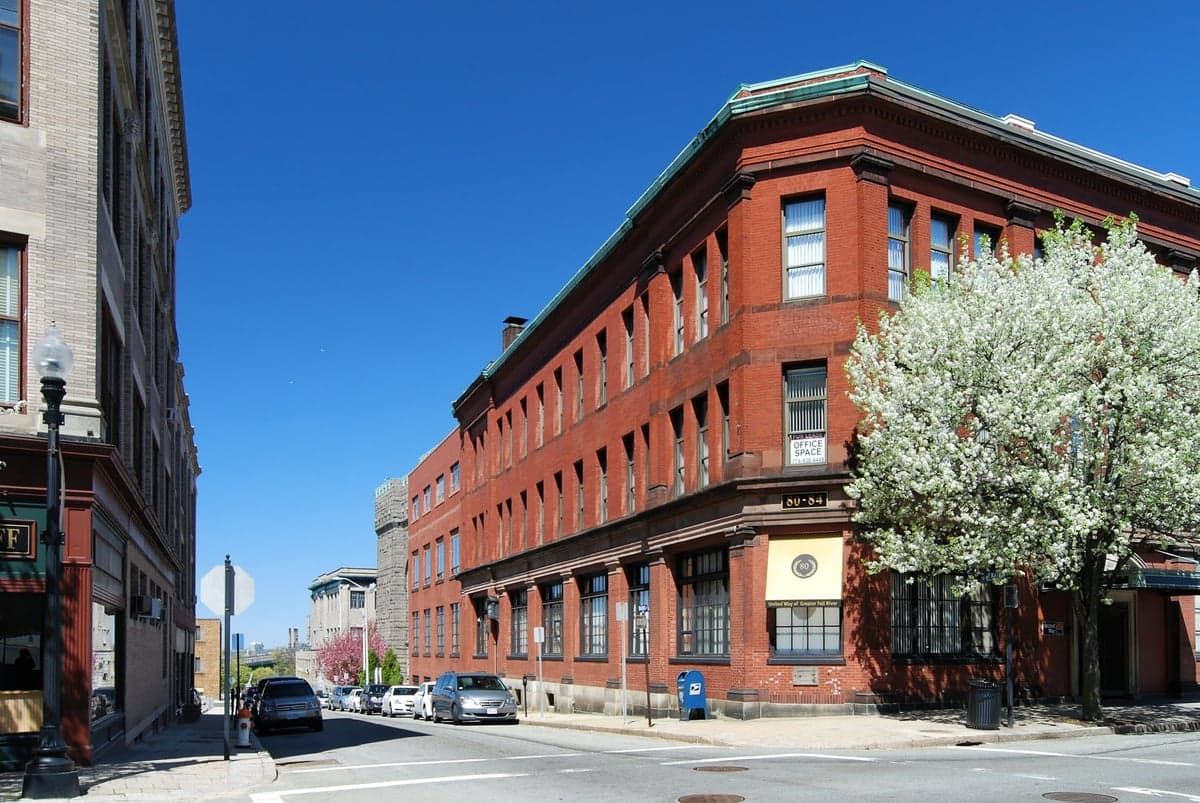
The people of Fall River, Massachusetts, today number 93,764, forming a dense, historically rooted, and predominantly white working-class city with a notable Portuguese-American identity. The population is older and less educated than the state average—only 16.8% hold a college degree—and is marked by a significant Hispanic minority (13.2%) and smaller Black (5.5%) and East/Southeast Asian (2.4%) communities. Distinctive markers include a strong sense of ethnic neighborhood identity, a high rate of homeownership among older residents, and a population that has been slowly declining since its 1920s peak of over 120,000.
How the city was settled and grew
Fall River’s population history is a story of industrial migration. The city was originally settled by English colonists in the 17th century, but its explosive growth began in the early 1800s with the rise of cotton textile manufacturing along the Quequechan River. The first major wave of immigrants were Irish, who arrived in the 1840s and 1850s to build the mills and dig the canals, settling in the Highlands and Pleasant Street neighborhoods. They were followed by French-Canadians in the 1860s and 1870s, who clustered in the South End around St. Anne’s Church. The defining wave came between 1880 and 1920, when tens of thousands of Portuguese immigrants—first from the Azores and later from mainland Portugal—arrived to work in the textile mills. They established a strong presence in Flint Village and the North End, building the city’s largest ethnic enclave, which remains today. Smaller numbers of Polish, Italian, and Jewish immigrants also settled in the Maplewood and South End areas during this period. By 1920, Fall River was one of the most densely populated cities in the United States, with a population of over 120,000.
Modern era (post-1965)
The post-1965 era brought significant demographic change as the textile industry collapsed, leading to a population decline of roughly 25% from its peak. The 1965 Hart-Cellar Act opened immigration from new regions, but Fall River’s foreign-born population today is only 10.0%, lower than the national average. The most notable post-1965 shift has been the growth of the Hispanic community, primarily Puerto Rican and Dominican, who have settled in the South End and Pleasant Street corridors, areas that once housed earlier immigrant waves. The Black population (5.5%) is concentrated in the North End and parts of Flint Village, while East/Southeast Asian communities (2.4%), largely Cambodian and Vietnamese, have established a small but visible presence in the Maplewood area. The Indian-subcontinent population remains negligible at 0.3%. White flight to surrounding suburbs like Tiverton and Somerset has been modest but steady since the 1970s, leaving the city’s white population at 69.5%, down from over 95% in 1970. The Portuguese-American community, while still the largest ethnic group, has aged and begun to assimilate, with younger generations often moving to the suburbs.
The future
The population of Fall River is likely to continue its slow decline, with projections suggesting a drop below 90,000 by 2035. The city is not homogenizing but rather tribalizing into distinct enclaves: the Portuguese-American core in the North End and Flint Village remains strong but aging, while the Hispanic population in the South End is growing and younger. The East/Southeast Asian community is small and stable, with little new immigration expected. The Black population is plateauing. The biggest wildcard is the potential for redevelopment of the former mill buildings and the new commuter rail connection to Boston, which could attract younger, more educated residents—but the city’s low college attainment rate (16.8%) and weak job market make a major influx unlikely. The next 10-20 years will likely see a continued shift toward a more Hispanic and older white population, with the Portuguese-American identity slowly fading as a political and cultural force.
For someone moving in now, Fall River is becoming a more diverse but still predominantly white, working-class city with a strong sense of neighborhood identity. The city offers affordable housing and a dense, walkable urban fabric, but the population is aging and the economy remains tied to healthcare, education, and retail rather than a single dominant industry. New arrivals will find a place where ethnic enclaves still matter, and where the future is likely to be more Hispanic and less Portuguese than the past.

* Values derived from national, state, county, city and local statistics and may differ in a specific area. Last updated: 2026-04-19T06:06:07.000Z
Narrative content on this page is AI-generated and may contain mistakes. Verify any details that matter before acting on them.
ReloMaps may earn a commission from affiliate links at no extra cost to you.

