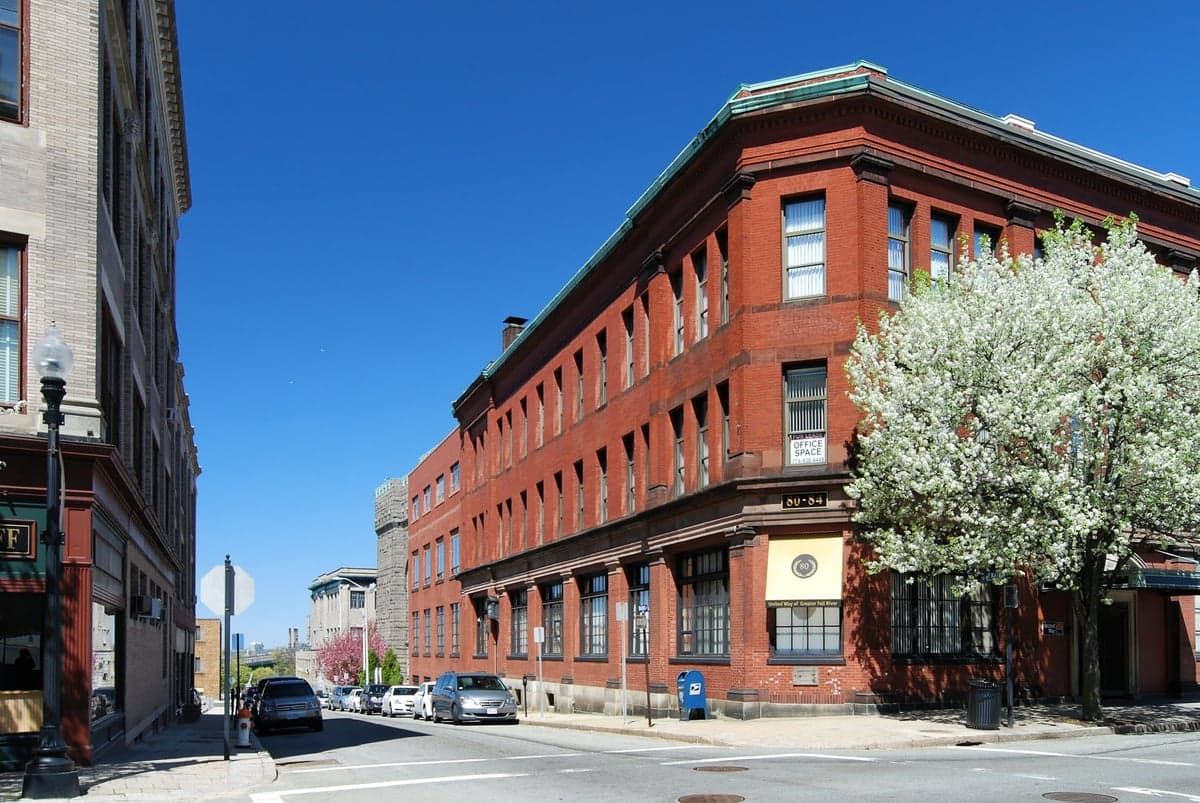
Photo: Wikipedia
Personal Sovereignty in Fall River, MA
Moderate friction. Expect trade-offs in some aspect of personal liberty and independence.
What does Personal Sovereignty tell us?
Personal Sovereignty measures your capacity for self-reliance and independence with minimal government friction. Higher scores mean fewer barriers between you and the way you want to live... but it assumes you have the space you need and good neighbors.
What does this tell us?
Personal Sovereignty measures your capacity for self-reliance and independence with minimal government friction. Higher scores mean fewer barriers between you and the way you want to live... but it assumes you have the space you need and good neighbors.
State Policy
Energy independence: Importer (5% of energy produced in-state)
Personal Liberty
Homesteading

Personal Liberty Analysis
Fall River, Massachusetts, presents a complex and often contradictory environment for personal sovereignty, one where the tangible benefits of a lower cost of entry and a resilient, blue-collar ethos are constantly weighed against the aggressive reach of a deep-blue state government. For the strategic relocator with a survivalist or prepper mindset, the city offers a unique paradox: a place where you can own a solid, older home on a decent lot for a fraction of the cost of Boston, yet live under some of the most restrictive state-level laws in the nation regarding self-defense, taxation, and personal medical choice. The key to navigating this landscape is understanding that your autonomy will be a constant negotiation between the practical, self-reliant culture of the city itself and the top-down mandates emanating from Beacon Hill.
Tax burden and regulatory posture: the cost of doing business with the state
Massachusetts is a high-tax, high-regulation state, and Fall River is not exempt from this reality. The state imposes a flat 5% income tax on all earned income, which, while not progressive, is a fixed cost on your labor. More impactful for property owners is the state’s reliance on property taxes. While Fall River’s residential tax rate is often lower than that of its immediate suburbs, the state’s overall property tax burden is consistently ranked among the top ten in the nation. This is a direct, recurring claim on your wealth and a significant factor in long-term financial sovereignty. The regulatory posture is equally challenging. The state’s strict building codes, environmental regulations (like Title 5 for septic systems), and the notorious Massachusetts General Laws Chapter 40B (the "anti-snob zoning" law) create a dense thicket of bureaucracy. For anyone looking to build a self-sufficient homestead or even a simple workshop, expect permitting delays, fees, and state-level oversight that can stifle projects. The state’s regulatory climate is fundamentally hostile to the "do-it-yourself" ethos, demanding that you pay for professional stamps and approvals at nearly every turn. This is a direct erosion of personal agency, turning what should be a simple act of improvement into a bureaucratic ordeal.
Self-defense and gun law specifics: navigating a hostile legal landscape
This is the single most critical area of concern for the survivalist-minded individual in Fall River. Massachusetts has some of the most restrictive gun laws in the United States, and they are aggressively enforced. The state requires a License to Carry (LTC) for any handgun possession, and the issuing authority—the Fall River Police Department—has significant discretion. While the city is generally more permissive than Boston or Cambridge, the process is invasive, requiring a background check, fingerprints, a state-approved safety course, and a "suitable person" determination. The state’s "assault weapons" ban is broad and poorly defined, effectively banning many common semi-automatic rifles and standard-capacity magazines. Magazine capacity is legally limited to ten rounds for long guns and ten for handguns. There is no legal "stand your ground" doctrine; Massachusetts imposes a "duty to retreat" in public before using deadly force, even if you are lawfully present. This fundamentally alters the calculus of self-defense. While you can legally own firearms for home defense, the legal framework is designed to make carrying them for personal protection outside the home a heavily regulated privilege, not a right. For the prepper, this means your ability to defend your family and property is legally constrained in ways that would be unthinkable in a state like New Hampshire or Texas. Stockpiling ammunition or building a defensive capability is not just a matter of cost, but of navigating a legal minefield where a single mistake can result in felony charges.
Self-reliance and homesteading viability: lot sizes, zoning, and off-grid feasibility
Fall River offers a mixed bag for the aspiring homesteader. The city is densely built out, with many homes on small lots of 5,000 to 10,000 square feet. This makes large-scale gardening, keeping livestock, or installing a significant solar array difficult. Zoning is strictly residential, and the city’s health department has clear rules against keeping chickens, goats, or other "farm animals" on standard residential lots. True off-grid living is virtually impossible within city limits. The city requires connection to municipal water and sewer, and building codes mandate grid-tied electrical systems. However, the city’s older housing stock—particularly the triple-deckers and mill houses—often have large, unfinished basements and attics that can be converted into root cellars, workshop space, or emergency storage. The real opportunity lies in the city’s industrial past. There are still pockets of light-industrial and mixed-use zoning where a savvy buyer could acquire a small warehouse or commercial space for a fraction of the cost of a suburban home. These spaces, while requiring a commercial permit, offer far more latitude for installing backup generators, water storage, and workshop equipment. The key is to look for properties in the city’s "opportunity zones" or along the waterfront, where zoning is more flexible. For the prepper, the strategy is not to create a self-sufficient farm, but to build a resilient urban redoubt: a secure, well-stocked home with redundant systems, located in a dense, walkable neighborhood where you can build community ties.
Personal liberties: parental rights, medical autonomy, speech, and property
On paper, Massachusetts is a state that aggressively curtails personal liberties in favor of state authority. Parental rights are under constant pressure from the state’s Department of Children and Families (DCF), which has a reputation for being overzealous and quick to intervene in family matters. The state has also mandated controversial curricula in public schools, including comprehensive sex education and social-emotional learning programs that many conservative parents find objectionable. Medical autonomy is severely limited. The state has some of the strictest vaccine mandates in the country, and during the COVID-19 pandemic, it was one of the most aggressive in imposing lockdowns, mask mandates, and vaccine passports. The right to refuse medical treatment is legally constrained, particularly for children. Free speech is protected by the First Amendment, but the state has a "hate crimes" law that can be used to prosecute speech deemed to incite violence or intimidation, and the state’s public university system has robust "speech codes" that can chill expression. Property rights are the most robust of the bunch, but even they are subject to the state’s powerful eminent domain authority, as seen in the city’s ongoing waterfront redevelopment projects. In practice, the culture of Fall River is more libertarian than the state’s laws suggest. People tend to mind their own business, and the city’s working-class roots mean there is a general distrust of government overreach. However, the legal framework is a sword of Damocles, and any conflict with state authorities—over a child’s education, a medical decision, or a building permit—can quickly escalate into a costly legal battle.
In the final analysis, Fall River offers a low barrier to entry for those seeking a base of operations in the Northeast, but it demands a high level of legal vigilance and strategic adaptation. Your personal sovereignty here is not a given; it is something you must actively defend against a state government that views individual autonomy as a threat to its own authority. Compared to a state like New Hampshire, where the ethos of "Live Free or Die" is enshrined in law and culture, Fall River is a place of constant friction. For the survivalist, this means your energy will be spent not just on stockpiling supplies and building skills, but on navigating a hostile legal environment. The city’s greatest asset is its resilient, self-reliant community and its affordable, solid housing stock. Its greatest liability is the state government that controls its destiny. If you are willing to fight for your freedoms on a daily basis, Fall River can be a viable, if challenging, outpost. If you want a place where the law is on your side from the start, look elsewhere.

* Values derived from national, state, county, city and local statistics and may differ in a specific area. Last updated: 2026-04-19T06:06:07.000Z
Narrative content on this page is AI-generated and may contain mistakes. Verify any details that matter before acting on them.
ReloMaps may earn a commission from affiliate links at no extra cost to you.

