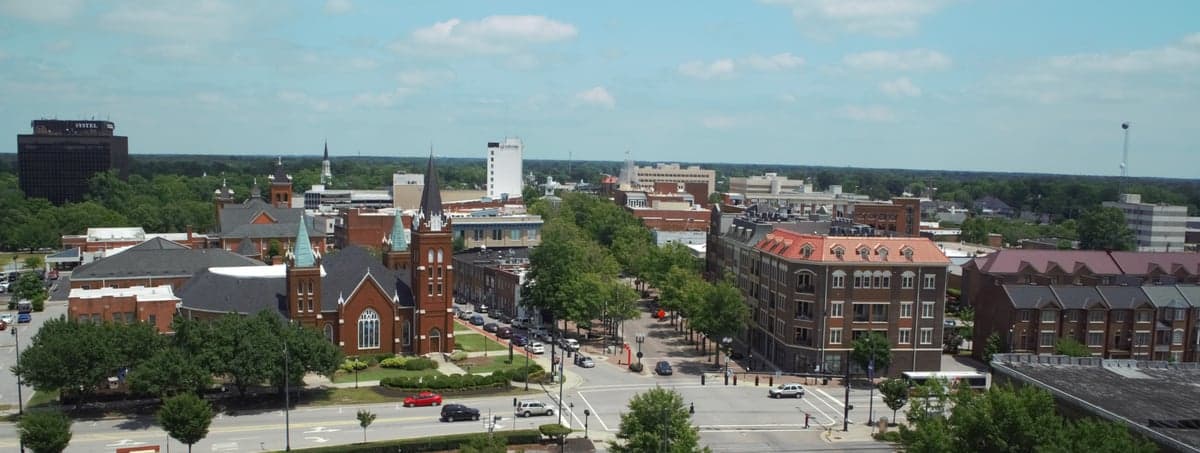
Photo: Wikipedia
Personal Sovereignty in Fayetteville, NC
Viable for self-reliance. Generally workable, though some barriers may limit total independence.
What does Personal Sovereignty tell us?
Personal Sovereignty measures your capacity for self-reliance and independence with minimal government friction. Higher scores mean fewer barriers between you and the way you want to live... but it assumes you have the space you need and good neighbors.
What does this tell us?
Personal Sovereignty measures your capacity for self-reliance and independence with minimal government friction. Higher scores mean fewer barriers between you and the way you want to live... but it assumes you have the space you need and good neighbors.
State Policy
Energy independence: Importer (15% of energy produced in-state)
Personal Liberty
Homesteading

Personal Liberty Analysis
Fayetteville, North Carolina, offers a mixed bag for those prioritizing personal sovereignty, with the state’s generally favorable legal framework partially offset by the city’s military-dependent economy and local governance quirks. As a prepper or survivalist, you’ll find North Carolina’s constitutional carry law, low property taxes, and right-to-farm protections appealing, but you’ll need to navigate Fayetteville’s higher crime rates and zoning restrictions that can limit off-grid ambitions. The city’s proximity to Fort Bragg (now Fort Liberty) means a transient population and federal presence, which can both bolster and challenge individual autonomy depending on your perspective on government overreach. Overall, Fayetteville provides a workable base for self-reliance, but it demands more vigilance and strategic property selection than rural North Carolina alternatives.
Tax burden and regulatory posture for independent living
North Carolina’s tax structure is relatively friendly to personal sovereignty, with a flat state income tax rate of 4.75% (set to drop to 3.99% by 2027) and no tax on Social Security benefits. Fayetteville’s combined state and local sales tax rate is 7.25%, which is moderate but not burdensome for stockpiling supplies. Property taxes in Cumberland County average around 0.72% of assessed value—well below the national average—meaning you can own land without the state bleeding you dry annually. However, the regulatory posture in Fayetteville itself is more intrusive than in surrounding rural areas. The city enforces building codes and zoning ordinances that can complicate constructing a detached garage, workshop, or bunker without permits. For example, accessory structures over 200 square feet require permits and inspections, which can delay projects and invite government scrutiny. If you’re looking to minimize interaction with local bureaucracy, consider unincorporated areas just outside city limits, where county-level oversight is lighter and you can operate with fewer restrictions on land use.
Self-defense rights and gun law specifics in Fayetteville
North Carolina is a strong Second Amendment state, and Fayetteville residents benefit from constitutional carry for concealed handguns (permitless carry for adults 18 and older who can legally possess a firearm). This means you can carry a sidearm without a permit, though a concealed carry permit is still useful for reciprocity with other states. Open carry is legal without a permit, and there are no magazine capacity restrictions or assault weapon bans at the state level. However, Fayetteville’s city government has attempted local gun control measures in the past, such as restricting firearms in city parks, though these have been largely preempted by state law (NC Gen. Stat. § 14-409.40). The practical reality: you can defend your home and person with a firearm, but you should be aware that Cumberland County’s sheriff’s office processes pistol purchase permits (required for handgun purchases from private sellers) with typical delays of 30-45 days. For preppers, this means buying firearms well in advance and maintaining a stock of ammunition, as local supply can be erratic during panic buying cycles. The high crime rate in Fayetteville—violent crime is roughly 2.5 times the national average—makes self-defense a daily consideration, not a theoretical one.
Self-reliance and homesteading viability: lot sizes, zoning, and off-grid feasibility
Homesteading in Fayetteville proper is challenging due to small lot sizes and restrictive zoning. Most residential lots within city limits are 0.25 acres or less, with covenants that often prohibit livestock, extensive gardening, or non-standard structures. The city’s zoning code (Chapter 14 of the Fayetteville Code of Ordinances) limits keeping chickens to a maximum of six hens (no roosters) on lots of at least 10,000 square feet, and beekeeping requires a permit and neighbor notification. Off-grid living is effectively illegal within city limits—the city requires connection to municipal water and sewer systems for habitable dwellings, and solar panels must comply with building codes that can be costly to navigate. For serious self-reliance, look to unincorporated Cumberland County or neighboring Harnett County, where lot sizes of 1-5 acres are common and zoning is minimal. In these areas, you can install a well, septic system, and solar array without city interference, though you’ll still need county permits for construction. The cost of raw land in the Fayetteville periphery is reasonable—$5,000-$15,000 per acre—making it feasible to establish a retreat within 30 minutes of the city’s amenities. Just be prepared for the reality that North Carolina’s building codes still apply to primary residences, so a true off-grid cabin may require creative legal structuring (e.g., classifying it as a “recreational vehicle” or “temporary structure”).
Personal liberties: parental rights, medical autonomy, speech, and property
North Carolina has strong parental rights protections under state law, including the Parents’ Bill of Rights (SB 49, enacted in 2023), which requires schools to notify parents of any medical or mental health services offered to their children and prohibits instruction on gender identity and sexual orientation in K-4 classrooms. This aligns well with a conservative, sovereignty-minded approach to family life. Medical autonomy is more limited—North Carolina has not expanded Medicaid (as of 2026, though a 2023 expansion is being phased in), and the state’s certificate-of-need laws restrict competition in healthcare, driving up costs. For preppers, this means maintaining a robust medical kit and training, as emergency room wait times at Cape Fear Valley Medical Center can exceed 4 hours. Free speech is protected under the First Amendment, and Fayetteville has a history of political activism, though the city’s military influence means some self-censorship around anti-government rhetoric is common. Property rights are generally strong, but the city’s use of eminent domain for redevelopment projects (e.g., the ongoing Fayetteville Market House area revitalization) is a concern for landowners near downtown. The key takeaway: your personal liberties in Fayetteville are largely what you make them, but you’ll need to stay informed and engaged with local politics to prevent erosion of these rights.
Compared to other mid-sized Southern cities, Fayetteville offers a moderate level of personal sovereignty—better than high-tax, high-regulation areas like Raleigh or Charlotte, but not as free as rural counties in the western part of the state. The city’s military presence provides a stabilizing influence but also a federal footprint that can feel intrusive to those wary of government overreach. For a survivalist or prepper, Fayetteville works best as a base of operations: live outside city limits for land and freedom, commute in for work and supplies, and maintain a low profile. The overall sovereignty environment is a solid C+—livable, but requiring constant attention to local ordinances and a willingness to push back against creeping regulation. If you’re willing to drive 45 minutes to a rural property, you can have both the city’s economic opportunities and the autonomy of a homestead. Just don’t expect Fayetteville itself to be a libertarian paradise; it’s a pragmatic compromise, not a sovereign haven.

* Values derived from national, state, county, city and local statistics and may differ in a specific area. Last updated: 2026-04-21T19:18:20.000Z
Narrative content on this page is AI-generated and may contain mistakes. Verify any details that matter before acting on them.
ReloMaps may earn a commission from affiliate links at no extra cost to you.

