 Popular
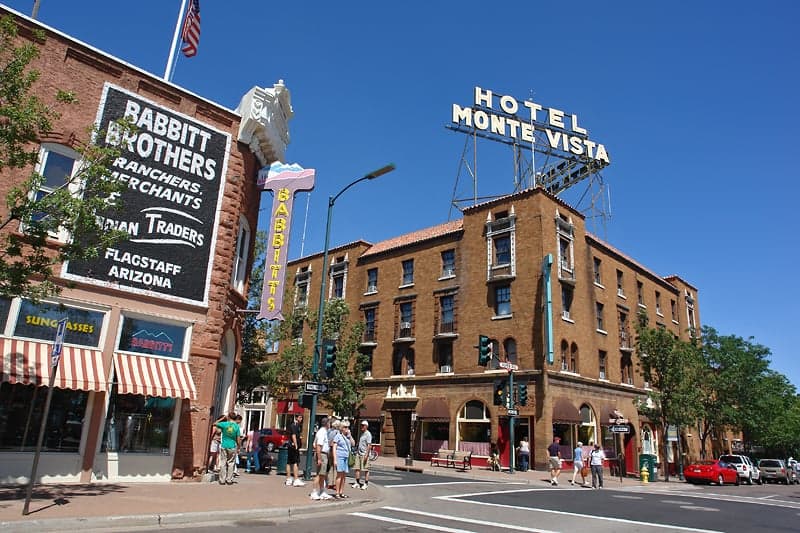
Photo: Wikipedia
Demographics of Flagstaff, AZ
Affluence Level in Flagstaff, AZ
A middle-class area roughly in line with national averages across income, home values, education, and employment.
People of Flagstaff, AZ
The people of Flagstaff, Arizona, today form a population of 76,333 that is notably young, educated, and outdoors-oriented, with a distinctive blend of longtime local families, university students and faculty from Northern Arizona University (NAU), and a growing Hispanic community. The city’s character is shaped by its role as a mountain-town college hub and a gateway to the San Francisco Peaks, giving it a density of 1,100 people per square mile—moderate for the Southwest but concentrated in a compact urban core. With 51.8% of adults holding a college degree, Flagstaff ranks among the most educated cities in Arizona, while its racial makeup—58.1% White, 19.7% Hispanic, 2.1% East/Southeast Asian, 1.9% Black, and 0.4% Indian—reflects a predominantly White and Hispanic population with smaller but visible minority communities.
How the city was settled and grew
Flagstaff’s human history begins with the Southern Paiute and Hopi peoples, who used the area seasonally, but permanent non-Native settlement started in the 1870s when the Atlantic and Pacific Railroad laid tracks through the region. The town was officially founded in 1881 as a railroad stop and lumber hub, drawing Anglo-American loggers, railroad workers, and merchants from the Midwest and East Coast. The historic Railroad District (now downtown) became the initial cluster, with wooden storefronts and boarding houses built by these early arrivals. By the early 1900s, Mexican laborers arrived to work on the railroad and in the lumber mills, settling in what is now the Southside neighborhood—a historically Hispanic enclave that remains a cultural anchor today. A second wave came in the 1920s with the establishment of Northern Arizona Normal School (now NAU), which drew faculty and students from across the country, many of whom lived in the University Heights area near campus. The Great Depression slowed growth, but World War II brought a small influx of military personnel to nearby Camp Navajo, and the post-war era saw Flagstaff’s population double from about 7,000 in 1950 to 18,000 in 1960, driven by expanded lumber operations and the rise of tourism tied to the newly paved Route 66.
Modern era (post-1965)
After the 1965 Hart-Cellar Act, Flagstaff’s foreign-born population remained low—currently just 3.5%—but domestic migration reshaped the city. The 1970s and 1980s saw an influx of White retirees and second-home buyers drawn to the cool climate and outdoor recreation, settling in newer subdivisions like Ponderosa Trails and Kachina Village south of town. Meanwhile, NAU’s expansion—enrollment grew from 8,000 in 1980 to over 20,000 by 2010—brought a steady stream of students and academics, many of whom stayed after graduation, boosting the college-educated share. The Hispanic population grew from about 10% in 1990 to 19.7% today, driven by family reunification and service-sector jobs in hospitality and construction. This growth concentrated in the Southside and East Flagstaff neighborhoods, where Hispanic-owned businesses and Spanish-language churches are common. The East/Southeast Asian community (2.1%) is smaller and more dispersed, with many families tied to NAU’s research programs or local healthcare jobs, while the Black population (1.9%) and Indian population (0.4%) are tiny but visible in professional and academic roles. Notably, Flagstaff lacks the large immigrant enclaves seen in Phoenix or Tucson; instead, its diversity is spread across the city, with the strongest ethnic clustering remaining in Southside’s historic Hispanic core.
The future
Flagstaff’s population is heading toward continued slow growth—projected to reach roughly 85,000 by 2040—driven by NAU enrollment, remote workers seeking mountain living, and retirees from hotter parts of Arizona. The city is not homogenizing; rather, it is becoming more tribally distinct. The Hispanic share is expected to rise to 25-28% by 2040, with Southside and East Flagstaff solidifying as Latino-majority areas, while White professionals and families dominate the newer subdivisions like Timber Sky and Silver Saddle on the city’s outskirts. The East/Southeast Asian and Indian communities are likely to grow modestly as NAU recruits internationally, but they will remain small—probably under 5% combined—and will not form distinct ethnic enclaves. The Black population is plateauing, with no major migration drivers. A key trend is the rising cost of living: Flagstaff’s median home price exceeds $600,000, pushing lower-income Hispanic and Native American families (the city is adjacent to the Navajo Nation) into outlying areas like Doney Park or Bellemont, which may increase economic segregation. The foreign-born share will stay low (under 5%) due to limited entry-level jobs and high housing costs, meaning most growth will come from domestic in-migration.
For someone moving to Flagstaff now, the city is becoming a bifurcated place: a well-educated, predominantly White and Hispanic college town with a strong outdoor culture, but one where affordability is increasingly dividing residents by income rather than ethnicity. New arrivals will find a community that values education and environmentalism, but should expect a tight housing market and a population that is slowly diversifying along Hispanic lines while remaining less immigrant-heavy than most U.S. cities its size.

* Values derived from national, state, county, city and local statistics and may differ in a specific area. Last updated: 2026-04-16T00:46:22.000Z
Narrative content on this page is AI-generated and may contain mistakes. Verify any details that matter before acting on them.
ReloMaps may earn a commission from affiliate links at no extra cost to you.

