Photo: Wikipedia
Political ClimatePolitical Climate in Florence, SC
District shown is the primary district for this city’s centroid. Cities may span multiple districts.
Local Political AnalysisPolitical Analysis of Florence, SC
Florence, South Carolina, has long been a reliably conservative stronghold, and that’s still the case today, but you can feel the winds shifting a bit. The area’s Cook Partisan Voting Index (PVI) of R+12 tells you the baseline is solidly Republican, and that’s been the reality for as long as I can remember. But if you’ve lived here for a while, you notice the political conversations aren’t quite what they used to be—there’s a growing undercurrent of progressive influence, especially among newer transplants and younger folks, that’s starting to nudge things in a direction that gives some of us pause.
How it compares
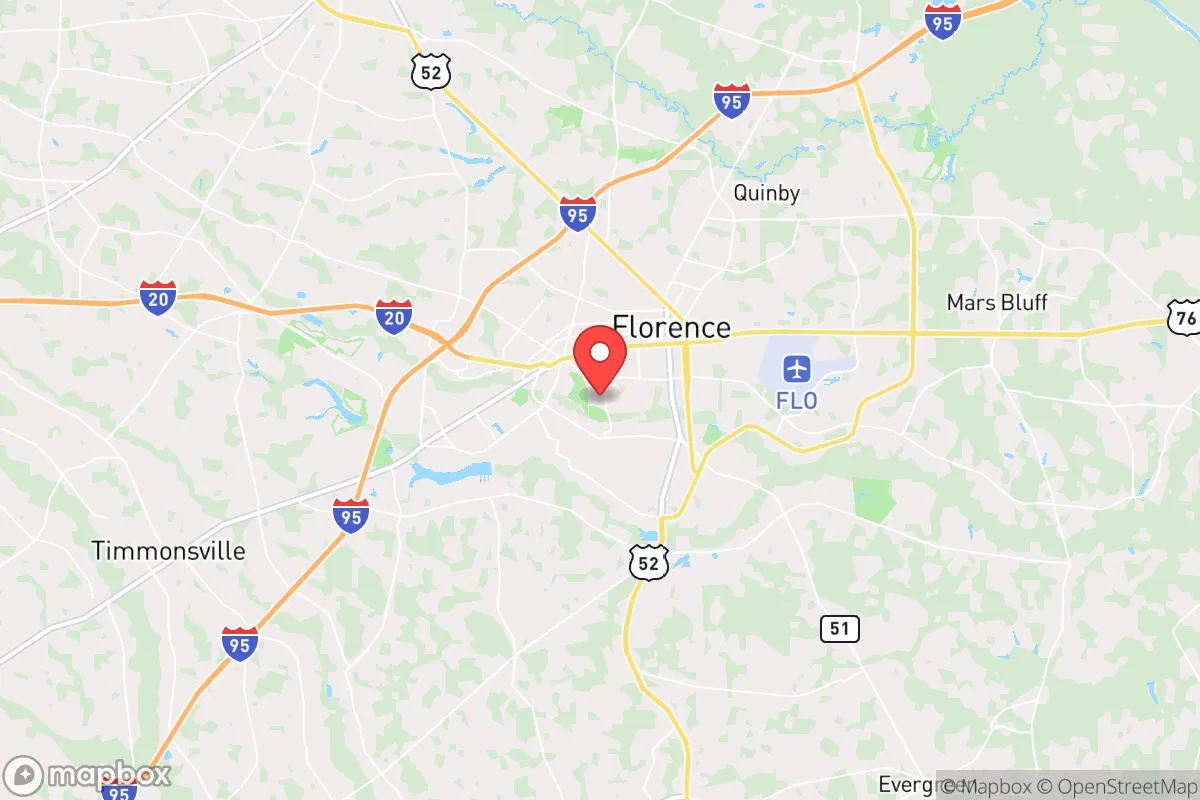
When you stack Florence up against the rest of the Pee Dee region, it’s still one of the more conservative hubs, but it’s not the most conservative. Head west to places like Hartsville or Darlington, and you’ll find communities that lean even more traditional, with a stronger resistance to any kind of government overreach. Drive east toward the coast, and Myrtle Beach is a whole different animal—more transient, more tourism-driven, and politically a bit of a mixed bag. The real contrast, though, is with Columbia, about 80 miles west. That’s a blue dot in a red state, and you can see some of that influence creeping into Florence’s local politics, especially in city council races and school board decisions. It’s not a full-on takeover, but it’s enough to make you keep an eye on things.
What this means for residents
For folks who value personal freedoms and want to keep government out of their lives, Florence is still a pretty good place to be, but you have to stay engaged. The local elections are where the rubber meets the road—things like zoning ordinances, business regulations, and school curriculum decisions can quietly shift the culture if you’re not paying attention. I’ve seen a few too many proposals lately that feel like they’re borrowing from bigger cities’ playbooks, like pushing for more restrictive housing policies or trying to bring in “equity” initiatives that sound good on paper but end up giving bureaucrats more control over everyday life. The good news is that the R+12 lean means most elected officials still understand that the majority of us want less interference, not more. But the trajectory is something to watch—if you’re not careful, you can wake up one day and find that the local government has decided it knows better than you do about how to run your business or raise your kids.
Culturally, Florence still holds onto that old-school Southern independence. You see it in the way people handle things themselves—neighbors helping neighbors, churches stepping up where the government falls short. There’s a strong sense that your rights end where someone else’s begin, and that’s a good thing. But there’s a growing push from some corners to redefine what “rights” mean, and that’s where the concern comes in. The long-term worry is that if we don’t keep a close watch, we could see more of that top-down thinking creep in, the kind that tells you what you can build on your own property or what your kids can read in school. For now, Florence is still a place where you can breathe easy, but the air is getting a little thicker. Stay involved, vote in every local election, and don’t let the quiet changes slide—because once they’re in, they’re hard to get out.

State Political ClimatePolitical Climate in South Carolina
State Political AnalysisPolitical Environment in the State
South Carolina has long been a reliably red state, but the political climate here is more layered than a simple "Republican" label suggests. The state leans solidly Republican at the statewide level, with Donald Trump winning by 18 points in 2020 and Republicans holding supermajorities in both legislative chambers. However, the past 10-20 years have seen a fascinating shift: the old-school, establishment GOP that dominated the 2000s is being challenged by a more populist, liberty-minded wing, while explosive growth in the Upstate and Lowcountry is slowly injecting new dynamics. If you’re moving here expecting a monolithic conservative monolith, you’ll find a state that’s deeply red but increasingly divided between its rural, traditionalist base and its fast-growing, more suburban and libertarian-leaning pockets.
Urban vs. rural divide
The political map of South Carolina is a study in contrasts. The rural "Corridor of Shame" counties along I-95—like Allendale, Bamberg, and Marlboro—are overwhelmingly Democratic and poor, but they have little statewide influence due to low turnout. The real power lies in the Upstate, anchored by Greenville, which has become a conservative powerhouse. Greenville County itself is deeply red, but the city of Greenville has a growing, younger, and more moderate population that has flipped some local races. Spartanburg and Anderson are even more reliably conservative, with strong evangelical and manufacturing bases. The Lowcountry, particularly Charleston, is the state’s most politically interesting metro. Charleston County has been trending blue for a decade, driven by transplants, tourism workers, and the tech sector, but the surrounding suburbs like Mount Pleasant and Summerville remain solidly red. The Pee Dee region, with Florence as its hub, is a mixed bag—rural areas are deep red, but the city itself leans Democratic. The real battleground is the fast-growing Lexington and York counties (suburbs of Columbia and Charlotte, respectively), where conservative transplants from the Northeast and Midwest are reinforcing the GOP’s hold, but also bringing more libertarian views on taxes and regulation.
Policy environment
South Carolina’s policy environment is broadly conservative, but with some notable wrinkles. The state has a flat income tax rate of 6.4%, which was cut from 7% in 2022, and there’s a strong push to eliminate it entirely. Property taxes are among the lowest in the nation, thanks to a 2006 law that capped assessments. The regulatory climate is business-friendly, with a right-to-work law and minimal zoning in most rural areas. On education, the state passed a school choice program in 2023 that created Education Savings Accounts for low- and middle-income families, a major win for parental rights. Healthcare is a mixed bag: the state refused Medicaid expansion, keeping government out of healthcare, but rural hospital closures are a real concern. Election laws are strict—voter ID is required, and the state has a 30-day residency requirement to register. There’s no early voting by mail without an excuse, though in-person early voting was expanded in 2020. The state also has a constitutional carry law (permitless concealed carry) passed in 2021, and a near-total abortion ban with no exceptions for rape or incest, only for the life of the mother. For a conservative, this is a state that largely respects traditional values and limited government, but the tax burden is still higher than in Florida or Tennessee.
Trajectory & freedom
Over the past five years, South Carolina has been moving in a decidedly more freedom-oriented direction, but not without some backsliding. The constitutional carry law (2021) was a major expansion of Second Amendment rights, and the state has resisted federal overreach on gun control. The Fetal Heartbeat Act (2023) effectively banned abortion after six weeks, a strong pro-life stance. On parental rights, the state passed a Parents’ Bill of Rights in 2023, requiring schools to notify parents about curriculum changes and medical services. However, there are concerns: the state’s COVID-19 emergency powers were used aggressively by Governor McMaster in 2020, including business closures and mask mandates, which angered many liberty-minded residents. The legislature has since passed a law limiting the governor’s emergency powers, but the memory of that overreach lingers. Property rights are generally strong, but the state’s Department of Transportation has a history of using eminent domain for highway projects, particularly in the Lowcountry. Overall, the trajectory is toward more personal freedom, but the establishment GOP in Columbia still has a tendency to compromise on core principles when federal money is involved.
Civil unrest & political movements
South Carolina has seen its share of political flashpoints, but they tend to be more localized than in other states. The Confederate flag removal from the Statehouse grounds in 2015 after the Charleston church shooting was a watershed moment, but it also galvanized a strong traditionalist backlash. The Black Lives Matter protests in 2020 were relatively muted compared to Portland or Seattle, with the largest gatherings in Columbia and Charleston, but they did lead to some calls for police reform that went nowhere in the legislature. The Moms for Liberty movement has a strong presence in the Upstate, particularly in Greenville and Spartanburg counties, where they’ve successfully challenged school board policies on critical race theory and LGBTQ curriculum. Immigration politics are less heated than in border states, but there’s a strong undercurrent of concern about illegal immigration, with the state passing a law in 2023 requiring local law enforcement to cooperate with ICE. There’s also a small but vocal nullification movement among some libertarian and constitutionalist groups, particularly around federal gun laws and marijuana prohibition. The state’s election integrity is generally seen as solid, with no major controversies in 2020, but there’s ongoing debate about the security of electronic voting machines. A new resident would notice that political activism here is more about school boards and county councils than street protests—it’s a quieter, more institutional kind of politics.
Projection
Looking ahead 5-10 years, South Carolina is likely to become more conservative, but in a different flavor. The massive in-migration from California, New York, and Illinois—particularly to the Greenville-Spartanburg corridor and the Charleston suburbs—is bringing people who are fleeing high taxes and progressive policies, but they also tend to be more libertarian than traditionalist. This could lead to a push for further tax cuts, school choice expansion, and deregulation, but also a softening of social conservatism on issues like marijuana (medical use is already being debated) and alcohol laws. The rural areas will continue to lose population and political clout, while the suburbs will dominate. The biggest wild card is the Democratic Party’s ability to mobilize the growing Black population in the Lowcountry and the transplants in Charleston—if they can turn out, they could flip a few state House seats and maybe a congressional district by 2030. But for now, the state’s trajectory is toward a more prosperous, more free, and more culturally conservative future, albeit with growing pains over development and infrastructure. Someone moving in now should expect a state that is solidly red but increasingly divided between the old guard and the new wave of liberty-minded conservatives.
For a new resident, the bottom line is this: South Carolina offers a high degree of personal freedom, low taxes, and a culture that respects traditional values, but it’s not a libertarian paradise. You’ll find strong gun rights, school choice, and a pro-life environment, but you’ll also encounter a state government that still has a taste for corporate welfare and occasional overreach. If you’re looking for a place where your voice matters at the local level and where the political culture is still rooted in common sense, the Upstate or the Lexington suburbs are your best bet. Just keep an eye on the growth—it’s changing the state faster than many locals are comfortable with.
* Values derived from national, state, county, city and local statistics and may differ in a specific area. Last updated: 2026-04-24T20:52:47.000Z
Narrative content on this page is AI-generated and may contain mistakes. Verify any details that matter before acting on them.
ReloMaps may earn a commission from affiliate links at no extra cost to you.

