Quality of Life in Forest Hills, TN
A high quality of life with strong walkability, manageable living costs, healthy neighborhood signals, and solid amenity access.
What does Quality of Life tell us?
Quality of Life blends cost of living, nearby amenities, socioeconomic signals, and neighborhood character. City-level scores represent the whole municipality; individual neighborhoods can differ.
What does this tell us?
Quality of Life blends cost of living, nearby amenities, socioeconomic signals, and neighborhood character. City-level scores represent the whole municipality; individual neighborhoods can differ.
Cost of Living
305% above national average
The Real Cost of Living in Forest Hills, TN for 2026
| Tier | Individual | Family (4) |
|---|---|---|
| Survival | $46k | $87k |
| Comfortable | $222k | $326k |
| Luxury | $452k+ | $700k+ |
| Elite (Top 5%) | $698k+ | $1.1M+ |
77%
The Area Signal
A metric tracking the socioeconomic signals of the area.
Hobbies
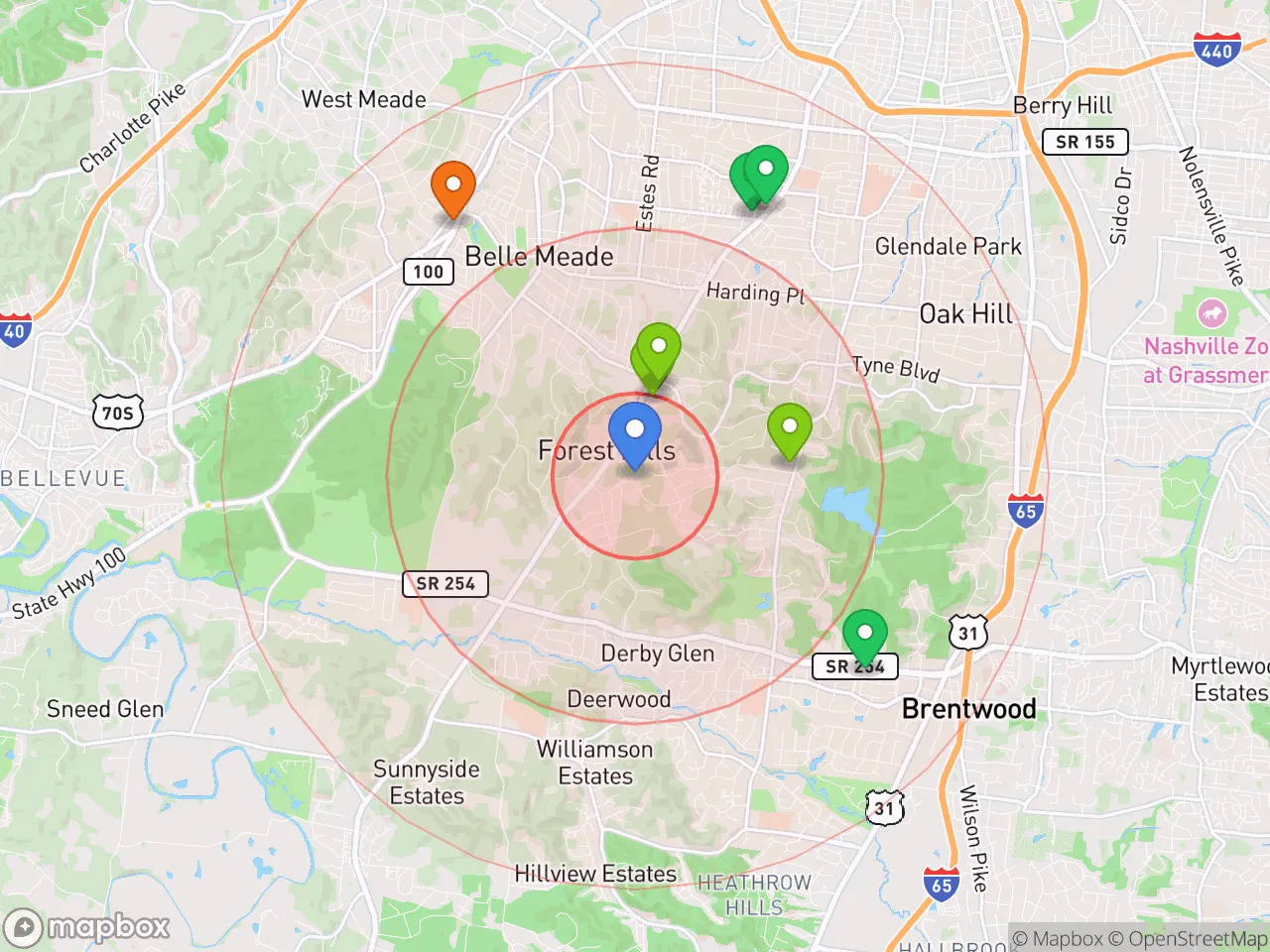
Explore the areaGroceries
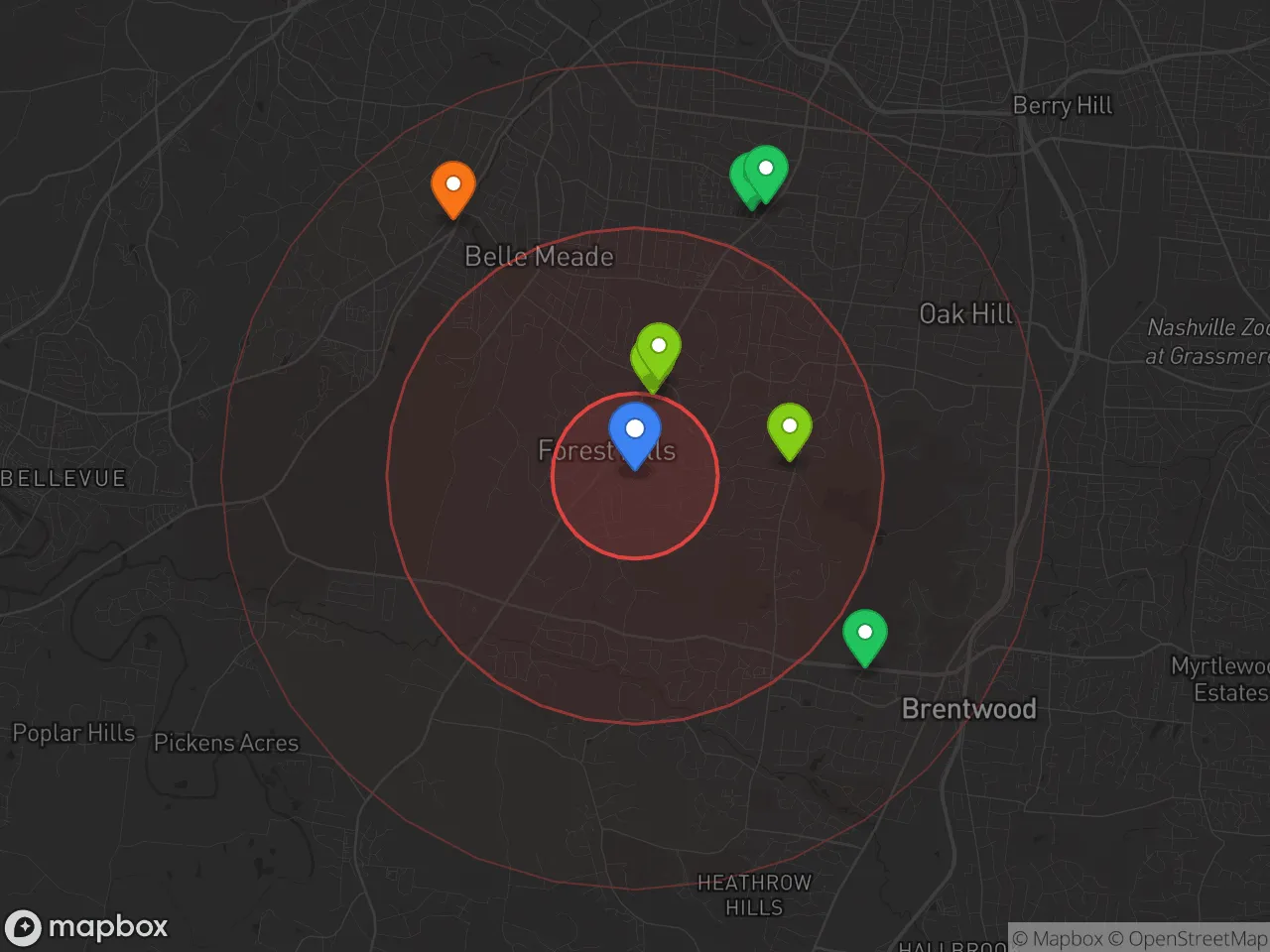
6 within 10 miles
Gas
20 within 10 miles
Hospital
20 within 20 miles
Airport
BNA — Nashville International
Post Office
USPS — Forest Hills, TN
Critical Amenities
Quality-of-Life Analysis
Forest Hills, Tennessee, is an affluent residential enclave in Davidson County, just south of downtown Nashville, where the cost of living index of 405 (more than four times the US average) reflects a community built around high-end real estate and privacy. The population of roughly 5,000 residents is predominantly composed of executives, healthcare professionals, and entertainment-industry figures who prioritize large wooded lots, low crime rates, and proximity to Nashville’s urban core without sacrificing a suburban feel. This is not a neighborhood for budget-conscious newcomers; it is a deliberate choice for those who can afford a median home value of $1,142,200 and value space, seclusion, and top-tier public services.
Cost of living, housing, and affordability compared to nearby areas
Forest Hills’ cost of living index of 405 is among the highest in Middle Tennessee, driven almost entirely by housing. The median home value of $1,142,200 is roughly 3.5 times the Nashville metro average and more than double the median in adjacent Belle Meade, which itself is a wealthy suburb. Rents, however, tell a different story: the median rent of $1,122 is actually below the Nashville citywide median of roughly $1,500, largely because the rental market here is tiny—most properties are owner-occupied single-family homes on one- to five-acre lots. For context, a comparable home in nearby Brentwood (Williamson County) might cost 10–15% less, but Forest Hills offers lower property tax rates (Davidson County’s combined rate is about 2.7% of assessed value versus Williamson’s 2.9%) and no city property tax, since Forest Hills is an incorporated town with its own minimal municipal levy. The average commute of 25.7 minutes is shorter than the Nashville metro average of 28 minutes, thanks to direct access to I-440 and I-65, making the trade-off of high home prices for a 5–10 minute shorter drive to downtown a tangible benefit for daily commuters.
Amenities, schools, and what daily life is like for families
Daily life in Forest Hills revolves around its zoned public schools, which are among the best in Davidson County: Julia Green Elementary (rated 9/10 on GreatSchools), John T. Moore Middle (8/10), and Hillsboro High (7/10) all serve the area, with Hillsboro offering an International Baccalaureate program and a strong performing-arts track. The town itself has no commercial district—no grocery stores, no gas stations, no restaurants—so residents drive 5–10 minutes to the nearby Green Hills neighborhood for shopping at The Mall at Green Hills, dining at spots like The Cheesecake Factory or local favorites like The Pancake Pantry, and errands at the Publix on Hillsboro Pike. Outdoor amenities include the 40-acre Percy Warner Park (adjacent to the town’s western border) with hiking trails, equestrian paths, and the Warner Park Nature Center, plus the smaller but well-maintained Forest Hills Park with a playground and tennis courts. The community’s rhythm is quiet and private: there are no sidewalks on most streets, no streetlights in many sections, and homes are set far back from the road, creating a rural feel within city limits. The town holds an annual Fourth of July parade and a fall festival, but most social life happens through school events, neighborhood gatherings, or memberships at the nearby Belle Meade Country Club or Richland Country Club.
Forest Hills is best suited for affluent families, empty-nesters, and professionals who prioritize large lots, excellent public schools, and a 25-minute commute to downtown Nashville over walkability, nightlife, or affordable entry-level housing. Singles or young renters will find the rental stock minimal and the social scene nonexistent within the town itself. Buyers should expect to compete in a tight market—homes typically sell within 30–45 days—and should budget for maintenance on older homes (many built in the 1950s–1970s) and potential HOA fees in the few subdivisions like the Estates of Forest Hills. For those who can absorb the $1.1 million+ entry point, Forest Hills offers a rare combination of seclusion, top-ranked schools, and urban access that few Nashville suburbs can match.

Crime in Forest Hills, TN
Higher crime rates than 58% of comparable U.S. locations.
Violent CrimeViolent Crime Analysis
Property CrimeProperty Crime Analysis
Crime Analysis
Forest Hills, Tennessee, presents a mixed safety profile that demands close scrutiny from potential residents. The town's violent crime rate of 490.5 incidents per 100,000 residents and property crime rate of 1,640.7 per 100,000 place it above national averages, a reality shaped in part by its position within the broader Nashville metropolitan area. As a small city adjacent to a large, progressive-leaning metro, Forest Hills is not insulated from the regional crime dynamics that often accompany liberal prosecutorial policies and lenient sentencing practices.
Crime in context
Forest Hills' violent crime rate is roughly 40% higher than the national average of approximately 350 per 100,000, while its property crime rate exceeds the U.S. norm by about 15%. These figures are significantly elevated compared to similarly sized, more conservative-leaning suburbs in Tennessee, such as those in Williamson County (e.g., Brentwood, which reports violent crime rates below 100 per 100,000). The disparity is not coincidental: Davidson County, which encompasses Forest Hills, has elected district attorneys and judges who have implemented progressive reforms, including reduced cash bail, diversion programs for repeat offenders, and a general reluctance to seek maximum sentences. These policies, while well-intentioned, have a documented effect of keeping more offenders on the street, directly undermining public safety and victim justice. The result is a crime environment that is worse than what the town's affluent, residential character would otherwise suggest.
What residents experience
For those living in Forest Hills, the daily reality is a heightened awareness of property crime, particularly vehicle break-ins and package thefts, which are common across the Nashville metro. Violent incidents, while less frequent, are a serious concern: the rate of 490.5 per 100,000 translates to roughly one violent crime for every 200 residents annually. This includes aggravated assaults and, in some years, robberies that spill over from nearby commercial corridors like Hillsboro Pike. Residents report that the Metro Nashville Police Department, stretched thin by citywide demands, often has slower response times in the town's winding, wooded neighborhoods. The progressive justice system's focus on rehabilitation over accountability means that even when arrests are made, offenders frequently cycle back into the community quickly, eroding the deterrent effect that swift, certain punishment provides.
Neighborhood-level variation within Forest Hills is notable but does not eliminate the overarching risk. The most expensive, gated enclaves along Old Hickory Boulevard experience lower property crime due to private security and limited access, while areas closer to the urban boundary—near the intersection of Granny White Pike and Franklin Road—see higher rates of car burglaries and trespassing. However, no part of Forest Hills is truly immune from the regional crime spillover driven by Nashville's progressive criminal justice policies. Prospective residents should weigh the town's desirable schools and green spaces against the concrete safety trade-offs that come with being part of a large, liberal metro area.
* Values derived from national, state, county, city and local statistics and may differ in a specific area. Last updated: 2026-04-27T15:26:24.000Z
Narrative content on this page is AI-generated and may contain mistakes. Verify any details that matter before acting on them.
ReloMaps may earn a commission from affiliate links at no extra cost to you.

