
Photo by Connor Anderson on Unsplash
Demographics of Fountain Hills, AZ
Affluence Level in Fountain Hills, AZ
An upper-middle-class area. Household wealth, education levels, and homeownership run ahead of national benchmarks.
People of Fountain Hills, AZ
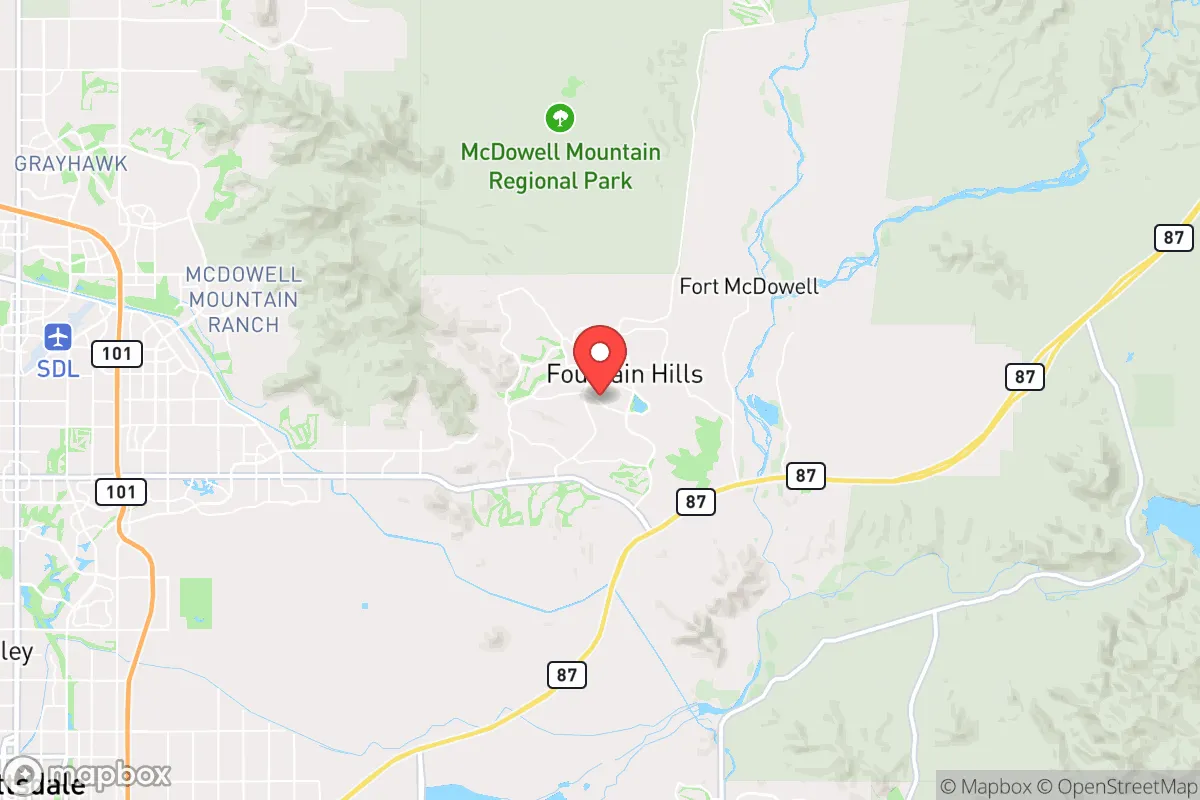
Fountain Hills, Arizona, is a planned community of 23,768 residents that remains overwhelmingly white (88.0%) and highly educated (49.5% hold a college degree), with a notably low foreign-born share of just 2.2%. The city’s population is older and more settled than the state average, shaped by decades of domestic in-migration from the Midwest and West Coast rather than international immigration. Its identity is defined by master-planned order, desert open space, and a retiree-and-family mix that prizes stability over rapid change.
How the city was settled and grew
Fountain Hills was not a pioneer settlement or railroad town. It was conceived in the late 1960s as a master-planned community by the McCulloch Properties corporation, which purchased 12,000 acres of Sonoran Desert northeast of Scottsdale. The first residents arrived in the early 1970s, drawn by the promise of a self-contained suburban enclave anchored by the world’s tallest fountain (launched in 1970). The original wave was overwhelmingly white, middle-to-upper-income, and largely from the Midwest and California — retirees seeking warm winters and younger families fleeing urban crowding. The earliest neighborhoods, such as Fountain Hills East (the original core around the fountain and Avenue of the Fountains) and Fountain Hills West (closer to the McDowell Mountains), were built out in the 1970s and 1980s with large lots, desert landscaping, and a uniform architectural code. No significant immigrant or minority enclave formed during this period; the city’s restrictive zoning and high lot prices filtered for a homogeneous, affluent population.
Modern era (post-1965)
Because Fountain Hills was built from scratch after 1970, the post-1965 immigration reforms had little direct effect on its founding population. The city’s growth through the 1990s and 2000s came almost entirely from domestic migration — particularly from California, Colorado, and the Midwest — as retirees and telecommuters sought lower taxes and more space. The 2000 census recorded a population of 20,235, with a white share above 92%. Since then, the city has diversified modestly. The Hispanic share rose from 2.1% in 2000 to 3.7% today, and the Black share from 0.4% to 2.6%. East/Southeast Asian residents (1.1%) and Indian-subcontinent residents (0.7%) are present but form no distinct ethnic neighborhood; they are dispersed across newer subdivisions such as SunRidge Canyon (a golf-course community built in the late 1990s) and Fountain Hills North (the last major phase of development, with homes built from 2000 onward). The Fountain Hills Village area, a denser mixed-use district near the fountain, has attracted a slightly younger, more diverse mix of renters and condo owners, but remains predominantly white. No single minority group has reached a concentration high enough to form a visible enclave; the city’s demographic change is a slow, thin spread rather than a wave.
The future
Fountain Hills is likely to remain one of the least diverse municipalities in Maricopa County over the next 10–20 years. The foreign-born share (2.2%) is roughly one-fifth the national average, and there is no sign of a rapid increase: the city lacks the rental stock, transit access, and entry-level jobs that attract immigrant families. The Hispanic share is growing slowly (from 2.1% to 3.7% over two decades) and will likely reach 5–6% by 2040, but will remain far below the county average of roughly 30%. East/Southeast Asian and Indian populations are growing from a tiny base and will remain below 2% each. The city is not tribalizing into ethnic enclaves; it is homogenizing at a slow pace, with the white share declining only gradually as older residents age in place and younger, slightly more diverse families move into newer developments like Fountain Hills Ranch (a recent infill project near the eastern boundary). The biggest demographic shift will be age: the median age (roughly 54) is well above the national median, and as the baby-boom cohort passes, the city will need to attract younger families to maintain its tax base. That will likely come from domestic migration, not international immigration.
For a conservative-leaning mover, Fountain Hills offers a stable, low-diversity, highly educated community where the population is aging in place rather than transforming. The city is not becoming a melting pot or a collection of ethnic enclaves; it is slowly, gently diversifying from a very homogeneous baseline. The practical implication is that a newcomer can expect a social environment that looks and feels much like it did in 2000 — orderly, white-collar, and politically conservative — with no major cultural or linguistic shifts on the horizon.

* Values derived from national, state, county, city and local statistics and may differ in a specific area. Last updated: 2026-04-19T08:12:20.000Z
Narrative content on this page is AI-generated and may contain mistakes. Verify any details that matter before acting on them.
ReloMaps may earn a commission from affiliate links at no extra cost to you.

