
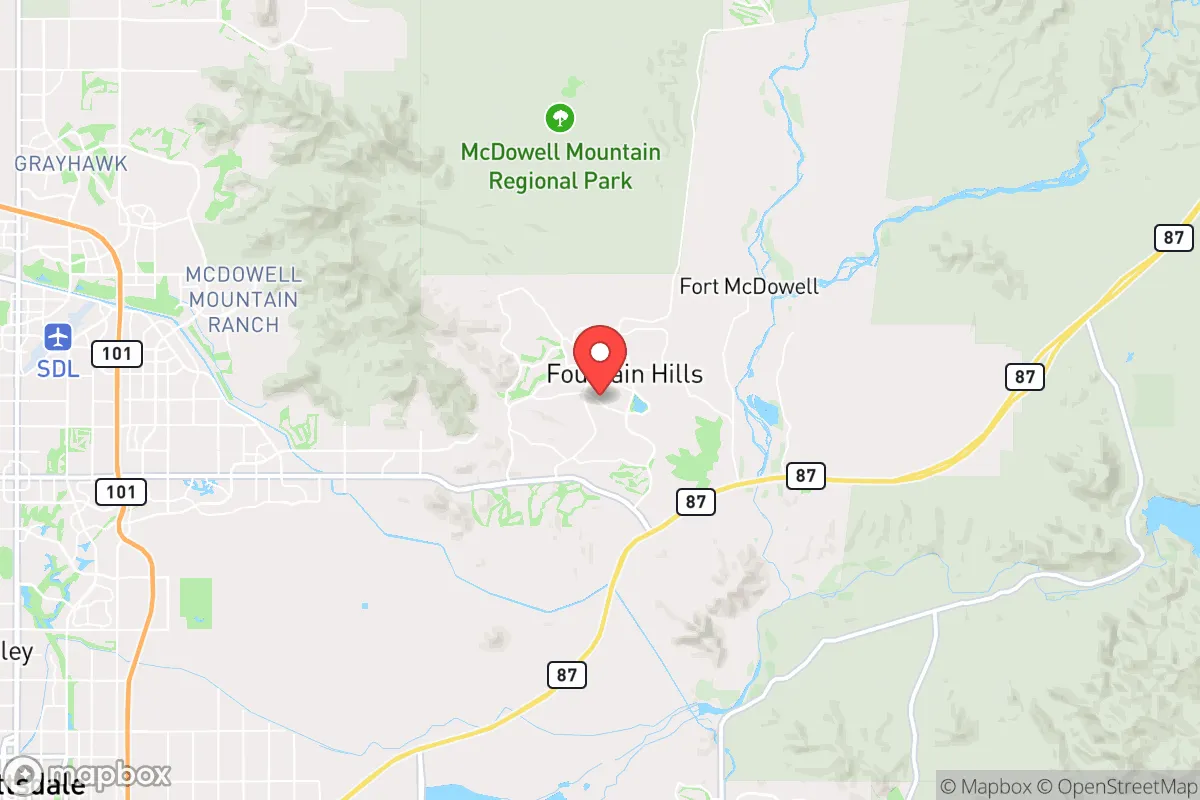
Photo by Connor Anderson on Unsplash
Personal Sovereignty in Fountain Hills, AZ
Viable for self-reliance. Generally workable, though some barriers may limit total independence.
What does Personal Sovereignty tell us?
Personal Sovereignty measures your capacity for self-reliance and independence with minimal government friction. Higher scores mean fewer barriers between you and the way you want to live... but it assumes you have the space you need and good neighbors.
What does this tell us?
Personal Sovereignty measures your capacity for self-reliance and independence with minimal government friction. Higher scores mean fewer barriers between you and the way you want to live... but it assumes you have the space you need and good neighbors.
State Policy
Energy independence: Importer (20% of energy produced in-state)
Personal Liberty
Homesteading

Personal Liberty Analysis
For the individual who values maximum personal autonomy—whether as a survivalist, a prepper, or simply someone who wants the government to stay out of your business—Fountain Hills, Arizona offers a uniquely favorable sovereignty environment within the Phoenix metro area. While no place is a perfect fortress against federal overreach, Arizona’s state-level constitutional protections, combined with Fountain Hills’ specific local governance culture, create a legal landscape where your right to self-determination is broadly respected. The town’s relatively low population density (roughly 24,000 residents) and its distance from the most aggressive urban regulatory regimes mean you can live with far less bureaucratic friction than you’d find in Phoenix proper or Scottsdale. The key question isn’t whether you can be fully independent here—it’s whether the trade-offs in climate and proximity to services align with your specific preparedness goals.
Tax burden and regulatory posture: How Arizona’s low-tax framework protects your earnings
Arizona’s state-level tax structure is a major pillar of personal sovereignty in Fountain Hills. The state imposes a flat income tax rate of 2.5% as of 2025, one of the lowest in the nation, meaning the government takes a smaller cut of your labor and investments compared to high-tax states like California or New York. There is no state-level estate or inheritance tax, which matters for anyone building generational wealth or a self-sufficient homestead. Property taxes in Maricopa County, where Fountain Hills sits, average around 0.55% of assessed value—roughly half the national average. For a $600,000 home, that’s about $3,300 annually, versus $6,000+ in many Midwestern or Northeastern states. Sales tax in Fountain Hills is 8.1% (state plus county), but essentials like groceries and prescription drugs are exempt. On the regulatory side, Arizona is a right-to-work state with minimal business licensing hurdles, and Fountain Hills has no city-level income tax or overly burdensome local ordinances. The town’s zoning code is less restrictive than Phoenix’s, particularly regarding home-based businesses and accessory dwelling units, which gives you more latitude to generate income or house family members without triggering a permitting nightmare. For the prepper mindset, this low-tax, low-regulation environment means more capital stays in your hands for land, supplies, and infrastructure—not siphoned off by government programs you may not support.
Self-defense and gun law specifics: What Arizona’s constitutional carry means for your safety
If personal security is a non-negotiable aspect of sovereignty, Fountain Hills sits in one of the most firearm-friendly states in the country. Arizona has permitless constitutional carry for anyone 21 or older who can legally possess a firearm—no license, no training requirement, no waiting period to carry concealed or openly. This applies statewide, including within Fountain Hills town limits. There is no state-level registry for firearms, no magazine capacity restrictions, and no “red flag” law that allows confiscation without due process. The state preempts local governments from enacting stricter gun ordinances, so Fountain Hills cannot ban carry in parks or impose its own waiting periods—what the state allows, the town must allow. For the survivalist, this means you can maintain a fully stocked armory without fear of local politicians changing the rules overnight. Stand-your-ground laws are robust: you have no duty to retreat in any place you are lawfully present, and the Castle Doctrine extends to your vehicle and workplace. The only notable restriction is that carrying on K-12 school grounds requires a valid concealed weapons permit (which is shall-issue and relatively easy to obtain). For parents, this is a minor inconvenience compared to the overall freedom. Compared to states like California or New York, where gun ownership is treated as a privilege to be regulated, Arizona treats it as a fundamental right—and Fountain Hills’ low crime rate (violent crime roughly 60% below the national average) means you’re unlikely to face legal scrutiny for exercising that right in self-defense.
Self-reliance and homesteading viability: Lot sizes, zoning, and off-grid feasibility in Fountain Hills
Fountain Hills offers a mixed bag for the serious homesteader or off-grid prepper. The town is built on a grid of suburban lots, with most residential parcels ranging from 0.25 to 1 acre. While you won’t find the 5- or 10-acre spreads common in rural Arizona, the town’s zoning does allow for some self-reliance activities. Chickens are permitted on lots of 20,000 square feet or more (about half an acre), and beekeeping is allowed with a simple registration. Larger livestock like goats or horses require a minimum of one acre and a special use permit, which is not guaranteed. The town’s water supply comes from the Central Arizona Project and local wells, but off-grid water independence is difficult—the area receives only about 10 inches of rain annually, making rainwater catchment insufficient for full household use without massive cistern storage. Solar panels are allowed without restriction, and net metering is available through the local utility (Salt River Project), so you can generate your own electricity and sell excess back. However, the town’s building codes require compliance with the 2021 International Residential Code, which means any new construction must meet modern energy and structural standards—no building a cob hut or shipping container home without permits. For the prepper, the best strategy is to buy a lot at the larger end of the spectrum (0.5–1 acre) on the town’s periphery, where you have more privacy and less neighbor scrutiny. The nearby Tonto National Forest offers public land for foraging, hunting, and bug-out cache placement, but true off-grid living within town limits is not feasible without significant compromise. If full self-reliance is your goal, look at unincorporated areas of Maricopa County or towns like Cave Creek, but Fountain Hills offers a reasonable middle ground for those who want suburban convenience with a strong self-reliance ethic.
Personal liberties: Parental rights, medical autonomy, speech, and property protections
Arizona’s legal framework provides strong protections for personal liberties that directly affect daily life in Fountain Hills. Parental rights are explicitly protected under state law (A.R.S. § 1-601), which affirms that parents have the fundamental right to direct their children’s education, healthcare, and religious upbringing. This means no mandatory vaccine requirements for school attendance (only a list of recommended vaccines, with easy opt-out provisions), and no government interference in homeschooling or private school choice. The state’s Empowerment Scholarship Account program gives parents access to public funds for private or homeschool expenses, which is a significant advantage for those who want to control their children’s curriculum. Medical autonomy is similarly robust: Arizona has no state-level mask or vaccine mandates in effect as of 2026, and the state passed legislation in 2023 prohibiting discrimination based on vaccination status. You can refuse any medical treatment for yourself or your children without fear of losing custody or employment. Free speech is protected by the Arizona Constitution, which has its own free speech clause that courts have interpreted broadly—no local ordinances in Fountain Hills restrict political signage, public assembly, or expressive conduct beyond standard time-place-manner rules. Property rights are strengthened by Arizona’s strong eminent domain protections; the state constitution requires “just compensation” and prohibits taking property for economic development purposes (a response to the Kelo decision). For the prepper, this means your land and improvements are less vulnerable to government seizure for private projects. The only notable liberty concern is that Fountain Hills, like most Arizona towns, has a homeowners’ association (HOA) presence—roughly 40% of homes are in HOAs, which can impose restrictions on vehicle storage, landscaping, and exterior modifications. If you want maximum property autonomy, prioritize non-HOA neighborhoods, which are common on the town’s east side and in older developments.
Overall, Fountain Hills ranks as a strong contender for personal sovereignty compared to most suburban areas in the United States. The combination of Arizona’s constitutional carry, low taxes, parental rights protections, and minimal regulatory overreach creates an environment where an individual or family can live with a high degree of autonomy. The trade-offs are real: you cannot go fully off-grid within town limits, and the HOA presence in some neighborhoods requires careful selection. But for the survivalist or prepper who wants a defensible, low-crime base within 30 minutes of Phoenix’s resources—while retaining the legal freedom to arm yourself, educate your children as you see fit, and keep most of your earnings—Fountain Hills offers a sovereignty profile that few other metro-area towns can match. It is not a libertarian utopia, but it is a practical, legally defensible place to build a life on your own terms.

* Values derived from national, state, county, city and local statistics and may differ in a specific area. Last updated: 2026-04-19T08:12:20.000Z
Narrative content on this page is AI-generated and may contain mistakes. Verify any details that matter before acting on them.
ReloMaps may earn a commission from affiliate links at no extra cost to you.

