
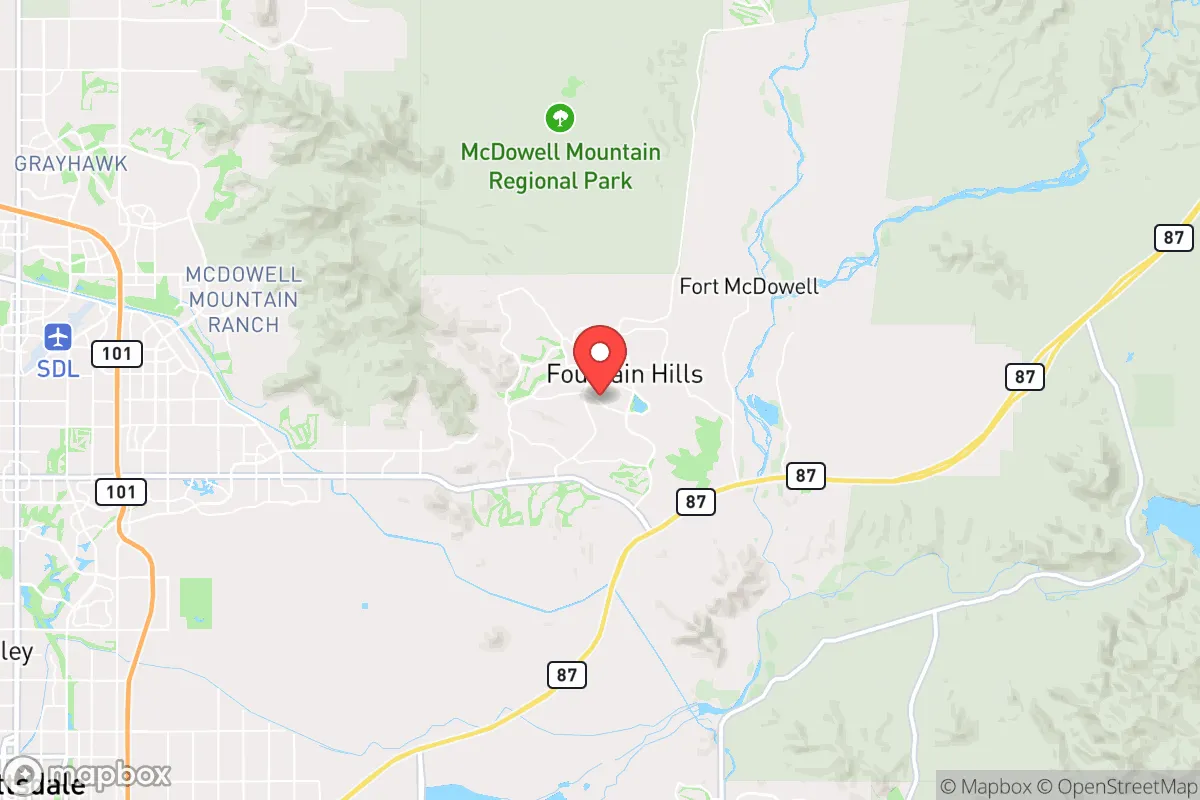
Photo by Connor Anderson on Unsplash
Political ClimatePolitical Climate in Fountain Hills, AZ
District shown is the primary district for this city’s centroid. Cities may span multiple districts.
Local Political AnalysisPolitical Analysis of Fountain Hills, AZ
Fountain Hills has long been a reliably conservative community, and while its Cook PVI of R+1 might sound moderate, that number doesn't fully capture the local vibe. For decades, this town was a rock-solid Republican stronghold, with most folks voting straight-ticket red and local politics reflecting a deep commitment to limited government and personal responsibility. In recent years, though, you've seen a slow but noticeable shift—some of the newer folks moving in from Phoenix and Scottsdale are bringing more progressive ideas with them, and that's starting to nudge the needle. The town still leans right overall, but the trajectory is something to keep an eye on if you value a place where government stays out of your business.
How it compares
If you look at the surrounding area, the contrast is pretty stark. Head south into Scottsdale, and you're in a much more politically mixed environment—parts of it are still conservative, but the city council and county politics have been trending left for years, especially on land use and spending. Go west to Phoenix, and you're in a deep blue urban core where the city government is constantly pushing new regulations on everything from short-term rentals to water usage. Even nearby Rio Verde Foothills, which is unincorporated and fiercely independent, has a more libertarian streak than Fountain Hills. Compared to those places, Fountain Hills still feels like a holdout for traditional values—lower taxes, fewer zoning headaches, and a general attitude that your property is your own. But the R+1 rating tells you the margin is shrinking, and the days of it being a slam-dunk conservative town are fading.
What this means for residents
For someone who's lived here a while, the biggest concern is how the political drift might affect daily life. Right now, Fountain Hills still has a relatively light touch when it comes to local government—no overbearing HOA-style rules on what you can do with your yard, no aggressive code enforcement, and a police department that focuses on real crime rather than petty nuisance complaints. But as the political center shifts, you're starting to see more talk about "sustainability" initiatives and "equity" programs that sound an awful lot like the kind of government overreach that's made life in Phoenix so frustrating. The town council elections are where this really plays out—every cycle, there are candidates who want to keep things small and local, and others who want to align with Maricopa County's progressive agenda. If you're a resident who values personal freedoms, it's worth paying close attention to those races, because the outcome will determine whether Fountain Hills stays a place where you can live your life without a bunch of bureaucratic interference.
Culturally, Fountain Hills still has that old-school Arizona feel—people wave to each other, the Fourth of July parade is a big deal, and there's a strong sense of community that doesn't revolve around government programs. But there's a growing tension between the longtime residents who remember when the town was founded on principles of self-reliance and the newcomers who see it as just another suburb to be managed. The policy battles you'll see are over things like water rights, property taxes, and whether to impose new development fees—all issues that boil down to how much control the government should have over your choices. For now, the conservative majority is holding, but the trend line is something to watch. If you're thinking about moving here, just know that the political climate is still good, but it's not as solid as it was ten years ago, and staying that way will require staying engaged.

State Political ClimatePolitical Climate in Arizona
State Political AnalysisPolitical Environment in the State
Arizona has shifted from a reliably Republican stronghold to a true battleground state over the past two decades, with its current political climate defined by a razor-thin partisan split. The state voted for Joe Biden in 2020 by just 0.3% and saw Donald Trump win it back in 2024 by roughly 5.5 points, reflecting a volatile electorate where Maricopa County’s explosive growth and shifting suburban allegiances now decide every election. The dominant coalitions are a conservative-leaning but libertarian-leaning base in the exurbs and rural areas, pitted against a rapidly growing progressive bloc concentrated in Phoenix, Tucson, and Flagstaff, making Arizona a state where no single faction holds lasting control.
Urban vs. rural divide
The political map of Arizona is starkly drawn between its major metros and everything else. Maricopa County, home to Phoenix, Mesa, Chandler, and Scottsdale, contains over 60% of the state’s population and has become the ultimate swing county—Biden won it by 2 points in 2020, then Trump flipped it back by 2.5 points in 2024. Within Maricopa, the affluent suburbs of Scottsdale and Paradise Valley have trended leftward as educated professionals move in, while Buckeye and Surprise in the West Valley remain deeply conservative. Pima County, anchored by Tucson, is a Democratic stronghold that votes blue by double digits, but its influence is diluted by the rest of the state. The rural counties—Yavapai (Prescott), Mohave (Kingman), Gila, and Cochise—vote Republican by 30-40 points, creating a classic urban-rural chasm. The swing factor is the fast-growing exurbs like Maricopa City and Casa Grande, where conservative-leaning families from California and the Midwest are settling, but their turnout patterns remain unpredictable.
Policy environment
Arizona’s policy landscape is a mixed bag that leans conservative on taxes and regulation but has seen progressive encroachment on education and election laws. The state has a flat income tax rate of 2.5% (down from 4.5% in 2021) and no estate tax, making it attractive for wealth preservation. Property taxes are among the lowest in the nation, averaging about 0.6% of home value. However, the regulatory environment is increasingly burdensome in the cities—Phoenix and Tucson have imposed strict water-use restrictions and zoning mandates that slow development. On education, the state has a robust school choice system with Empowerment Scholarship Accounts (ESAs) that let parents use public funds for private or homeschool, but the legislature has faced constant legal challenges from teacher unions. Election laws have been a flashpoint: the 2020 audit in Maricopa County sparked national controversy, and subsequent laws like SB 1260 (restricting ballot drop boxes) and HB 2492 (requiring proof of citizenship for voter registration) have tightened security, though courts have blocked parts of them. Healthcare policy remains a concern—Arizona expanded Medicaid under Obamacare, and the state’s certificate-of-need laws still limit competition in healthcare markets, driving up costs for families.
Trajectory & freedom
Arizona’s trajectory on personal freedom is a tug-of-war between conservative gains and progressive overreach. On the positive side, the state passed Constitutional Carry (permitless carry of firearms) in 2024, a major win for Second Amendment rights. Parental rights were strengthened with the passage of HB 2161 in 2023, which requires schools to notify parents of any changes to a child’s mental or physical health services. Property rights remain strong, with no statewide rent control and relatively weak eminent domain powers. However, the trend is concerning on medical autonomy and speech. In 2024, the state legislature passed a near-total abortion ban (the 1864 law), but it was quickly blocked by courts and then repealed by a coalition of Democrats and moderate Republicans—a sign that cultural battles are being decided by the judiciary, not the people. Vaccine mandates were banned for state employees in 2022, but private employers in Phoenix and Tucson still require them. The biggest threat to freedom is the growing influence of local governments: Phoenix and Tucson have enacted “sanctuary city” policies that limit cooperation with federal immigration enforcement, while Flagstaff has imposed strict short-term rental regulations that infringe on property rights. The state’s overall freedom ranking has slipped from top 10 to mid-20s in recent years, driven by urban overreach.
Civil unrest & political movements
Arizona has been a hotbed of political activism on both sides, with immigration politics at the center. The state’s proximity to the border makes it a frontline for the national debate—Cochise County and Santa Cruz County see frequent migrant crossings, and the Biden-era surge led to a massive increase in border patrol activity and local frustration. In 2024, the state deployed the National Guard to the border under Operation Secure, a move that drew both praise and protest. Left-wing movements are concentrated in Tucson and Flagstaff, where groups like the Arizona Palestine Coalition and Indivisible have organized large protests. On the right, the Arizona Freedom Caucus has been a powerful force in the legislature, pushing for election integrity audits and opposing mask mandates. The 2020 election audit in Maricopa County, led by the Senate, became a national spectacle and fueled ongoing distrust in election systems. Flashpoints for new residents include the visible presence of armed border watch groups in southern Arizona and the frequent clashes at school board meetings over curriculum and parental rights. The state also saw a recall effort against Democratic Governor Katie Hobbs in 2024, though it failed to gain traction.
Projection
Over the next 5-10 years, Arizona is likely to become more competitive and more polarized, with demographic shifts favoring conservatives in the long run but progressive gains in the short term. The in-migration from California and other blue states is slowing but still significant—these newcomers tend to be moderate-to-conservative on economics but socially liberal, which could push the state toward a more libertarian, less culturally conservative posture. The Hispanic population, now about 32% of the state, is not monolithic; younger Hispanic voters are trending left, but older generations remain socially conservative and could be swayed by Republican outreach on religious freedom and small business issues. The biggest wildcard is Maricopa County: if the West Valley continues to grow and turn out reliably, the GOP will hold a structural advantage. But if Phoenix and its inner suburbs keep trending left, the state could become a permanent swing state. Expect continued battles over election laws, school choice, and water rights—the latter will become a defining issue as the Colorado River compact renegotiations intensify. A new resident moving in now should expect a state where conservative values still dominate the legislature and rural areas, but where urban centers are increasingly hostile to traditional freedoms.
For a conservative family or individual considering relocation, Arizona offers a solid foundation of low taxes, school choice, and gun rights, but the urban centers are a growing liability. The practical takeaway: if you want the best of what Arizona offers, look to the exurbs like Buckeye, Maricopa City, or Prescott Valley, where the political climate still reflects the state’s libertarian-conservative roots. Avoid the core of Phoenix, Tucson, and Flagstaff unless you’re prepared for progressive governance and higher costs. The state is still a net positive for freedom compared to California or Illinois, but it’s not the Arizona of 2010—you’ll need to stay engaged locally to protect the gains that have been made.
* Values derived from national, state, county, city and local statistics and may differ in a specific area. Last updated: 2026-04-19T08:12:20.000Z
Narrative content on this page is AI-generated and may contain mistakes. Verify any details that matter before acting on them.
ReloMaps may earn a commission from affiliate links at no extra cost to you.

