Photo: Wikipedia
Demographics of Franklin, KY
Affluence Level in Franklin, KY
A below-average socioeconomic profile. Incomes, home values, and educational attainment trail the U.S., with higher poverty and unemployment.
People of Franklin, KY
The people of Franklin, Kentucky, today form a small, predominantly white, native-born community of just over 10,000 residents, shaped by a history of agricultural settlement, industrial booms, and a recent stabilization of its racial and ethnic makeup. With a foreign-born population of less than 1% and a college attainment rate of 13.4%, the city is characterized by its working-class roots, strong local identity, and a demographic profile that has remained remarkably stable over the past several decades. The population is concentrated in established neighborhoods like the historic downtown district, the residential areas around the Simpson County Park, and the newer subdivisions along Nashville Road, reflecting a community that values continuity over rapid change.
How the city was settled and grew
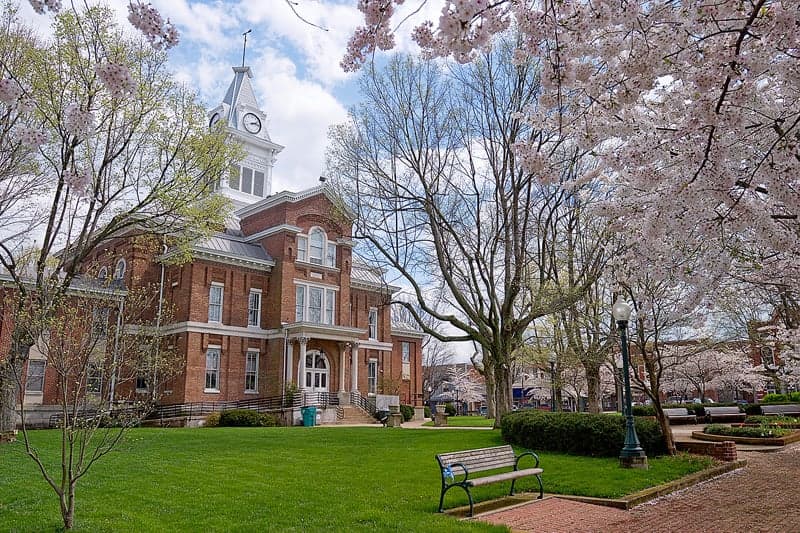
Franklin was founded in 1820 as the seat of Simpson County, drawing its earliest settlers from Virginia, North Carolina, and Tennessee who were attracted by the fertile, rolling farmland of the Pennyroyal Plateau. These original families, predominantly of English and Scots-Irish descent, established the town's grid around the public square, with the Historic Downtown District still bearing the architectural imprint of that era. The arrival of the Louisville and Nashville Railroad in 1859 transformed Franklin from a market town into a regional shipping hub for tobacco, corn, and livestock, spurring a second wave of settlement by merchants, craftsmen, and a small number of German and Irish laborers who built homes in the West End near the rail depot. The early 20th century saw the rise of the tobacco industry—Franklin became a major loose-leaf tobacco market—which drew African American families from surrounding rural areas into the South Franklin neighborhood, where they formed a tight-knit community centered on churches and the segregated school system. By 1950, the population had reached roughly 5,000, with the city's character firmly set as a conservative, agricultural, and religiously observant community.
Modern era (post-1965)
The post-1965 period brought gradual, rather than dramatic, demographic change to Franklin. The Immigration and Nationality Act of 1965 had minimal impact here: the foreign-born share remains at 0.9%, and the city did not experience the large-scale immigration seen in metropolitan areas. Instead, domestic in-migration from rural Simpson County and neighboring counties drove growth, with families moving into the North Franklin subdivisions built along U.S. 31-W during the 1970s and 1980s. The racial composition shifted modestly: the Black population, which had been around 15% in 1960, declined to 8.8% by the 2020s, reflecting outmigration of younger African Americans to larger cities for employment and education. The Hispanic population grew to 5.0%, largely through families working in agriculture and light manufacturing, with a small concentration in the East Franklin area near the industrial parks. The Asian population remains negligible at 0.2%, and the Indian-subcontinent population is effectively zero. The Lake Spring neighborhood, developed around the city's reservoir in the 1990s, attracted middle-class families seeking larger lots and newer homes, reinforcing the city's pattern of outward, low-density expansion rather than densification.
The future
Franklin's population is projected to remain stable or grow slowly, with no major demographic disruption on the horizon. The city is not homogenizing into a single enclave, but rather maintaining distinct, stable neighborhoods: the Historic Downtown is seeing a modest revival of young families and retirees, while the Nashville Road Corridor continues to attract new subdivisions for commuters working in Bowling Green (30 minutes north) or Nashville (60 minutes south). The Hispanic population may grow incrementally through natural increase and continued agricultural labor demand, but the foreign-born share is unlikely to exceed 2-3% in the next decade. The Black population has plateaued, and there is no evidence of significant Asian or Indian immigration. The most notable trend is the aging of the white population, with the median age rising above 40, which could lead to a slight population decline if younger families do not move in to replace retirees. The city's college attainment rate of 13.4%—well below the national average—suggests that Franklin will remain a working-class community, with limited attraction for highly educated professionals unless new industries emerge.
For someone moving in now, Franklin offers a stable, predictable community where the population is largely native-born, conservative, and rooted in local traditions. The city is not becoming more diverse in any meaningful sense, and its future demographic trajectory points toward slow, incremental change rather than transformation. New residents will find a place where neighborhoods are defined by income and housing age rather than ethnic enclaves, and where the social fabric remains tightly woven around churches, schools, and family networks.

* Values derived from national, state, county, city and local statistics and may differ in a specific area. Last updated: 2026-04-21T09:52:55.000Z
Narrative content on this page is AI-generated and may contain mistakes. Verify any details that matter before acting on them.
ReloMaps may earn a commission from affiliate links at no extra cost to you.

