
Photo: Wikipedia
Political ClimatePolitical Climate in Franklin, KY
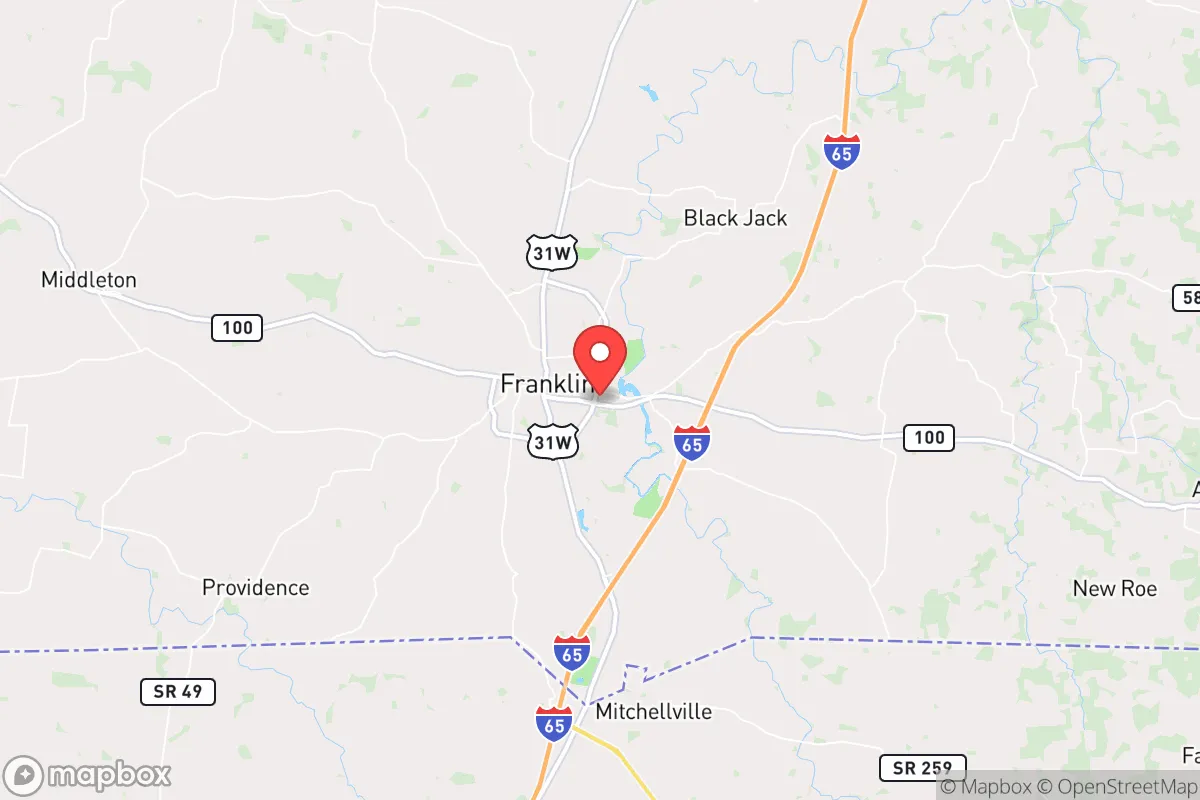
District shown is the primary district for this city’s centroid. Cities may span multiple districts.
Local Political AnalysisPolitical Analysis of Franklin, KY
Franklin, Kentucky, is about as solidly conservative as it gets, with a Cook PVI of R+23 that tells you pretty much everything you need to know about the political lean of the place. This isn't a purple area that's been trending blue; it's a deep red stronghold that's held steady for decades, and the local culture reflects that. You'll find a lot of folks here who remember when the biggest political fights were about school board budgets and road repairs, not the kind of culture-war stuff that's crept into other parts of the state. That said, there's a quiet but real concern among long-time residents that the national progressive agenda is trying to push its way into our local schools and businesses, and people are paying close attention.
How it compares
Drive thirty minutes north to Bowling Green, and you'll feel a noticeable shift—it's a bigger city with a younger, more transient population, and while it's still conservative overall, you see more visible support for progressive causes, especially around the university. Head south to Nashville, and you're in a completely different world, a deep blue metro where the politics and lifestyle are almost unrecognizable to someone from Franklin. That contrast is exactly why a lot of people choose to live here: you get the economic benefits of being close to a major job center like Nashville without having to live under its government overreach. The surrounding rural counties—Simpson, Allen, and Logan—are all similarly conservative, so there's no real "blue island" nearby to cause friction. It's a pretty uniform political landscape, which makes for a stable, predictable environment where you don't have to worry about your local government suddenly deciding to impose new mandates or restrictions on your property or your business.
What this means for residents
For the people who live here, the political climate means a few concrete things. First, your taxes stay low, and there's a general distrust of any new spending that isn't absolutely necessary—the county fiscal court and city council are both dominated by fiscal conservatives who think twice before raising a dime. Second, you have a lot of personal freedom in how you run your life, your business, and your family. There's no push for the kind of zoning overhauls or "equity" initiatives that are popping up in more progressive towns. Third, and this is the part that worries some of us, you see the national trends trying to seep in through school curriculum debates and local library board meetings. It's not a crisis yet, but the older residents who remember when Franklin was even more hands-off are keeping a close eye on any attempt to bring in the kind of government overreach that's become common in places like Louisville or Lexington. The general attitude is: we moved here to get away from that, and we'll fight to keep it that way.
One thing that sets Franklin apart from some other conservative towns is its strong sense of self-reliance and a deep skepticism of any outside authority, whether it's Frankfort or Washington D.C. You see it in the way people handle their own property—lots of folks have gardens, hunt, or keep livestock, and there's a real pride in not needing the government for much. The local gun culture is strong, not as a political statement, but as a practical part of life. There's also a noticeable lack of the kind of performative political displays you see in some places; people here vote conservative and live conservative, but they don't feel the need to put signs in every yard or fly giant flags. It's a quiet, confident conservatism that's more about being left alone than about making a scene. The biggest worry for the future is whether the next generation will hold that same line, especially as more people move in from out of state looking for cheaper land and a slower pace, but without the same deep-rooted understanding of what makes this place work.

State Political ClimatePolitical Climate in Kentucky
State Political AnalysisPolitical Environment in the State
Kentucky has long been a reliably red state in federal elections, but its political climate is more nuanced than a simple partisan label suggests. The state has voted for the Republican presidential candidate in every election since 2000, often by double-digit margins, with Donald Trump carrying it by 26 points in 2020 and 30 points in 2024. However, the state’s political trajectory over the past 20 years has been a steady march rightward, driven by a realignment of rural and working-class voters away from the Democratic Party, which once dominated state and local offices. Today, the GOP holds supermajorities in both chambers of the General Assembly, the governorship, and every statewide office, making Kentucky one of the most solidly conservative states in the nation.
Urban vs. rural divide
The political map of Kentucky is a textbook study in the urban-rural split. The state’s two major population centers—Louisville (Jefferson County) and Lexington (Fayette County)—are the only reliably blue areas, consistently voting Democratic by margins of 15-20 points in statewide races. These cities are home to the University of Louisville, the University of Kentucky, and a concentration of white-collar professionals, healthcare workers, and younger voters who lean left on social issues. In contrast, the rest of the state is overwhelmingly Republican. The rural counties of eastern Kentucky, once a Democratic stronghold due to unionized coal miners, have flipped hard red since 2008, with places like Pikeville and Hazard now voting GOP by 60-70 point margins. The western part of the state, including the Paducah and Owensboro areas, is also deeply conservative, driven by agricultural interests and evangelical churches. The only notable suburban exception is Boone County in northern Kentucky, part of the Cincinnati metro area, which has shifted from purple to solid red over the past decade as transplants from Ohio and Indiana have moved in. The divide is stark: if you draw a line from Louisville to Lexington, everything south and east of that line is deep red, while the two blue islands are increasingly isolated.
Policy environment
Kentucky’s policy environment is aggressively conservative, with a focus on low taxes, limited regulation, and cultural traditionalism. The state has a flat income tax rate of 4.5% as of 2025, down from 6% in 2018, with a scheduled phase-down to 4% by 2027. There is no state-level property tax on real estate, though local governments levy their own. The regulatory posture is business-friendly, with right-to-work laws in place since 2017 and a tort reform system that caps non-economic damages in medical malpractice cases. On education, Kentucky has a robust school choice movement: the state passed a charter school law in 2017 (though no charters have opened yet due to local opposition) and enacted the “Education Opportunity Account” program in 2021, which provides tax credits for donations to scholarship funds for private school tuition. However, the state’s public school system remains a battleground, with teacher strikes in 2018 and 2019 over pension reform and funding. Healthcare is a mixed bag: Kentucky expanded Medicaid under the Affordable Care Act in 2014, but the state has since imposed work requirements and premiums for able-bodied adults, a model that has been challenged in court. Election laws are among the most secure in the nation: Kentucky requires photo ID to vote, has strict voter roll maintenance, and does not allow no-excuse absentee voting. The state also passed a constitutional amendment in 2022 declaring that there is no right to abortion, effectively banning the procedure except to save the mother’s life.
Trajectory & freedom
On the freedom front, Kentucky is moving in a decidedly libertarian-conservative direction, but with some notable caveats. The state has expanded gun rights significantly: in 2019, it passed constitutional carry (permitless concealed carry), and in 2021, it enacted a “Second Amendment Sanctuary” law that prohibits state enforcement of any future federal gun bans. Parental rights have been strengthened: the 2022 “Parents’ Bill of Rights” requires schools to notify parents of any changes to a child’s mental, emotional, or physical health, effectively banning transgender policies without parental consent. On medical autonomy, Kentucky has been a leader in protecting conscience rights: the 2023 “Medical Freedom Act” prohibits employers and insurers from requiring COVID-19 vaccines or masks, and the state has banned vaccine passports. Property rights are strong, with no statewide zoning mandates and a low property tax burden. However, there are areas where government overreach persists: the state’s medical marijuana program, signed into law in 2023, is heavily restricted and won’t be operational until 2025, and recreational cannabis remains illegal. Additionally, the state’s occupational licensing requirements are among the most burdensome in the country, though a 2024 reform bill began to chip away at them. Overall, the trajectory is toward more personal liberty, but the pace is slower than some conservatives would like.
Civil unrest & political movements
Kentucky has seen its share of political flashpoints, but they are less frequent and less intense than in many other states. The most notable recent unrest was the 2020 protests in Louisville following the death of Breonna Taylor, which led to several nights of clashes between demonstrators and police, and the eventual passage of “Breonna’s Law,” which banned no-knock warrants. However, these protests were largely confined to Louisville and did not spread statewide. The state has a strong grassroots conservative movement, particularly in the eastern coal counties, where “Trump Country” rallies and “Stop the Steal” events were common in 2020 and 2021. There is also a growing secessionist sentiment in eastern Kentucky, with some activists pushing for a separate state called “East Kentucky” due to perceived neglect by the state government in Frankfort. Immigration politics are relatively quiet, as Kentucky has a small foreign-born population (about 4%), but there have been local flashpoints over the resettlement of refugees in Bowling Green, which has a sizable Kurdish community. Election integrity is a hot-button issue: the state’s Republican Secretary of State, Michael Adams, has been praised by both parties for running clean elections, but some grassroots activists continue to push for hand-counting of ballots and paper-only voting. Overall, the political climate is stable, but the cultural divide between urban and rural areas is palpable, and a new resident would notice the strong presence of church and family values in daily life.
Projection
Looking ahead 5-10 years, Kentucky is likely to become even more conservative, but with a growing tension between its rural base and its urban centers. In-migration is modest but increasing, with most newcomers coming from neighboring states like Ohio, Indiana, and Tennessee, who tend to be conservative-leaning. The biggest demographic shift is the continued decline of eastern Kentucky’s population, as coal jobs disappear and young people leave for Louisville, Lexington, or out of state. This will further concentrate political power in the suburbs of Louisville and Lexington, which are slowly trending redder as families move out of the urban cores. The state’s Republican supermajority is unlikely to be threatened, but internal GOP fights over school choice, tax cuts, and Medicaid expansion could intensify. The biggest wildcard is the state’s pension crisis: Kentucky has one of the worst-funded public pension systems in the country, and any future tax increases or benefit cuts could spark a backlash. For a conservative moving in, the state will remain a safe haven for traditional values, low taxes, and gun rights, but the cultural battles over education and healthcare will only grow louder. The bottom line: Kentucky is a solid bet for someone seeking a red state with a stable economy and strong community ties, but don’t expect it to be a libertarian paradise—government overreach still exists, especially in licensing and drug laws, and the urban-rural divide means you’ll need to pick your county carefully.
For a new resident, the practical takeaway is this: Kentucky offers a low-cost, low-tax, family-friendly environment with a strong sense of community, especially in smaller towns and rural areas. The political climate is overwhelmingly conservative, and you’ll find that your values are reflected in state law and local culture. However, if you move to Louisville or Lexington, be prepared for a more progressive environment, particularly in city government and public schools. For parents, the school choice options are growing, but you’ll need to research local districts carefully. Overall, Kentucky is a state where you can live freely, raise a family with traditional values, and enjoy a slower pace of life—just know that the political battles are real, and they’re not going away anytime soon.
* Values derived from national, state, county, city and local statistics and may differ in a specific area. Last updated: 2026-04-21T09:52:55.000Z
Narrative content on this page is AI-generated and may contain mistakes. Verify any details that matter before acting on them.
ReloMaps may earn a commission from affiliate links at no extra cost to you.

