Photo: Wikipedia
Demographics of Glendale, AZ
Affluence Level in Glendale, AZ
A middle-class area roughly in line with national averages across income, home values, education, and employment.
People of Glendale, AZ
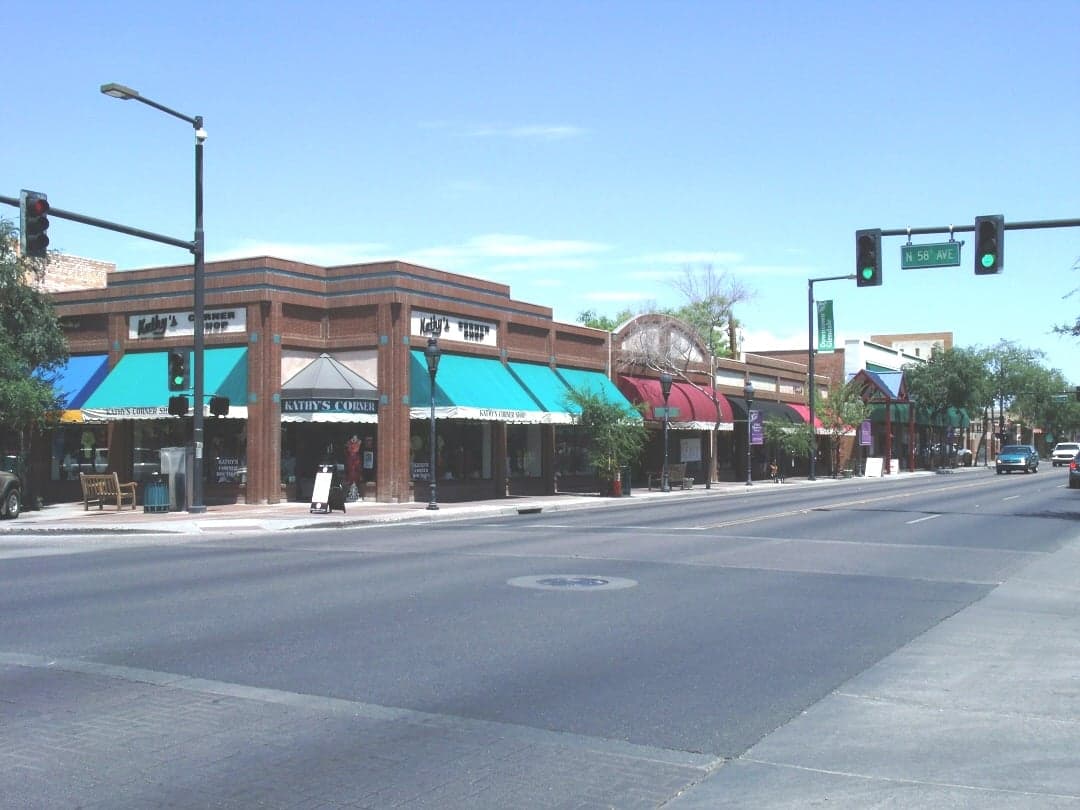
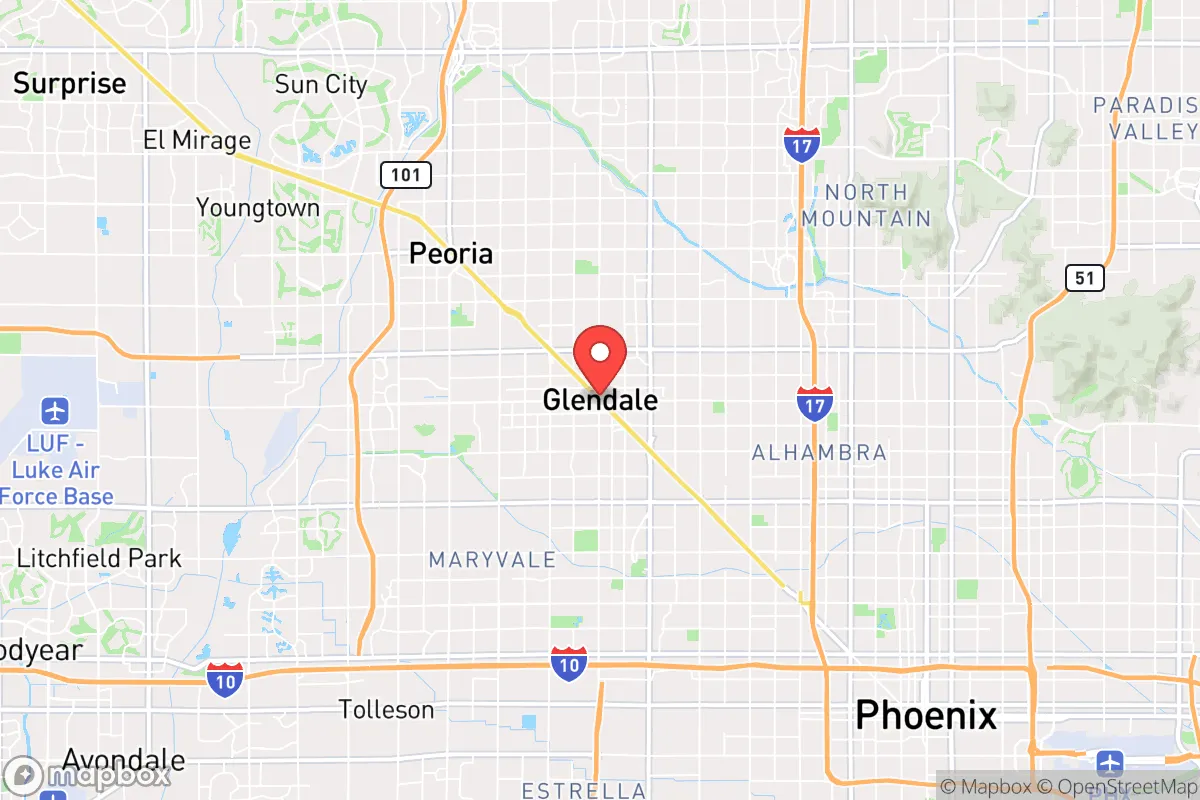
Glendale, Arizona, is a city of roughly 250,000 residents defined by a near-even split between non-Hispanic white (43.2%) and Hispanic (40.5%) populations, with smaller Black (6.6%) and East/Southeast Asian (3.3%) communities. It is a classic Sun Belt suburb that feels more working-to-middle class than its glitzy neighbor Scottsdale, with a density of about 3,200 people per square mile. The city’s identity is rooted in its agricultural past and its role as a bedroom community for Phoenix, but it has developed its own distinct character around Westgate Entertainment District, the Arizona Cardinals stadium, and a growing aerospace and manufacturing base. Only 9.0% of residents are foreign-born, and the college-educated share sits at 23.5%, reflecting a population that is historically blue-collar and family-oriented.
How the city was settled and grew
Glendale was founded in 1892 by a group of New England settlers, primarily of English and German descent, who were drawn by the promise of irrigated farmland along the newly built Arizona Canal. The original plat was laid out by the Glendale Land Company, and the first residents were farmers growing citrus, alfalfa, and cotton. The historic Catlin Court neighborhood, centered around 58th and Palmaire avenues, contains the oldest homes and was the heart of the original settlement. A second early wave came during the 1910s and 1920s, when Midwestern farmers—many from Kansas and Nebraska—moved in during the Dust Bowl era, settling in the Brentwood area near 59th Avenue and Bethany Home Road. These groups were overwhelmingly white and Protestant, and they established Glendale’s reputation as a conservative, church-going community. The city remained small—under 5,000 residents—until after World War II, when returning veterans and defense workers began filling new subdivisions like Greenway Manor (near 51st Avenue and Greenway Road), built in the 1950s for families employed at Luke Air Force Base and the growing Phoenix industrial corridor.
Modern era (post-1965)
The 1965 Immigration and Nationality Act opened the door for a major demographic shift, though Glendale’s transformation was slower than in Phoenix or Los Angeles. The first significant Hispanic population growth came in the 1970s and 1980s, as Mexican-American families moved north from central Phoenix and south from agricultural towns like Tolleson. They concentrated in the Alta Vista neighborhood (roughly 51st to 55th avenues, between Glendale and Northern avenues), a working-class area of modest post-war homes that became the city’s first majority-Hispanic enclave. By the 1990s, Hispanic growth accelerated, and the Cholla area (near 67th Avenue and Cholla Street) saw heavy Mexican-American settlement, alongside smaller numbers of Central American immigrants. The white population, meanwhile, began a slow out-migration to newer suburbs like Surprise and Peoria, a pattern that continues today. The Black population, at 6.6%, is concentrated in the Ocotillo district (around 59th Avenue and Ocotillo Road) and the Palo Verde area, where African-American families moved during the 1980s and 1990s, drawn by affordable housing and proximity to Luke Air Force Base. The East/Southeast Asian community (3.3%) is smaller and more dispersed, with a notable cluster of Vietnamese and Filipino families in the Westgate area, many employed in hospitality and retail near the stadium district. The Indian-subcontinent population (0.7%) is tiny and scattered, with no single ethnic enclave.
The future
Glendale’s population is trending toward a Hispanic majority, a shift that is likely to occur within the next 10–15 years. The white share has dropped from roughly 60% in 2000 to 43.2% today, while the Hispanic share has risen from 25% to 40.5% over the same period. This is not a story of rapid immigration—the foreign-born share is low at 9.0%—but of natural increase and domestic migration of Hispanic families from other parts of Arizona and California. The city is not tribalizing into hostile enclaves; rather, neighborhoods like Alta Vista and Cholla are becoming more uniformly Hispanic, while historically white areas like Catlin Court and Greenway Manor are aging and slowly diversifying. The Black and Asian populations are stable but not growing rapidly, and the Indian community remains negligible. The biggest wildcard is housing affordability: Glendale is still cheaper than Phoenix or Scottsdale, which may attract younger white families priced out of those markets, potentially slowing the Hispanicization trend. The college-educated share (23.5%) is low but rising, driven by the growth of Midwestern University and the expansion of the Westgate employment corridor.
For a conservative-leaning newcomer, Glendale is becoming a more Hispanic, more working-class city, but one that remains politically moderate-to-conservative and family-oriented. The old white Protestant farming culture is fading, replaced by a younger, more diverse population that still values low taxes, strong police presence, and traditional family structures. The city is not becoming a liberal enclave; it is becoming a solidly middle-American suburb with a Latino majority. Anyone moving in now should expect a community where English remains dominant in public life, but where Spanish is increasingly heard in stores and schools, and where the civic culture is shaped more by church and sports than by coastal trends.

* Values derived from national, state, county, city and local statistics and may differ in a specific area. Last updated: 2026-04-19T09:12:17.000Z
Narrative content on this page is AI-generated and may contain mistakes. Verify any details that matter before acting on them.
ReloMaps may earn a commission from affiliate links at no extra cost to you.

