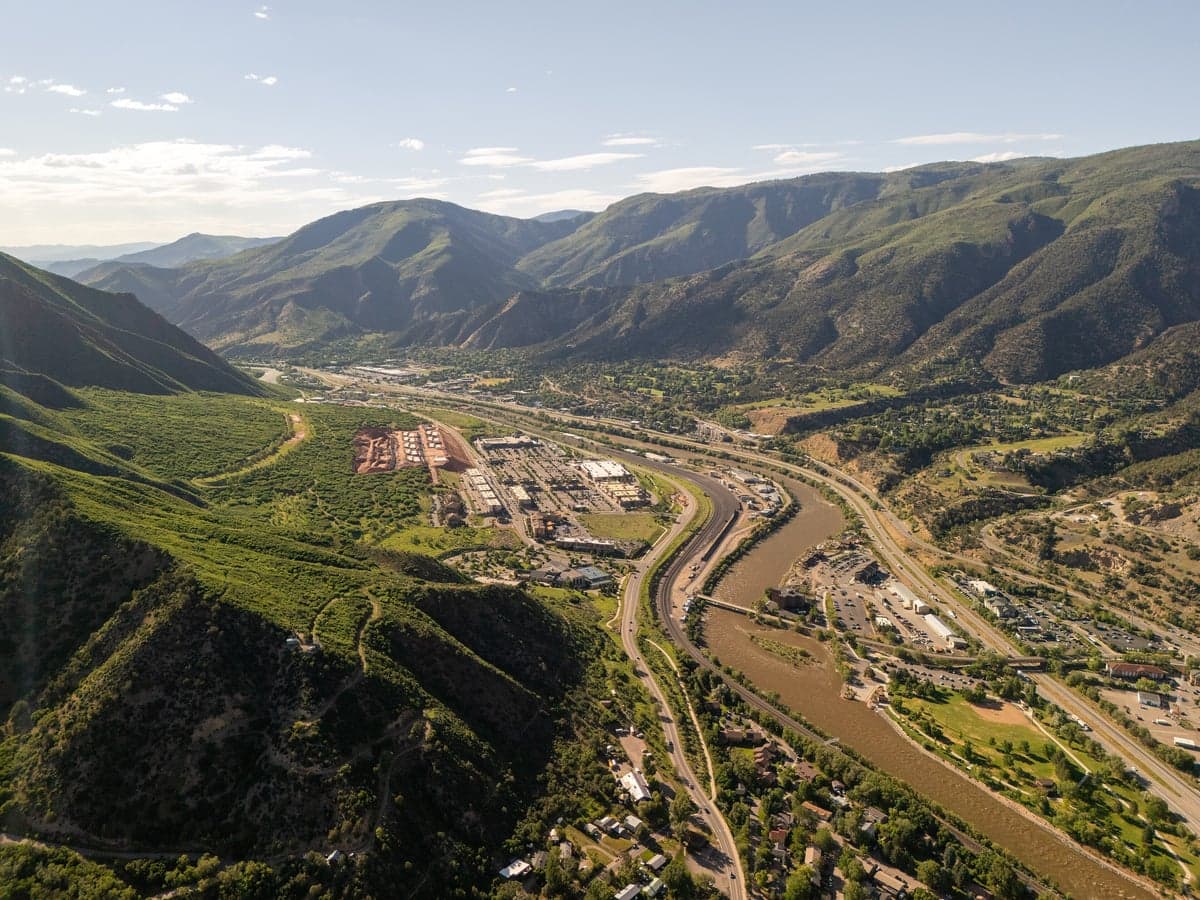
Photo: Wikipedia
Demographics of Glenwood Springs, CO
Affluence Level in Glenwood Springs, CO
An upper-middle-class area. Household wealth, education levels, and homeownership run ahead of national benchmarks.
People of Glenwood Springs, CO
Glenwood Springs, Colorado, is a small mountain city of 10,171 residents with a distinctive demographic profile: a white population of 56.8% and a substantial Hispanic community of 36.4%, reflecting a long history of labor-driven migration. The city has a relatively high college attainment rate of 38.1% and a foreign-born population of 10.6%, largely tied to service and hospitality industries. Its character is shaped by a blend of outdoor recreation tourism, a historic downtown, and a working-class Hispanic presence that contrasts with the more uniformly affluent ski towns nearby.
How the city was settled and grew
Glenwood Springs was formally founded in 1885 as a railroad and resort town, built around the hot springs that had long been known to the Ute people. The original white settlers were Anglo-American entrepreneurs, railroad workers, and health-seekers drawn by the mineral springs and the Denver & Rio Grande Railway. The city’s first major population wave came in the 1880s and 1890s, with European immigrants—primarily Irish, German, and Italian—arriving to work in the railroad yards, coal mines, and construction trades. These groups settled in the West Glenwood neighborhood, which remains a working-class area with older housing stock and a mix of longtime residents. The historic downtown, centered on Grand Avenue, was built by these early settlers and retains much of its Victorian-era architecture. A second wave occurred during the early 20th century as the city became a regional medical and tourism hub, drawing more Anglo professionals and small business owners to North Glenwood, a quieter residential area near the Colorado River. The Hispanic population began arriving in significant numbers during the 1910s and 1920s, primarily as agricultural laborers in the surrounding fruit orchards and sugar beet fields, settling in South Glenwood near the railroad tracks. This pattern of Anglo dominance in professional roles and Hispanic concentration in labor-intensive sectors was firmly established by mid-century.
Modern era (post-1965)
After the 1965 Hart-Cellar Act, Glenwood Springs saw a modest increase in immigration, but the city’s modern demographic story is primarily one of domestic in-migration and Hispanic growth. The Hispanic population expanded steadily from the 1970s onward, driven by continued demand for construction, hospitality, and service workers in the booming Roaring Fork Valley resort economy. This wave settled heavily in West Glenwood and the Midland Avenue corridor, where affordable housing and proximity to service jobs created a concentrated Hispanic enclave. The white population, meanwhile, grew through an influx of amenity migrants—retirees, remote workers, and second-home buyers—who moved into Red Mountain and Sunlight Mountain areas, where newer, higher-end housing developments catered to affluent newcomers. The city’s Asian population remains very small at 0.5% (East/Southeast Asian), and the Indian subcontinent population is effectively zero, reflecting the limited draw for these groups compared to larger Colorado cities. The Black population is also minimal at 0.9%. The college-educated share of 38.1% is high for a mountain town of this size, driven by the professional class in healthcare, tourism management, and remote work. The foreign-born share of 10.6% is almost entirely Hispanic, with many residents holding permanent residency or citizenship after decades in the area.
The future
Glenwood Springs is likely to continue its trajectory of demographic bifurcation: a growing, wealthier white population in higher-elevation neighborhoods and a stable or slowly expanding Hispanic population in the older, lower-cost areas. The Hispanic community is not rapidly assimilating into Anglo neighborhoods; instead, it is maintaining a distinct cultural and residential presence in West Glenwood and South Glenwood. The city’s housing affordability crisis—median home prices exceeding $700,000—will likely accelerate the out-migration of younger, less affluent white residents while reinforcing the Hispanic population’s role in the service economy. The Asian and Black populations are expected to remain negligible, as the city lacks the economic diversity or institutional anchors (universities, large employers) that attract these groups. The overall population growth rate is modest, constrained by geography and land-use regulations, meaning Glenwood Springs will remain a small, socially stratified town rather than homogenizing into a uniform suburb.
For a conservative-leaning individual or family considering relocation, Glenwood Springs offers a stable, low-crime environment with strong outdoor recreation and a clear social structure: a predominantly white professional class in the hills and a Hispanic working class in the flats. The city is not experiencing rapid diversification or cultural conflict, but rather a slow, predictable sorting by income and ethnicity. New arrivals should expect a community where neighborly relations are cordial but where residential and social networks remain largely separate along economic and ethnic lines.

* Values derived from national, state, county, city and local statistics and may differ in a specific area. Last updated: 2026-05-16T10:02:27.000Z
Narrative content on this page is AI-generated and may contain mistakes. Verify any details that matter before acting on them.
ReloMaps may earn a commission from affiliate links at no extra cost to you.

