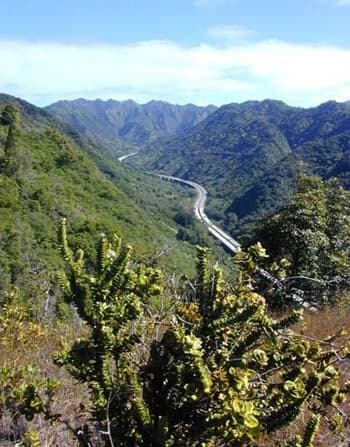
Photo: Wikipedia
Personal Sovereignty in Halawa, HI
Moderate friction. Expect trade-offs in some aspect of personal liberty and independence.
What does Personal Sovereignty tell us?
Personal Sovereignty measures your capacity for self-reliance and independence with minimal government friction. Higher scores mean fewer barriers between you and the way you want to live... but it assumes you have the space you need and good neighbors.
What does this tell us?
Personal Sovereignty measures your capacity for self-reliance and independence with minimal government friction. Higher scores mean fewer barriers between you and the way you want to live... but it assumes you have the space you need and good neighbors.
State Policy
Energy independence: Importer (2% of energy produced in-state)
Personal Liberty
Homesteading

Personal Liberty Analysis
Halawa, Hawaii presents a complex and often contradictory environment for personal sovereignty. While the island’s physical isolation and strong local culture of self-reliance offer some advantages, the overarching legal and regulatory framework of the state of Hawaii imposes significant constraints on individual autonomy. For a conservative or survivalist-minded individual, the trade-offs are stark: you gain a defensible, remote location with a tight-knit community, but you lose substantial control over your property, your ability to defend yourself, and your freedom from government oversight. This analysis breaks down the key factors affecting personal sovereignty in Halawa, from tax burdens to gun laws, to help you decide if the price of paradise is worth the loss of liberty.
Tax burden and regulatory posture in Halawa
Hawaii’s tax burden is among the highest in the nation, and Halawa residents feel this acutely. The state imposes a general excise tax (GET) of 4% on nearly all goods and services, which acts like a hidden sales tax that compounds at every level of business. Property taxes in Honolulu County, which includes Halawa, are relatively moderate for owner-occupied homes (around 0.35% of assessed value), but this is deceptive because Hawaii’s cost of living is roughly 80% higher than the national average, driven largely by housing and energy costs. The regulatory posture is equally burdensome: building permits, land-use changes, and even minor home improvements can require months of approvals from the City and County of Honolulu. For a prepper looking to build a secure, self-sufficient compound, the red tape is a major obstacle. The state’s strict environmental and coastal zone management laws also limit what you can do with your land, making it difficult to dig wells, install solar arrays, or construct outbuildings without extensive permitting. This regulatory density is a clear form of government overreach that directly undermines personal sovereignty.
Self-defense and gun law specifics in Halawa
Hawaii’s gun laws are among the most restrictive in the United States, and Halawa offers no refuge from them. The state requires a permit to acquire a firearm, a registration for every firearm, and a license to carry a concealed weapon—which is effectively impossible to obtain for ordinary citizens. Open carry is illegal, and the state has a “may-issue” concealed carry policy that, until a 2024 court ruling, was essentially a de facto ban. Even after the ruling, the process remains onerous, requiring a “justifiable need” that is rarely granted. For a survivalist, this is a critical vulnerability: you cannot legally defend your home or family with a firearm in a manner consistent with the Second Amendment. The state also bans many common self-defense tools, including pepper spray over a certain size and tasers without a permit. The only practical option for self-defense in Halawa is a knife or a baseball bat, which are poor substitutes against a determined threat. This legal environment forces residents to rely on the police, who are often hours away in a crisis, rather than their own capabilities—a direct erosion of personal sovereignty.
Self-reliance and homesteading viability in Halawa
Halawa’s geography and zoning create a mixed picture for homesteading and off-grid living. The valley is primarily residential, with most lots ranging from 5,000 to 10,000 square feet—enough for a substantial garden and a few fruit trees, but not for livestock or large-scale food production. Zoning in the area is predominantly R-5 (residential), which restricts agricultural uses and the keeping of animals like goats, pigs, or chickens beyond a few hens. Off-grid feasibility is limited: Hawaii has a net metering program for solar, but it is capped and often subject to utility approval, and the state’s building codes require grid connection for new construction. Rainwater catchment is legal but must meet strict health department standards if used for drinking. The biggest challenge is water rights—most of Halawa’s water comes from the municipal system, and drilling a private well is expensive and subject to groundwater permits. For a prepper, the best strategy is to focus on intensive gardening, food preservation, and small-scale renewable energy, but full self-sufficiency is unrealistic without significant capital and legal navigation. The regulatory environment actively discourages the kind of independent living that sovereignty-minded individuals seek.
Personal liberties in Halawa: parental rights, medical autonomy, speech, and property
Hawaii’s progressive governance extends into personal liberties in ways that may concern conservative residents. Parental rights are relatively weak—the state has mandatory reporting laws that can override parental decisions on medical care, and the Department of Education has broad authority over curriculum, including sex education and critical race theory, with limited opt-out options. Medical autonomy is similarly constrained: Hawaii has a vaccine mandate for school attendance and has shown willingness to enforce public health orders, as seen during the COVID-19 pandemic. Free speech is protected by the First Amendment, but Hawaii’s “Hate Crime” laws and speech codes on public property can chill expression on controversial topics like immigration or gender ideology. Property rights are the most concerning: the state’s strong eminent domain powers and strict land-use regulations mean that your property is never truly yours. The Hawaii Land Use Commission can rezone your land without your consent, and the county can impose costly retroactive code requirements. For a survivalist, this means that even if you buy a remote parcel in Halawa, you cannot be sure the government won’t later restrict how you use it. These constraints on personal liberties are a direct threat to the sovereignty that many relocators seek.
Overall, Halawa offers a unique but compromised form of personal sovereignty. The island’s isolation provides a natural buffer against many of the societal breakdowns that preppers fear, and the strong local community can be a valuable asset in a crisis. However, the state’s heavy tax burden, restrictive gun laws, regulatory hostility to self-reliance, and erosion of parental and property rights make it a poor choice for those seeking maximum individual autonomy. Compared to states like Texas, Idaho, or Montana, where gun rights are robust, property rights are stronger, and taxes are lower, Halawa falls short. For a conservative or survivalist-minded individual, the best approach is to view Halawa as a temporary retreat or a second home, not a permanent base for long-term sovereignty. If you value freedom from government overreach above all else, you will find more fertile ground elsewhere in the mainland United States.

* Values derived from national, state, county, city and local statistics and may differ in a specific area. Last updated: 2026-04-24T06:09:54.000Z
Narrative content on this page is AI-generated and may contain mistakes. Verify any details that matter before acting on them.
ReloMaps may earn a commission from affiliate links at no extra cost to you.

