Photo: Wikipedia
Demographics of Hoboken, NJ
Affluence Level in Hoboken, NJ
A wealthy area with high-earning, well-educated households. Incomes, home values, and educational attainment meaningfully outpace national averages.
People of Hoboken, NJ
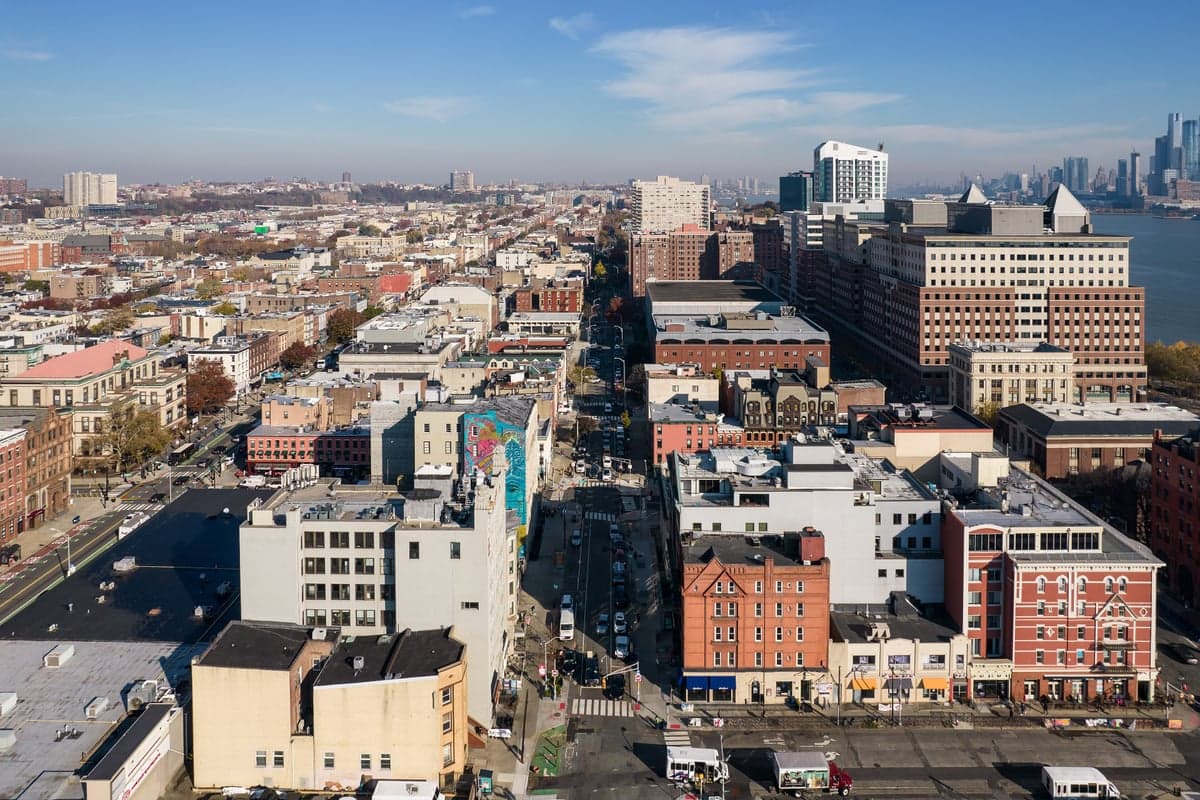
Hoboken, New Jersey, is a densely packed city of 58,340 residents where 83.1% hold a college degree, making it one of the most educated municipalities in the United States. The population is predominantly White (64.8%), with a significant Hispanic community (13.8%) and notable East/Southeast Asian (6.8%) and Indian-subcontinent (6.2%) populations, while the Black share stands at 3.7%. The city’s character is defined by young professionals, families drawn to top-tier schools, and a historic working-class DNA that still surfaces in its neighborhoods and local politics. Only 9.3% of residents are foreign-born, a figure well below the national average, reflecting a population shaped more by domestic in-migration than by recent international arrivals.
How the city was settled and grew
Hoboken’s human history begins with the Lenni-Lenape people, who used the area as a seasonal fishing camp before Dutch colonists purchased the land in the 1600s. The city’s modern population story starts in the early 19th century, when Colonel John Stevens developed the area as a resort and ferry terminal, drawing wealthy New Yorkers to summer homes along the waterfront in what is now the Shipyard and Hudson Street corridor. The real population boom came with German and Irish immigrants in the 1840s–1860s, who built the city’s brownstones and worked in the new rail yards and factories. These groups settled heavily in the West Side and Church Square Park area, establishing Catholic parishes and social clubs that anchored the community for generations. By 1900, Italian immigrants arrived in force, clustering in the Mile Square neighborhood around Adams and Jefferson Streets, where they dominated the longshoreman and construction trades. Eastern European Jews followed in the early 1900s, settling along Washington Street and opening small shops that gave the commercial corridor a distinctly ethnic character through the mid-20th century.
Modern era (post-1965)
The post-1965 period brought dramatic demographic change. The 1965 Hart-Cellar Act opened immigration from Asia and Latin America, but Hoboken’s foreign-born share actually declined as the city emptied out during the 1970s and 1980s suburban flight. The population bottomed at roughly 33,000 in 1980, with many Italian and Irish families leaving for Bergen County suburbs. The city’s revival began in the 1990s, driven by young professionals priced out of Manhattan. This wave—overwhelmingly White and college-educated—concentrated in the Uptown and Hoboken Terminal areas, where renovated brownstones and new luxury rentals replaced aging tenements. The Hispanic population grew during this period, rising to 13.8% today, with many families settling in the Southwest Hoboken corridor near the projects and along Observer Highway, where rents remained lower. The East/Southeast Asian community (6.8%) arrived primarily in the 2000s and 2010s, drawn by tech and finance jobs, and concentrated in the Midtown and Waterfront luxury towers. The Indian-subcontinent population (6.2%) grew rapidly after 2010, with many families choosing the Heights and Western Slope areas for their larger apartments and proximity to the PATH train. The Black population, once 10% in 1970, has declined to 3.7%, with many families displaced by rising rents moving to Jersey City or Newark.
The future
Hoboken’s population is likely to continue homogenizing along income lines, with the college-educated share (already 83.1%) pushing higher as new luxury developments replace older housing stock. The Hispanic community, which has held steady at roughly 13–14% for two decades, may plateau or decline slightly as the Southwest Hoboken corridor redevelops. The East/Southeast Asian and Indian-subcontinent populations are both growing, but from a small base, and are unlikely to exceed 10% each in the next decade. The foreign-born share (9.3%) is low and may fall further as domestic in-migration from other U.S. cities continues to dominate. The city is not tribalizing into distinct ethnic enclaves—rather, it is becoming a largely White, wealthy, and highly educated city with smaller, dispersed minority communities. The working-class Italian and Irish identity that defined Hoboken for a century is now largely symbolic, preserved in festivals and parish names rather than in daily life.
For someone moving in now, Hoboken is a city that has completed its transformation from an immigrant industrial hub to a professional-class bedroom community. The population is stable, highly educated, and increasingly homogeneous by income and education, even as it retains modest ethnic diversity. The trade-off is clear: excellent schools, low crime, and a vibrant downtown come at the cost of the economic and cultural diversity that once defined the Mile Square City.

* Values derived from national, state, county, city and local statistics and may differ in a specific area. Last updated: 2026-05-23T21:47:46.000Z
Narrative content on this page is AI-generated and may contain mistakes. Verify any details that matter before acting on them.
ReloMaps may earn a commission from affiliate links at no extra cost to you.

