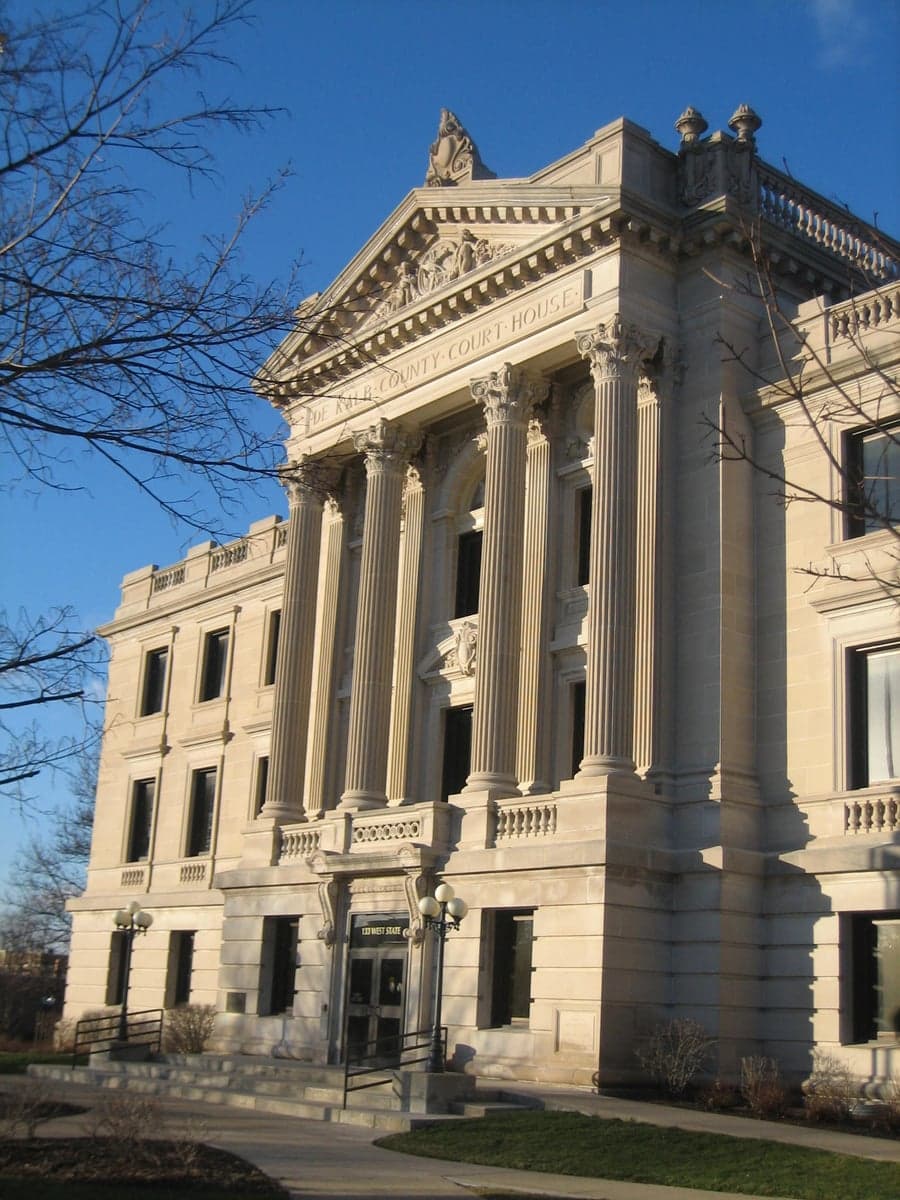
Photo: Wikipedia
Demographics of Dekalb County
Affluence Level in Dekalb County
A below-average socioeconomic profile. Incomes, home values, and educational attainment trail the U.S., with higher poverty and unemployment.
People of Dekalb County
DeKalb County, Illinois, is a predominantly white, college-educated community of just over 100,000 residents, anchored by the city of DeKalb and the main campus of Northern Illinois University. The county’s population is notably less diverse than the national average, with a foreign-born share of only 3.2%, and its character is shaped by a blend of agricultural heritage, a major public university, and steady suburban growth along the Interstate 88 corridor. The people here today are a mix of long-standing farming families, university faculty and students, and commuters drawn to communities like Sycamore and Genoa for their lower cost of living relative to the Chicago suburbs.
Settlement & growth (pre-1960)
Before American settlement, the region was inhabited by the Potawatomi, Sauk, and Fox nations, who used the area for hunting and seasonal camps. The first permanent American settlers arrived in the 1830s, following the Black Hawk War and the subsequent forced removal of Native peoples. These early pioneers were primarily of Yankee stock—English-descended families from New England and upstate New York—who were drawn by the fertile prairie soil and the promise of land under the 1830 Preemption Act. They founded the county seat of Sycamore in 1837 and the town of DeKalb in 1837, naming the latter after a Revolutionary War hero.
The next major wave came in the 1840s and 1850s, when German and Irish immigrants arrived to work on the Galena and Chicago Union Railroad, which reached the county in 1853. German farmers, in particular, settled in the rural townships around Waterman and Sandwich, establishing tight-knit Lutheran and Catholic communities that remain visible today in local church affiliations and family names. The Irish concentrated in DeKalb and Sycamore, working as railroad laborers and later in the emerging manufacturing sector. By 1860, the county’s population had reached roughly 20,000, with agriculture—especially corn and oats—as the economic backbone.
The late 19th and early 20th centuries saw a smaller but significant influx of Swedish immigrants, who settled in Clare and Kingston, drawn by the region’s resemblance to their homeland’s farmland. The founding of the Northern Illinois State Normal School (now NIU) in DeKalb in 1895 began to shift the county’s demographic center of gravity, attracting faculty and students from across the Midwest. The 1920s and 1930s brought a modest number of Italian and Polish families to DeKalb and Cortland, many working in the new barbed-wire factories that made the county famous. The Dust Bowl and Great Depression had little direct impact on migration here, as the county’s agricultural economy remained relatively stable. By 1960, the population had grown to about 51,000, still overwhelmingly white and native-born, with a strong rural and small-town character.
Modern era (post-1965)
The 1965 Hart-Cellar Act had a muted effect on DeKalb County compared to major urban centers. The foreign-born population today is just 3.2%, far below the national average of roughly 14%. The most notable post-1965 immigrant group is a small but growing Hispanic community, primarily of Mexican origin, who began arriving in the 1980s and 1990s to work in agriculture and food processing. This population concentrates in DeKalb and Sandwich, where they have established small enclaves with Spanish-language churches and tiendas. The Hispanic share of the county’s population now stands at 14.0%, up from about 5% in 1990.
Domestic migration has been more transformative. The expansion of NIU from a teachers’ college to a comprehensive research university in the 1960s and 1970s brought a steady stream of faculty, staff, and students from across the country and, to a lesser extent, abroad. This influx diversified the county’s racial makeup modestly: the Black population, at 7.7%, is concentrated in DeKalb and is largely tied to the university and its athletic programs. East and Southeast Asian communities (1.3%) and Indian-subcontinent residents (0.7%) are also primarily university-affiliated, living in DeKalb and Sycamore. Suburbanization along the I-88 corridor, which connects the county to Chicago’s western suburbs, has driven growth in Genoa and Hinckley, attracting white-collar commuters who work in Naperville, Aurora, and even Chicago. These newcomers tend to be more educated—32.7% of county residents hold a bachelor’s degree or higher—and more politically moderate than the older farming population.
The county’s overall racial composition remains 72.4% white, reflecting both the limited impact of post-1965 immigration and the tendency of new residents to be white and native-born. The Black and Hispanic populations have grown slowly but steadily, while the Asian and Indian shares remain small and concentrated in specific neighborhoods near the university.
The future
DeKalb County is likely to continue its gradual diversification, driven primarily by NIU’s recruitment of out-of-state and international students and by the ongoing suburbanization of the I-88 corridor. The Hispanic population is projected to grow to roughly 18-20% by 2040, as younger families settle in DeKalb and Sandwich and as agricultural labor demand persists. The Black and Asian shares will probably increase modestly, but the county will remain less diverse than the Chicago metro area as a whole. The white population, while still the majority, is aging and declining slightly, as younger white residents often leave for larger cities after college.
The county is not tribalizing into distinct ethnic enclaves in the way that some suburban Chicago communities have. Instead, the Hispanic population is integrating into existing neighborhoods and schools, particularly in DeKalb, while the university community remains a separate, transient demographic layer. The cultural identity of the county is likely to remain a blend of agricultural conservatism and university liberalism, with the balance slowly tipping toward the latter as suburban in-migration continues. For a newcomer, this means a place where traditional Midwestern values coexist with a college-town atmosphere, and where the pace of change is slow enough to feel manageable.
DeKalb County is becoming a slightly more diverse, more educated, and more suburban place, but it retains a strong small-town and agricultural character that sets it apart from the denser Chicago collar counties. For someone moving in now, the county offers a stable, affordable environment where the population is growing slowly and the cultural divides are less pronounced than in many other parts of Illinois.

* Values derived from national, state, county, city and local statistics and may differ in a specific area. Last updated: 2026-05-29T18:24:21.000Z
Narrative content on this page is AI-generated and may contain mistakes. Verify any details that matter before acting on them.
ReloMaps may earn a commission from affiliate links at no extra cost to you.

