Photo: Wikipedia
Political ClimatePolitical Climate in Porter County
Showing district-level results — no local-only data available.
Local Political AnalysisPolitical Analysis of Porter County
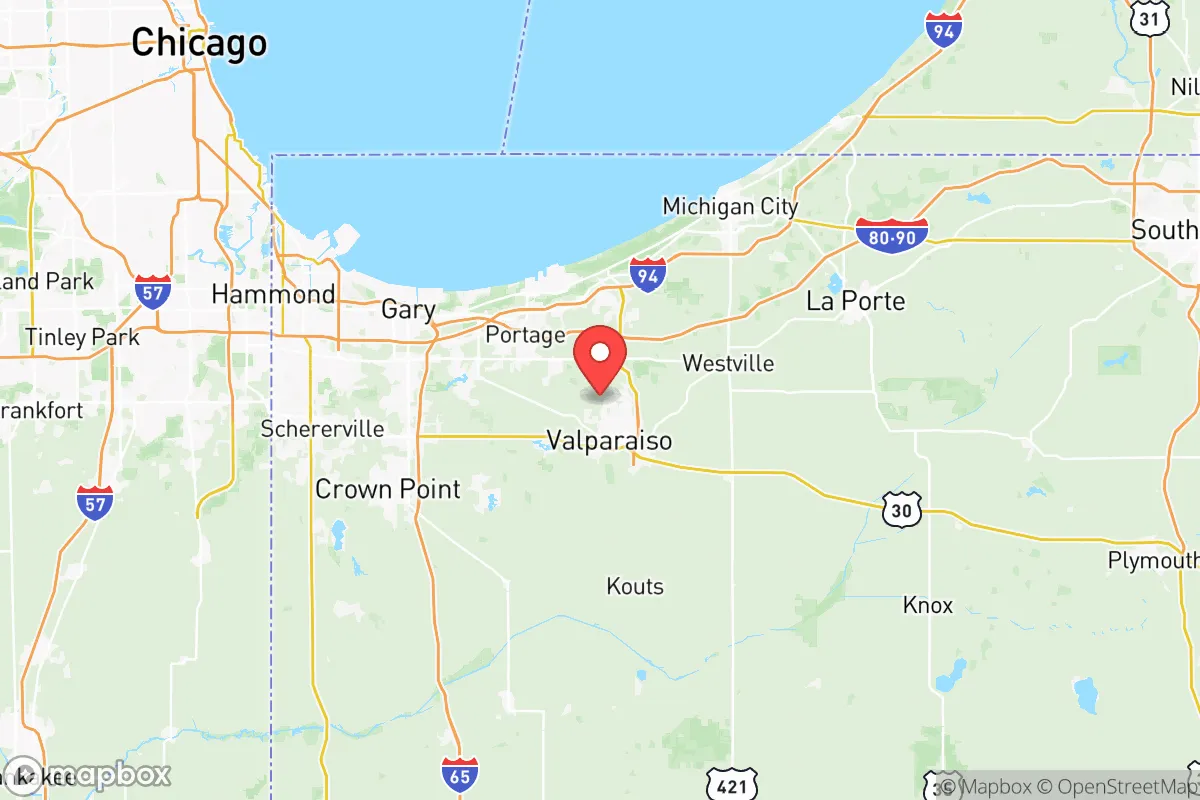
Porter County used to be a place where common sense and conservative values were just the air you breathed, but over the last decade it's shifted noticeably left. The Cook PVI now sits at D+1, which puts it square in swing territory. Meanwhile, the rest of Indiana leans solidly red at R+9, meaning our county is an outlier — and not in a good way if you're worried about government creep and progressive overreach. Go from the farm fields of Hebron to the college town of Valparaiso and you'll feel the political temperature change fast.
How it compares
Compared to the rest of Indiana, Porter County is a blue dot in a red sea. The state's R+9 rating shows Hoosier common sense is still alive statewide, but here in the northwest corner, it's being eroded. The swing precincts are the ones to watch — places like Liberty Township and Portage often decide elections, and they've been trending away from the conservative values that built this area. Meanwhile, Chesterton and Beverly Shores near the lake lean blue, while Hebron, Kouts, and Morgan Township still hold the line for fiscal responsibility and limited government. The difference is stark: in a state that overwhelmingly rejected progressive policies, Porter County's D+1 rating means we're a battleground for ideas that many Hoosiers elsewhere wouldn't touch.
What this means for residents
If you value local control and minimal government interference, Porter County's political drift is concerning. The push for higher taxes, expansive zoning regulations, and woke school board policies has grown louder in places like Valparaiso and Ogden Dunes. Over the past few years, we've seen county commissioners flirt with progressive environmental mandates that would hit property rights hard. The Indiana state government in Indianapolis generally keeps the worst impulses in check — for example, preempting local gun control efforts and protecting parental rights in schools. But here at home, the fight is constant. If you move here, expect to stay engaged; the local elections in Porter County really matter because they determine how much of that state-level freedom actually reaches your doorstep.
Culturally, there's a real split. The old rural towns still host 4-H fairs and church potlucks, but the lakeshore communities and the university area have embraced a kind of coastal, progressive mindset that sees government as a solution instead of a threat. You can still find a welcome from folks who believe in personal freedom and low taxes, especially if you head south of the county line toward Jasper or Pulaski counties where the R+ numbers are even stronger. But Porter County itself is no longer a safe bet for conservatives. It's become a place where you have to pick your town carefully and keep an eye on every ballot measure. The next few election cycles will tell if we can pull it back toward the sensible middle or if we'll keep sliding toward overreach and regulation.

State Political ClimatePolitical Climate in Indiana
State Political AnalysisPolitical Environment in the State
Indiana is reliably Republican, with a Cook PVI of R+9, but that number only tells half the story. The state has shifted to the right over the past 20 years, driven by the exurban sprawl of Indianapolis, the industrial conservatism of Fort Wayne, and a deep rural vote that shows no sign of softening. Still, it’s not a monolith—pockets of blue in Bloomington, Gary, and South Bend keep the map interesting, and the policy battles here are increasingly national in character.
Urban vs. rural divide
The political map breaks cleanly: the seven-county Indianapolis metro area, anchored by Marion County, provides nearly all of the state’s Democratic votes. Outside that donut, the rest of Indiana is a sea of red. Hamilton County, the state’s wealthiest and fastest-growing suburb, has been trending rightward since the 1990s and now routinely delivers 60%+ Republican margins. Allen County (Fort Wayne) has shifted red in presidential years, while Lake County (Gary) remains the last reliably blue stronghold in the northwest, though its influence is shrinking with population loss. The small cities—Terre Haute, Muncie, Kokomo—have all moved right, reflecting a broader realignment of working-class voters away from the Democratic Party. The rural counties, especially those along the Ohio River like Switzerland and Perry, vote 70-80% Republican and have become the bedrock of the state’s conservative majority.
Policy environment
Indiana’s policy posture is broadly conservative with a pragmatic tilt. The state has a flat income tax of 3.15% (scheduled to drop to 2.9% by 2027), no inheritance tax, and a property tax cap written into the state constitution. Governor Eric Holcomb signed a 2022 bill that eliminated the business personal property tax for most small manufacturers, and the legislature has repeatedly cut corporate tax rates. On education, Indiana has one of the oldest and most robust school choice programs in the country—any family can use a state voucher to attend private or charter schools, and over 65,000 students did so in the 2023-24 school year. Parents have statutory rights to review curriculum materials and opt their children out of instruction they find objectionable. On health care, the state expanded Medicaid under the Affordable Care Act (HIP 2.0) with a work requirement waiver, a compromise that pleased few ideologues but kept coverage stable. Election law is restrictive but stable: voter ID is required, early voting windows are uniform across counties, and drop boxes are allowed only at county clerk offices. There is no no-excuse absentee voting by mail, though permanent absentee status exists for seniors and disabled voters.
Trajectory & freedom
On the freedom ledger, Indiana has been moving in the right direction for conservatives. The state became a Constitutional Carry state in 2022—no permit required to carry a handgun—and preempts local gun ordinances entirely. Parents’ rights were strengthened in 2023 with a law that lets parents sue school districts over instructional materials they deem harmful, and the state has banned gender-transition procedures for minors. COVID-era lockdowns were relatively mild compared to the coasts, and the legislature passed a 2021 law limiting the governor’s emergency powers, so a future crisis won’t see the same unilateral closures. On taxation, Indiana is on track to become one of the flattest-lowest income tax states in the Midwest. Property taxes, however, remain a pain point in high-growth suburbs like Westfield and Fishers, where assessed values have surged and caps (1% of assessed value for residential) are binding. The legislature has talked about further compression, but no bill has passed. There’s no state-level rent control, and zoning reform has been slow—most new development is still single-family, though Indianapolis has loosened rules on accessory dwelling units.
Civil unrest & political movements
Indiana has seen its share of political friction, but it’s generally quieter than its neighbors. The 2020 protests in Indianapolis over George Floyd’s death led to property damage downtown and a heavy police response, but no long-term unrest. The Moms for Liberty movement found fertile ground in Hamilton County and Johnson County, where school board meetings became flashpoints over critical race theory and library book content. The state legislature responded by banning CRT in K-12 curriculum and requiring schools to post all instructional materials online. On immigration, Indiana is a “Second Amendment sanctuary” state (no state resources enforcing federal gun bans) but has no sanctuary city policies—Gary and East Chicago have considered “welcoming” resolutions, but nothing has stuck. Election integrity became a talking point after the 2020 cycle, and the legislature tightened chain-of-custody rules for absentee ballots and banned private funding of election administration. There’s been no serious secession talk, but the Indiana Freedom Coalition and similar groups have pushed for county-level Second Amendment sanctuary resolutions, which about half of Indiana counties have passed.
Projection
Over the next 5-10 years, Indiana is likely to stay solidly red, but with some demographic pressure from the Indianapolis metro’s growth. Tens of thousands of people are moving to Noblesville, Carmel, and Greenwood from bluer states like Illinois and California, bringing slightly more moderate views on social issues like marijuana legalization (which polls well even among Republicans in Indiana but has not passed the legislature). The state’s population is growing slowly, about 1-2% per cycle, and the rural vote is aging out. The real question is whether the Republican supermajority in the legislature will fracture along “establishment” vs. “freedom caucus” lines—primary challenges have become common in Wayne County and Howard County. Democrats have no path to statewide power without a total collapse of the GOP, but they could pick up a few suburban House seats if moderate Republicans stay home. For a conservative mover, the trajectory is largely reassuring: low taxes, strong gun rights, school choice, and parental control over education are all baked in. The only wildcard is property tax relief, which could become a defining issue in 2026.
For a new resident, the bottom line is simple: Indiana offers a genuinely conservative policy environment with stable taxes, school choice, and limited government interference in daily life. You won’t face the regulatory creep of coastal states, but you will see rising property taxes in growing suburbs and occasional culture-war debates at school board meetings. If you can tolerate cold winters and flat farmland, it’s a solid bet for a family or individual who values practical freedom over partisan theatrics.
* Values derived from national, state, county, city and local statistics and may differ in a specific area. Last updated: 2026-06-05T15:13:36.000Z
Narrative content on this page is AI-generated and may contain mistakes. Verify any details that matter before acting on them.
ReloMaps may earn a commission from affiliate links at no extra cost to you.

