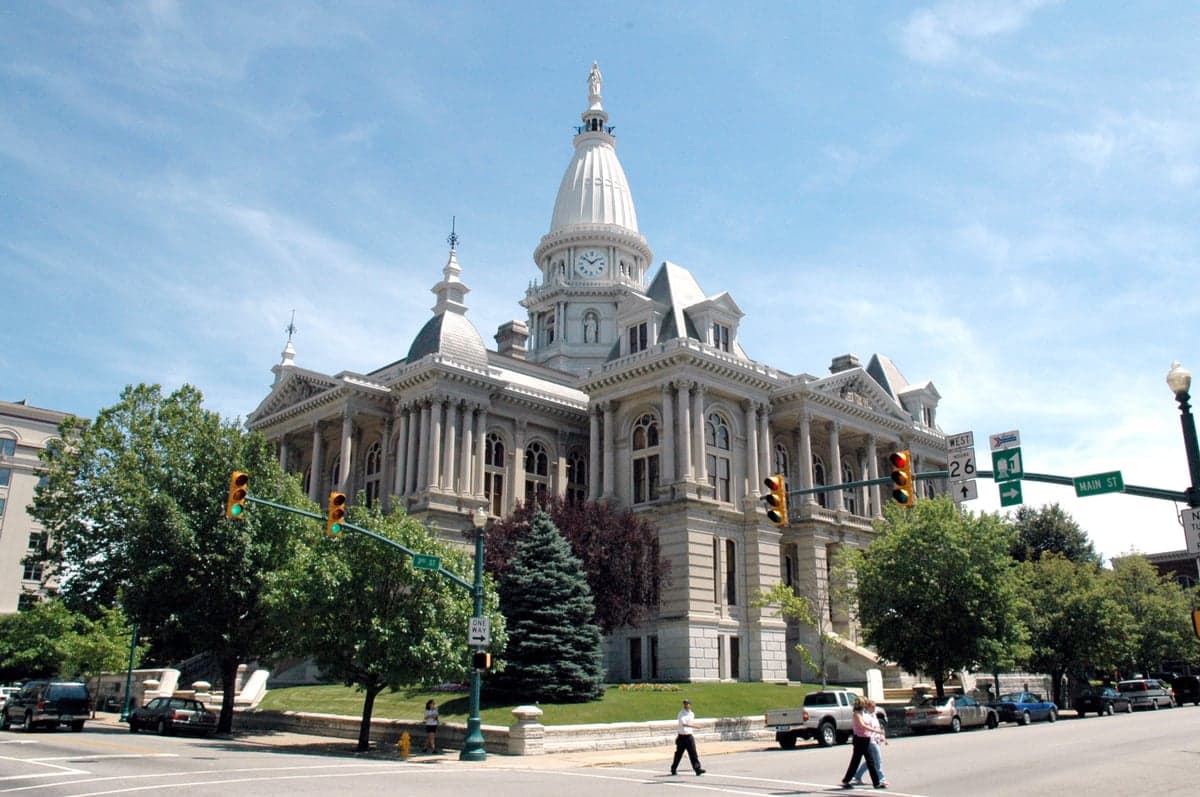
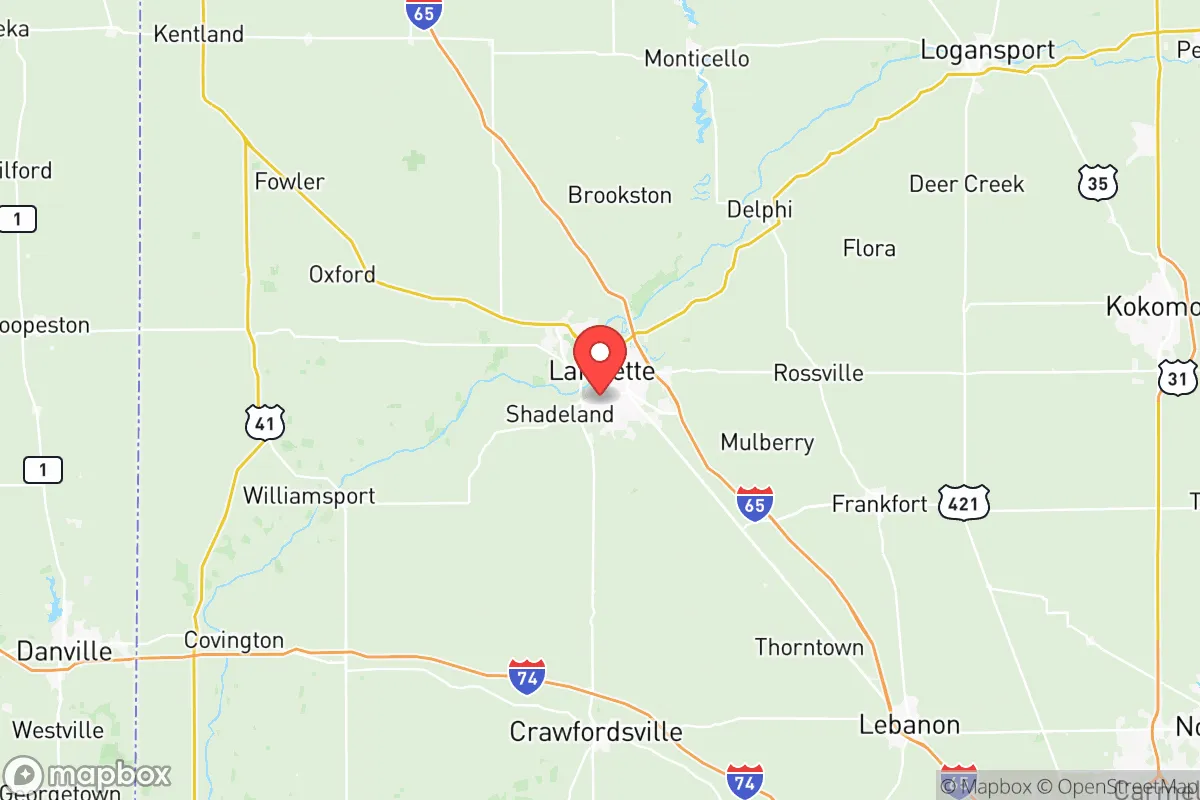
Photo: Wikipedia
Political ClimatePolitical Climate in Tippecanoe County
Showing district-level results — no local-only data available.
Local Political AnalysisPolitical Analysis of Tippecanoe County
Tippecanoe County is a fascinating political outlier in Indiana, a blue dot in a sea of red that has only become more pronounced in recent years. While the county as a whole leans Republican with a Cook PVI of R+15, that number masks a deeply divided electorate where the city of West Lafayette acts as a powerful Democratic stronghold, while the rest of the county, particularly the rural areas and towns like Battle Ground and Dayton, are reliably conservative. The county's trajectory is one of increasing polarization, driven by the growth of Purdue University and its surrounding tech corridor, which pulls the county's overall vote closer to the center even as the state of Indiana (PVI R+9) has moved decisively to the right.
How it compares
The difference between Tippecanoe County and the state of Indiana is stark and comes down to one thing: West Lafayette. The state's R+9 rating reflects a broad, rural-to-suburban conservative consensus, but Tippecanoe County's R+15 is a statistical artifact of a county that contains one of the most liberal college towns in the Midwest. In a typical election, West Lafayette precincts can deliver 70-80% of their votes to Democratic candidates, while the rest of the county—including the city of Lafayette itself, which is more of a swing area—votes heavily Republican. This creates a countywide result that is more Republican than the state average, but only because the conservative vote outside West Lafayette is so lopsided. The county's political geography is essentially a tug-of-war between the university's progressive influence and the surrounding agricultural and exurban communities that align with the state's dominant GOP lean.
What this means for residents
For a conservative resident living in a place like Battle Ground or Dayton, the political climate feels very much in line with the rest of Indiana. Local offices, from the county commission to the sheriff, are reliably Republican, and the cultural tone of those communities is traditional and family-oriented. For a liberal resident in West Lafayette, the experience is entirely different. You can live, work, and socialize in a bubble where progressive politics are the norm, but you are acutely aware that a 15-minute drive into the county's rural precincts takes you into a completely different political world. This split means that local policy debates—over things like land use, school funding, and public health measures—are often fought along this urban-rural divide, with the university community pushing for more progressive stances and the county's rural and suburban voters pushing back.
Culturally, this creates a county that is more tolerant and diverse than its statewide reputation would suggest, but also one where the political battles are fought in plain sight. The presence of Purdue means the county has a more international, educated, and secular population than most of Indiana, which influences everything from the restaurant scene to the types of local businesses that thrive. However, the county's conservative majority ensures that policy remains largely in line with state-level Republican priorities, such as limited gun control and restrictions on abortion. For a new resident, the key takeaway is that Tippecanoe County offers a genuine choice: you can find a community that matches your political values, but you will also live in a place where the other side is a very real and vocal presence, making local politics a constant, engaging feature of daily life.

State Political ClimatePolitical Climate in Indiana
State Political AnalysisPolitical Environment in the State
Indiana has been a reliably Republican state for decades, with a Cook Partisan Voting Index of R+9, meaning it votes about nine points more Republican than the nation as a whole. The state hasn't backed a Democrat for president since 2008, when Barack Obama narrowly won it, and that now looks like an anomaly driven by a unique coalition of urban turnout and economic anxiety. Over the last 10-20 years, the trajectory has been steadily rightward, driven by the exurban growth around Indianapolis and the deep red consolidation of small-town and rural counties, even as the core of Marion County (Indianapolis) has become a Democratic stronghold.
Urban vs. rural divide
The political map of Indiana is a textbook study in the urban-rural split. Marion County, home to Indianapolis, is the state's Democratic anchor, regularly delivering margins of 20-30 points for Democratic candidates. The other urban counties—Lake (Gary), Monroe (Bloomington), and Tippecanoe (West Lafayette)—also lean blue, driven by university populations and diverse industrial bases. But the rest of the state is overwhelmingly red. The fastest-growing parts of Indiana are the suburban and exurban rings around Indianapolis, places like Hamilton County (Carmel, Fishers, Noblesville), which is one of the most Republican counties in the nation. Similarly, Allen County (Fort Wayne) has trended right as its manufacturing base has held steady. The rural south, including counties like Dubois County (Jasper) and Vanderburgh County (Evansville), votes heavily Republican, though Evansville itself is a bit more competitive. The only real blue pockets outside the major metros are college towns like Bloomington and West Lafayette, where student and faculty populations push the vote left. The divide is stark: drive 20 minutes outside any city center, and you're in deep red territory.
Policy environment
Indiana's policy environment is consistently conservative, with a low-tax, low-regulation posture that has been in place for decades. The state has a flat income tax rate of 3.05%, which is scheduled to drop further to 2.9% by 2027, and a sales tax of 7%. Property taxes are capped at 1% of assessed value for owner-occupied homes, which keeps housing costs manageable. The state is a "right-to-work" state (enacted in 2012), which has weakened union influence, particularly in manufacturing. Education policy has been dominated by school choice: Indiana has one of the nation's most expansive voucher programs, and charter schools are widespread. The state also passed a law in 2022 requiring schools to post curriculum materials online and notify parents of "instructional materials" involving human sexuality. On healthcare, Indiana expanded Medicaid under the Affordable Care Act via a conservative waiver program (HIP 2.0), but the state has not pursued a public option. Election laws have tightened: voter ID requirements are among the strictest in the nation, and in 2021 the legislature reduced the early voting window and limited absentee voting. There is no statewide nonpartisan redistricting commission; the GOP-controlled legislature draws the maps, which has produced heavily gerrymandered districts.
Recent policy direction
The last few years have seen Indiana move decisively in a conservative direction on a broad set of issues. On gun rights, the state became a constitutional carry state in 2022, meaning no permit is required to carry a handgun in public. On education and parental rights, the 2022 "Parental Bill of Rights" law (HB 1134) requires schools to notify parents about any changes to a student's mental, emotional, or physical health, which has been controversial regarding LGBTQ+ students. In 2023, the state banned gender-affirming care for minors (SB 480), overriding a veto from Governor Eric Holcomb. On abortion, Indiana was one of the first states to pass a near-total ban after Dobbs, with exceptions only for rape, incest, and life of the mother; that law (SB 1) took effect in 2023 after legal challenges. On property rights, the state has a strong tradition of protecting landowners, with relatively few zoning restrictions outside of major cities. On taxation, the trend is toward further cuts: the flat income tax is scheduled to decline, and there is ongoing discussion about eliminating the business personal property tax. On voting, the 2021 law (SB 398) reduced early voting from 28 days to 10 days and tightened absentee ballot rules. On privacy and surveillance, Indiana has not passed a comprehensive data privacy law, though there are sector-specific rules. The overall direction is clear: the state is moving to solidify a conservative policy framework across the board.
Civil unrest & political movements
Indiana has not seen the kind of large-scale civil unrest seen in some coastal states, but there have been notable flashpoints. The 2020 George Floyd protests in Indianapolis were significant, with several nights of demonstrations and some property damage, but they were smaller and shorter than in many peer cities. The state has an active and organized conservative movement, particularly around gun rights (the Indiana Gun Owners group is influential) and anti-abortion activism. On the left, the Indiana Democratic Party is weak at the state level but maintains strong local organizations in Marion, Monroe, and Lake counties. Immigration politics have been relatively quiet compared to border states, though there have been localized controversies over refugee resettlement in Fort Wayne and South Bend. There is no serious secession or nullification movement in Indiana. Election integrity has been a recurring theme: after the 2020 election, some Republican county officials called for audits, but there were no major controversies or overturned results. The most visible political flashpoint for a new resident would likely be the abortion debate, which remains highly charged, with clinics closing and ongoing legal battles. Overall, the political climate is stable but polarized along familiar lines.
Projection
Over the next 5-10 years, Indiana is likely to become even more Republican, but with a twist. The growth of the Indianapolis suburbs—particularly Hamilton County and Hendricks County—will continue to drive the GOP vote, but these areas are also becoming more educated and diverse, which could moderate some positions over time. The Democratic base in Marion County will grow as the city attracts new residents, but it will be increasingly isolated. The rural areas will continue to depopulate slowly, reducing their electoral weight. The biggest wild card is in-migration: Indiana is attracting people from Illinois and California, many of whom are moving for lower taxes and housing costs. These newcomers tend to be conservative-leaning but may not align with the state's most hardline positions on social issues. The state's political leadership will likely remain firmly in GOP hands, but internal divisions between the business-friendly, Chamber of Commerce wing and the more populist, culture-war-focused wing could intensify. A new resident moving in now should expect a state that is reliably conservative on taxes, guns, and education, but where the culture war battles over abortion, LGBTQ+ rights, and curriculum will continue to be fought at the local level.
For someone relocating to Indiana, the practical takeaway is straightforward: if you are conservative, you will find a state that largely aligns with your values on taxes, regulation, gun rights, and education. If you are liberal, you will find a state where your vote matters most in Indianapolis, Bloomington, or West Lafayette, and where state-level policy will often be at odds with your preferences. Either way, the cost of living is low, the politics are stable, and the pace of change is slow. The state is not a political battleground in the way that Ohio or Michigan are; it is a solidly red state where the main political action is internal Republican factionalism. That means less drama, but also less chance of a sudden shift in direction.
* Values derived from national, state, county, city and local statistics and may differ in a specific area. Last updated: 2026-08-08T16:50:12.000Z
Narrative content on this page is AI-generated and may contain mistakes. Verify any details that matter before acting on them.
ReloMaps may earn a commission from affiliate links at no extra cost to you.

