 Popular
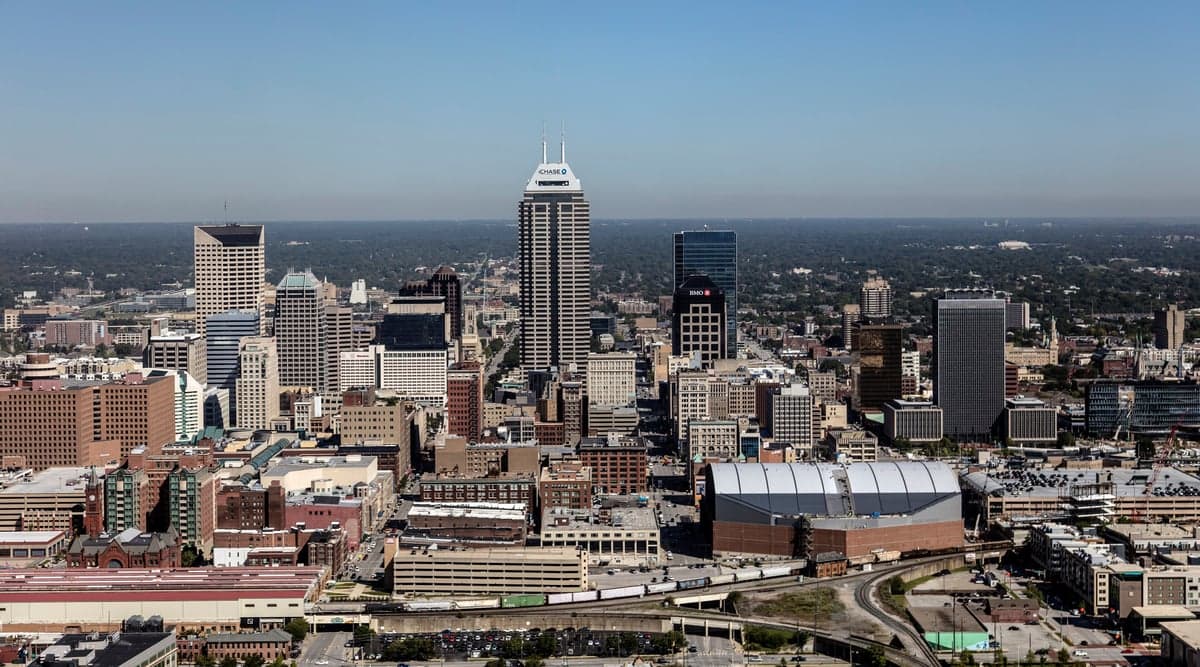
Photo: Wikipedia
Demographics of Indianapolis, IN
Affluence Level in Indianapolis, IN
A middle-class area roughly in line with national averages across income, home values, education, and employment.
People of Indianapolis, IN
Indianapolis today is a majority-minority city of 882,043 residents, characterized by a distinctive blend of Midwestern pragmatism and Southern-influenced culture, with a population that is 49.9% white, 27.8% Black, 13.3% Hispanic, 2.8% East/Southeast Asian, and 1.2% Indian (subcontinent). The city's identity is shaped by its role as a state capital, a manufacturing and logistics hub, and the home of the Indianapolis 500, giving it a blue-collar, family-oriented character that leans conservative relative to other large Midwestern cities. Foreign-born residents make up 7.7% of the population, a lower share than many peer cities, and the college-educated rate stands at 34.2%, reflecting a workforce rooted in industry and trades as much as in professional services. The city's people are notably spread across distinct neighborhoods that retain strong ethnic and economic identities, from historic white ethnic enclaves to newer immigrant corridors.
How the city was settled and grew
Indianapolis was founded in 1821 as a planned state capital at the geographic center of Indiana, deliberately situated on a flat, marshy plain to attract settlers via the White River and later the National Road. The original population was overwhelmingly native-born white settlers from Kentucky, Ohio, and the Upper South, bringing a conservative, agrarian Protestant culture that still echoes in the city's social fabric. The construction of the Central Canal in the 1830s and the arrival of railroads by the 1850s transformed Indianapolis into a manufacturing and distribution center, drawing German and Irish immigrants who settled in neighborhoods like Fountain Square and Holy Rosary (near the old St. Joseph Church), where German Catholic and Irish communities built churches, breweries, and mutual-aid societies. The post-Civil War industrial boom, centered on meatpacking, carriage-making, and later automobile parts, attracted a wave of Southern Black migrants beginning in the 1890s, who established Indiana Avenue and the Ransom Place historic district as the heart of a vibrant African American cultural and business corridor. By 1900, the city's population had swelled to over 169,000, with white ethnic enclaves in Haughville (Eastern European and Italian) and Brightwood (German and Irish) shaping the city's working-class character.
Modern era (post-1965)
The 1965 Hart-Cellar Act and subsequent immigration reforms began diversifying Indianapolis beyond its Black-white binary, though the city's foreign-born share remains modest compared to coastal metros. The most significant post-1965 shift was the acceleration of suburbanization and white flight to northern suburbs like Carmel and Fishers, which drained white population from the city core while concentrating Black residents in neighborhoods such as Martindale-Brightwood and the Near Westside. Hispanic growth accelerated in the 1990s and 2000s, driven by Mexican and Central American immigrants drawn to construction, meatpacking, and warehouse jobs; they concentrated in the Westside (around Lafayette Road) and the Southside (near the former Indianapolis International Airport corridor), where Spanish-language businesses and Catholic parishes now anchor a community that has grown to 13.3% of the city's population. East/Southeast Asian communities (2.8%) arrived primarily after 1980, with Burmese, Vietnamese, and Chinese families settling in the Castleton area and the Far Eastside, often drawn by affordable housing and proximity to logistics and healthcare jobs. The Indian subcontinent population (1.2%) is a more recent, professional wave, concentrated in the Carmel and Zionsville suburbs rather than inside city limits, reflecting a pattern of direct migration to tech and medical hubs.
The future
Indianapolis's population is projected to grow modestly, reaching roughly 920,000 by 2035, driven primarily by Hispanic and East/Southeast Asian natural increase and continued domestic in-migration from the Rust Belt and California. The white population share is declining steadily, while the Black share is stabilizing after decades of out-migration to suburbs; the city is becoming more multiethnic rather than homogenizing, with mixed-race and Hispanic identities growing fastest. Immigrant communities are not assimilating into a single melting pot but are forming distinct enclaves: the Westside Hispanic corridor is expanding westward into Pike Township, while the Far Eastside Asian corridor is pushing into Lawrence and Warren Township. The city's conservative-leaning character is likely to persist, as the growing Hispanic population tends to be more socially conservative than the national average, and the suburbanizing Black middle class often holds moderate-to-conservative views on crime and education. For a newcomer, Indianapolis offers a relatively affordable, family-oriented environment where neighborhood choice strongly correlates with ethnic and economic background, and where the political culture remains pragmatic and business-friendly rather than progressive-activist.
Indianapolis is becoming a more diverse, moderately growing Midwestern city where distinct ethnic neighborhoods persist alongside a conservative, family-focused civic culture. The population is not homogenizing but tribalizing into recognizable enclaves, and the city's future depends on whether these groups integrate economically while maintaining their cultural identities. For a conservative-leaning individual or family moving in now, the key decision is which neighborhood's character—historic white working-class, Black middle-class, Hispanic corridor, or Asian suburban—best aligns with their priorities for schools, safety, and community values.

* Values derived from national, state, county, city and local statistics and may differ in a specific area. Last updated: 2026-09-21T19:36:35.000Z
Narrative content on this page is AI-generated and may contain mistakes. Verify any details that matter before acting on them.
ReloMaps may earn a commission from affiliate links at no extra cost to you.

