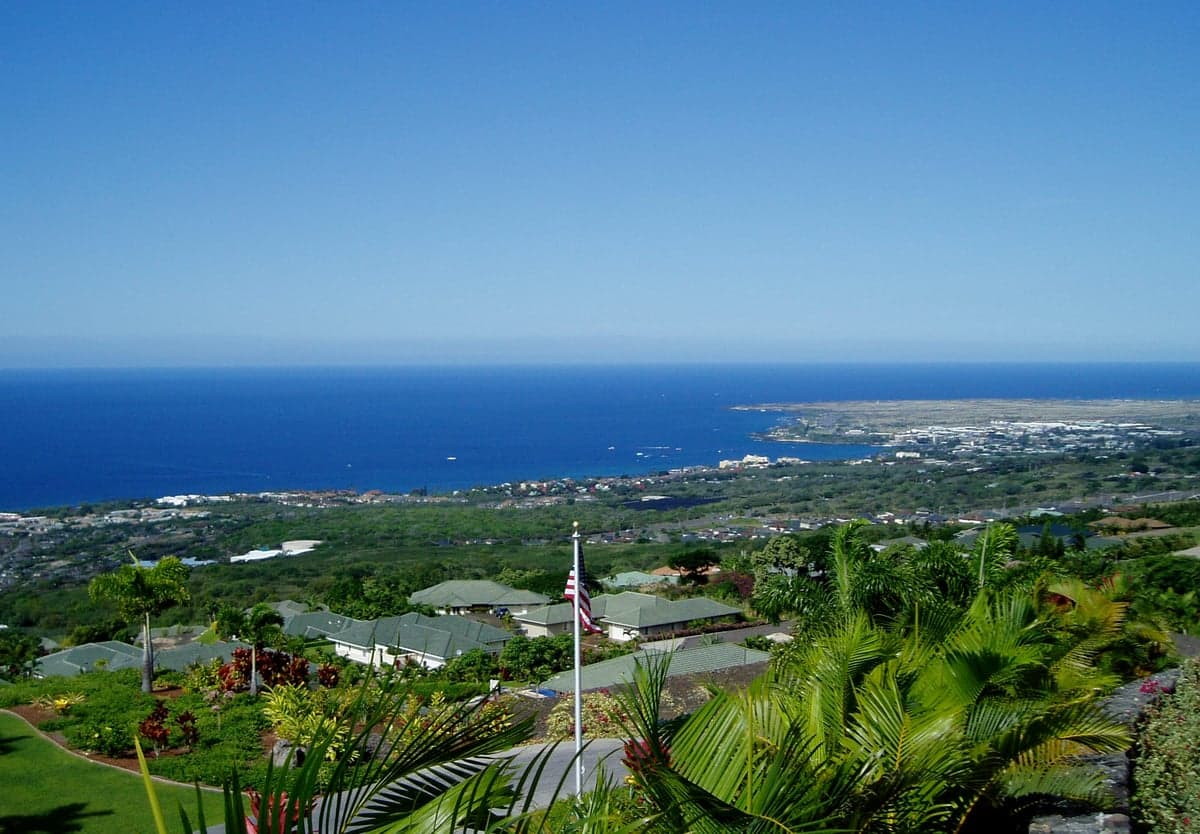
Photo: Wikipedia
Demographics of Kailua-Kona, HI
Historical data isn't available for Kailua-Kona, HI. Trends shown are for Hawaii County, HI.
Affluence Level in Kailua-Kona, HI
An upper-middle-class area. Household wealth, education levels, and homeownership run ahead of national benchmarks.
People of Kailua-Kona, HI
The people of Kailua-Kona today form a distinctive blend shaped by centuries of migration, where a white plurality (44.1%) coexists with a substantial East and Southeast Asian population (25.4%) and a growing Hispanic community (10.8%). With just 4,167 residents, this west Hawaii town feels more like a tight-knit coastal village than a city, marked by a strong sense of local identity rooted in the ocean, coffee culture, and a slower pace of life. The foreign-born share sits at 8.1%, lower than the state average, reflecting a population that is largely domestic in origin but retains deep multiethnic roots from earlier plantation-era settlement.
How the city was settled and grew
Kailua-Kona’s human history begins with Native Hawaiians, who established coastal fishing villages and agricultural terraces along the dry leeward slopes long before Western contact. The area became a political center under King Kamehameha I, who made Kailua his royal residence after unifying the islands in the early 19th century. The first major non-Hawaiian wave arrived with Protestant missionaries in the 1820s, followed by Chinese laborers in the 1850s who worked on sugar and coffee plantations. These early Chinese settlers concentrated in what is now Kailua Village (Kailua Town), the historic waterfront district where many of their descendants still operate small businesses. Japanese immigrants arrived in larger numbers after 1885, recruited for sugar plantations, and established a strong presence in the Holualoa uplands, where they became central to Kona coffee farming. Portuguese and Puerto Rican workers followed in the early 1900s, settling in the Keauhou area and contributing to the town’s Catholic and ranching traditions. By the mid-20th century, Kailua-Kona remained a small, ethnically stratified plantation town, with Native Hawaiians, Japanese, Chinese, and a white minority living in distinct but overlapping neighborhoods.
Modern era (post-1965)
The 1965 Hart-Cellar Act ended national-origin quotas, but Kailua-Kona’s modern demographic shift was driven less by new immigration and more by domestic in-migration from the U.S. mainland. Beginning in the 1970s, white retirees and remote workers from California and the Pacific Northwest began moving to the area, drawn by the climate and ocean access. This wave settled primarily in newer subdivisions like Kona Vistas and Alii Drive condominium complexes, reshaping the town’s character from plantation outpost to tourist and retirement destination. The Asian population, while still significant at 25.4%, is largely composed of long-established Japanese and Chinese families rather than recent arrivals, with many concentrated in Holualoa and the Kainaliu district just south of town. The Hispanic community, now 10.8%, grew steadily from the 1990s onward, driven by labor demand in construction, hospitality, and coffee harvesting, with many settling in the Kealakehe area near the new high school and industrial park. The Black population remains negligible at 0.2%, and the Indian subcontinent population is effectively zero, reflecting Kailua-Kona’s limited draw for those groups compared to Oahu or the mainland. The college-educated share of 31.6% is moderate, boosted by remote professionals and retirees, but the town lacks a major university, limiting brain-drain retention.
The future
Kailua-Kona’s population is likely to grow slowly but steadily, constrained by limited land, high housing costs, and strict county zoning that limits dense development. The white plurality is expected to hold or increase slightly as mainland retirees continue to arrive, particularly in the Kona Heights and Kona Bay Estates subdivisions, where new luxury homes are being built. The Asian share may decline gradually as younger generations leave for Oahu or the mainland for education and jobs, though the coffee-farming Japanese community in Holualoa remains deeply rooted. The Hispanic population is the most dynamic segment, growing through both migration and higher birth rates, and is likely to become a larger share of the workforce and school-age population. The town is not tribalizing into stark enclaves—most neighborhoods are mixed—but economic stratification is increasing, with wealthy newcomers in oceanfront properties and working-class families pushed inland toward Kealakehe and Honalo. For someone moving in now, Kailua-Kona offers a stable, multiethnic community with a strong sense of place, but newcomers should expect a tight housing market and a culture that values local connections over rapid change.
Bottom line: Kailua-Kona is becoming a more affluent, white-plurality retirement and remote-work hub, while its Hispanic workforce grows and its Asian and Native Hawaiian populations hold steady but age. The town remains distinct from the rest of Hawaii—less diverse than Honolulu, more rooted in plantation history than tourist-centric Waikiki—and offers a genuine small-town experience for those willing to adapt to its pace and cost.

* Values derived from national, state, county, city and local statistics and may differ in a specific area. Last updated: 2026-04-24T00:07:43.000Z
Narrative content on this page is AI-generated and may contain mistakes. Verify any details that matter before acting on them.
ReloMaps may earn a commission from affiliate links at no extra cost to you.

