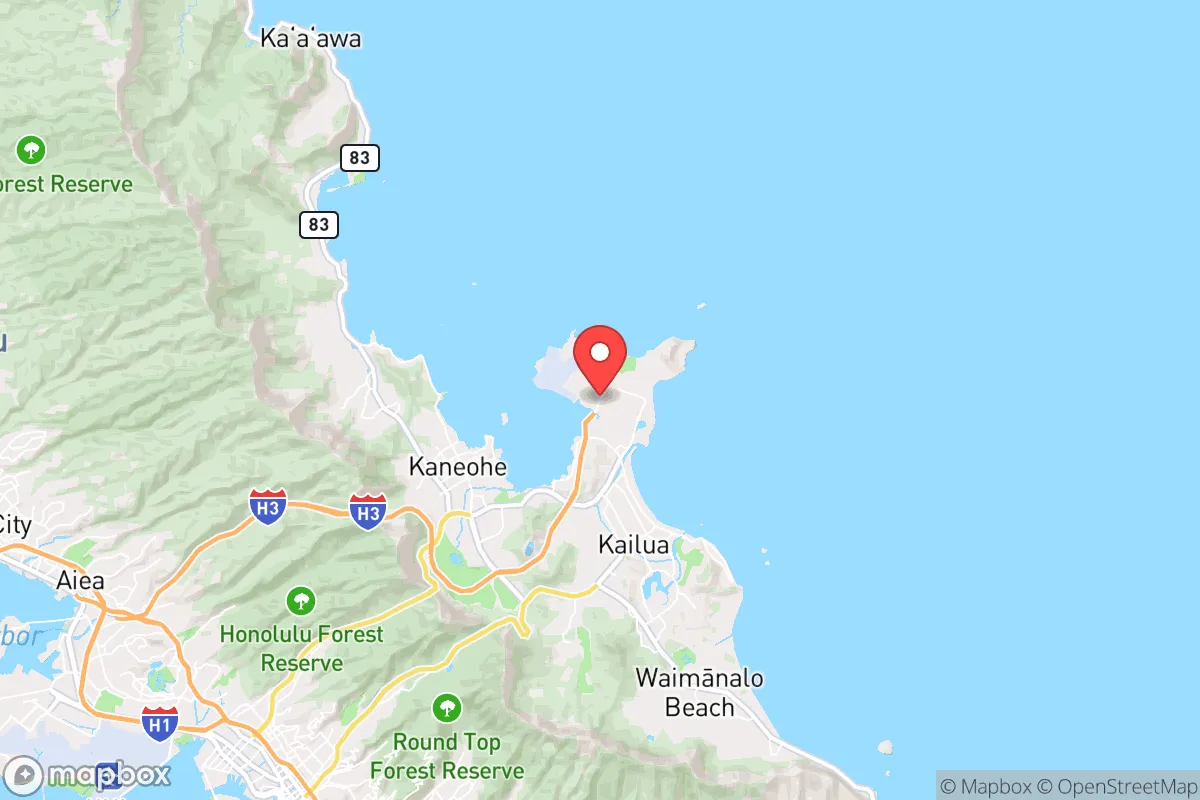
Personal Sovereignty in Kaneohe Base, HI
Moderate friction. Expect trade-offs in some aspect of personal liberty and independence.
What does Personal Sovereignty tell us?
Personal Sovereignty measures your capacity for self-reliance and independence with minimal government friction. Higher scores mean fewer barriers between you and the way you want to live... but it assumes you have the space you need and good neighbors.
What does this tell us?
Personal Sovereignty measures your capacity for self-reliance and independence with minimal government friction. Higher scores mean fewer barriers between you and the way you want to live... but it assumes you have the space you need and good neighbors.
State Policy
Energy independence: Importer (2% of energy produced in-state)
Personal Liberty

Personal Liberty Analysis
For the individual or family prioritizing personal sovereignty, Kaneohe Base on Oahu presents a complex and often contradictory environment. While the immediate military base offers a structured, federally governed space with certain protections from state-level overreach, the surrounding Hawaii state government imposes some of the nation's most restrictive policies on firearms, taxation, and land use. A strategic relocation here requires understanding that your autonomy is heavily mediated by both the Department of Defense's rules and Hawaii's progressive regulatory apparatus. The net effect is a location where personal freedom is significantly constrained compared to mainland conservative strongholds, though the base's federal jurisdiction provides a partial buffer against the most aggressive state mandates.
Tax burden and regulatory posture in Hawaii
Hawaii's tax climate is among the most hostile in the nation for those seeking to maximize personal financial sovereignty. The state imposes a progressive income tax with a top marginal rate of 11%, one of the highest in the country, applying to income over $200,000 for single filers. Property taxes are comparatively low, averaging around 0.28% of assessed value, but this is offset by a general excise tax (GET) of 4% that applies to nearly all business transactions, effectively functioning as a hidden sales tax that can reach 4.712% in Honolulu County. For those living on Kaneohe Base, military pay is exempt from state income tax under the Servicemembers Civil Relief Act, a significant advantage. However, any off-base employment, rental income, or business activity is fully exposed to Hawaii's high levies. The regulatory environment is equally dense: Hawaii has some of the nation's strictest land use laws, a powerful state planning apparatus, and a permitting process that can delay construction projects for years. This creates a climate where starting a home-based business or making significant property improvements requires navigating a thicket of bureaucratic approvals, directly impeding self-reliance.
Self-defense and gun law specifics in Hawaii
Hawaii's firearm regulations are among the most restrictive in the United States, and Kaneohe Base residents must navigate a dual system of federal and state control. The state requires a permit to acquire a firearm, a process that involves fingerprinting, a background check, and a 14-day waiting period. Carrying a concealed weapon in public is effectively impossible for civilians; Hawaii is a "may-issue" state with no track record of issuing permits to ordinary residents, and the state's supreme court has upheld this near-total ban. On-base, possession is governed by Department of Defense directives, which generally allow personal firearms in private residences but prohibit carrying them in common areas or vehicles without specific authorization. The practical reality for a prepper is stark: you can own a handgun or long gun for home defense on base, but you cannot legally carry it off the property. The state also bans "assault pistols" and magazines over 10 rounds, and registration is mandatory. For those prioritizing the right to self-defense, this is a deeply compromised environment. The only workaround is living off-base in a rural area like Laie or Kahuku, where state law still applies but enforcement is less omnipresent, though you lose the federal buffer of base jurisdiction.
Self-reliance and homesteading viability on Oahu
The feasibility of true homesteading or off-grid living near Kaneohe Base is severely limited by geography and zoning. The base itself is a dense suburban installation with no agricultural land available for personal use. Off-base, the Windward side of Oahu features some larger lots in areas like Waimanalo and Kahaluu, but minimum lot sizes in agricultural districts are typically 1-2 acres, and such parcels often sell for $500,000 to $1 million. Zoning is strictly enforced: the state's Land Use Commission designates most of the island as "Urban," "Agricultural," or "Conservation," with the latter two categories imposing heavy restrictions on residential structures, water catchment, and waste systems. Off-grid solar is technically feasible but requires permits and compliance with building codes that mandate grid interconnection. Rainwater catchment is legal for non-potable uses but must meet health department standards for drinking water. The reality is that true self-sufficiency is nearly impossible within a 30-minute drive of the base; the cost of land, the regulatory hurdles, and the island's dependence on imported goods make homesteading a hobby rather than a survival strategy. For a prepper, the focus here shifts to stockpiling supplies and building community networks rather than land-based independence.
Personal liberties: parental rights, medical autonomy, speech, and property
Hawaii's legal framework generally aligns with progressive national trends, which can conflict with conservative values on parental rights and medical autonomy. The state has strong vaccine mandates for school attendance, with no philosophical exemption, and during the COVID-19 pandemic, it maintained some of the longest-lasting emergency orders in the country. Parental rights in education are limited: the state mandates comprehensive sex education that includes LGBTQ+ content, and parents cannot opt their children out of specific lessons, only the entire program. Medical autonomy is similarly constrained; Hawaii has a "Right to Try" law for terminally ill patients, but the state's health department maintains broad authority over treatment protocols. Free speech is protected under the First Amendment, but the state has enacted laws against "hate speech" that some critics argue chill political expression. Property rights are the most compromised area: Hawaii's strong zoning laws, rent control in some areas, and the state's unique "public trust doctrine" mean that the government can restrict land use in ways that would be unconstitutional in many mainland states. For a conservative individual, the cumulative effect is a jurisdiction where personal autonomy is consistently secondary to state-defined collective interests.
In the broader context of American personal sovereignty, Kaneohe Base offers a unique but limited sanctuary. The federal bubble of the base provides relief from Hawaii's high taxes and some regulatory burdens, but it does not shield residents from the state's restrictive gun laws, medical mandates, or land use controls. Compared to a place like rural Texas or Idaho, where property rights, gun access, and low taxes create a high-sovereignty environment, Oahu is a low-sovereignty zone where strategic compliance and careful legal navigation are essential. For a prepper or survivalist, this location is best viewed as a temporary assignment or a niche option for those who value the military community and Pacific location over personal freedom. The sobering takeaway is that Hawaii's state government has built a system that systematically subordinates individual autonomy to collective planning, making Kaneohe Base a place to live within the system rather than escape it.

* Values derived from national, state, county, city and local statistics and may differ in a specific area. Last updated: 2026-05-02T22:44:10.000Z
Narrative content on this page is AI-generated and may contain mistakes. Verify any details that matter before acting on them.
ReloMaps may earn a commission from affiliate links at no extra cost to you.

