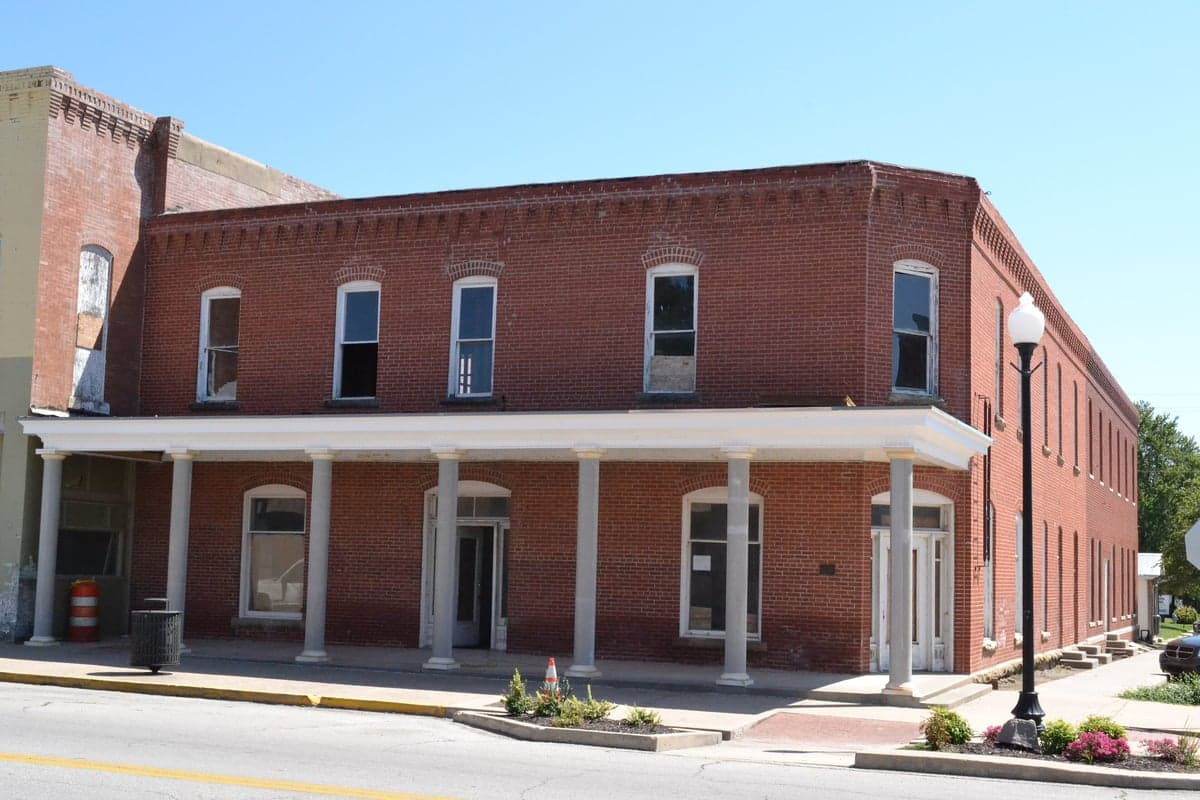
Photo: Wikipedia
Political ClimatePolitical Climate in Wilson County
Showing district-level results — no local-only data available.
Local Political AnalysisPolitical Analysis of Wilson County
Wilson County, Kansas, is a reliably Republican area with a Cook Partisan Voting Index (PVI) of R+10, making it slightly more conservative than the state of Kansas as a whole, which sits at R+9. This isn't a dramatic difference, but it reflects a consistent, deep-rooted red lean that has held steady for decades, with no signs of shifting blue in the near future. The county's politics are shaped by its rural, agricultural economy and small-town values, though there are subtle variations between its communities that a longtime resident would recognize.
How it compares
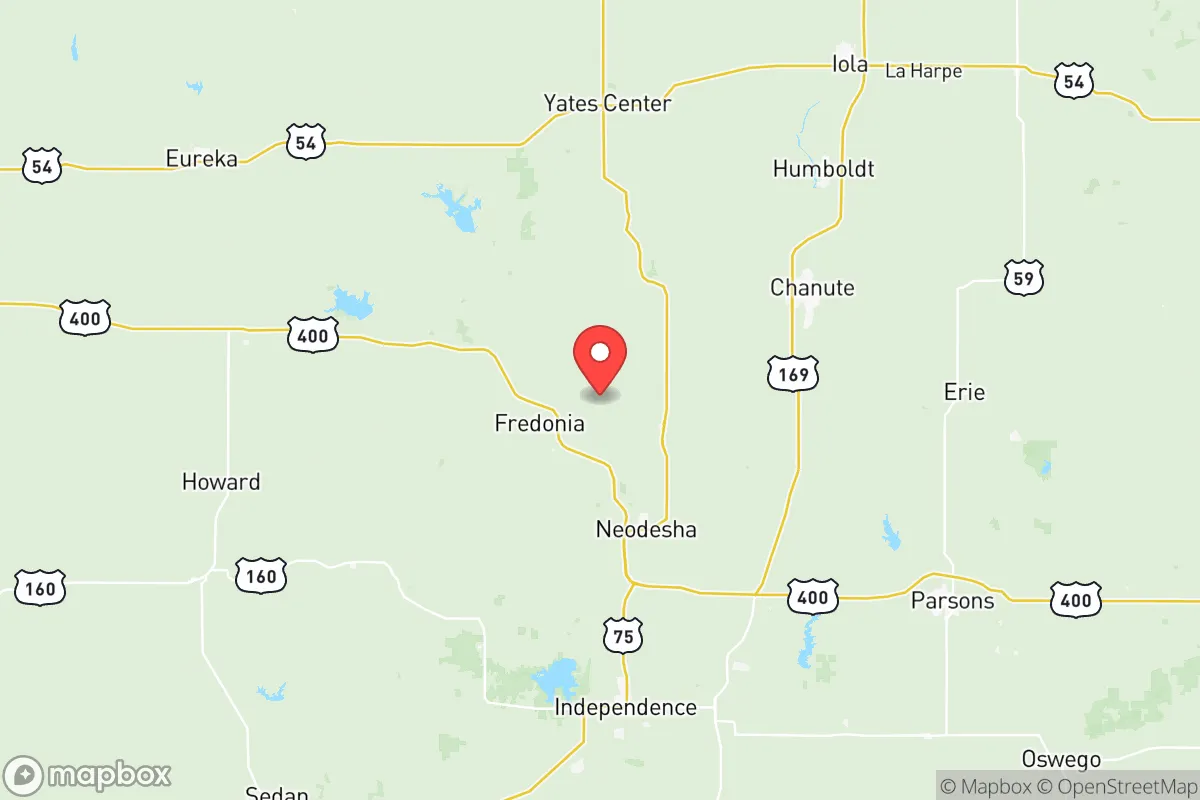
When you stack Wilson County against the rest of Kansas, the R+10 versus R+9 gap is narrow, but it matters in local races. The state's R+9 is pulled slightly left by the more moderate suburbs of Johnson County and the liberal stronghold of Lawrence. Wilson County, by contrast, lacks any major urban or college-town influence. Within the county, Fredonia, the largest town, tends to be the most moderate precinct, occasionally swinging closer to the state average in local elections due to its mix of retirees and younger families. Neodesha leans more solidly red, driven by its older, more traditional population and ties to the oil and gas industry. The rural precincts around Altoona and Buffalo are the deepest red, often voting 70% or more Republican in presidential races. There are no reliably blue precincts in Wilson County; even the most moderate areas rarely break for Democrats. The trajectory is stable—unlike some rural Kansas counties that have drifted further right in response to national polarization, Wilson County has held its R+10 position for the last two cycles, suggesting a settled political identity rather than a trending one.
What this means for residents
For conservative residents, the political climate is comfortable and affirming. Local offices—county commission, school boards, and sheriff—are almost always held by Republicans, and policy debates tend to focus on tax rates, road maintenance, and agricultural issues rather than culture-war flashpoints. A conservative can expect their views to be the default in most public settings. For liberal residents, the reality is more isolating. While no one is hostile, progressive voices are rare, and there is little organized Democratic infrastructure. A liberal in Fredonia might find a few like-minded neighbors, but in Neodesha or Altoona, they would likely keep their politics private to avoid awkwardness. The practical effect is that local policy leans heavily toward low taxes and limited government, with fewer social services or public transit options than in more liberal parts of Kansas. Both sides, however, share a common appreciation for the county's quiet, self-reliant way of life.
Culturally, Wilson County stands apart from the state's more diverse urban centers. There is a strong emphasis on church involvement, community events like the Neodesha Oil Festival, and a general distrust of state-level mandates from Topeka. The county's policy distinctions are subtle but real: it has been a vocal opponent of renewable energy mandates, favoring traditional oil and gas development, and it tends to resist state-led efforts to consolidate rural schools. For anyone moving here, the political climate is straightforward—it's a place where conservative values are the norm, and where the biggest political debates are about local roads and grain prices, not national headlines.

State Political ClimatePolitical Climate in Kansas
State Political AnalysisPolitical Environment in the State
Kansas is a solidly Republican state with a Cook PVI of R+9, meaning it typically votes about nine points more Republican than the nation as a whole. Over the past 10-20 years, the state has shifted rightward, driven by a deepening rural-urban split and a series of conservative policy moves that have made it a national laboratory for tax cuts, school choice, and Second Amendment expansion. However, the state is not a monolith — the Kansas City suburbs and the college town of Lawrence provide a persistent Democratic counterweight, while the rest of the state has become increasingly red.
Urban vs. rural divide
The political map of Kansas is a study in contrasts. The two major population centers — the Kansas City metro (Johnson, Wyandotte, and Douglas counties) and the Wichita area (Sedgwick County) — are the only real blue or purple zones. Johnson County, the wealthiest and most populous county, has been trending Democratic for a decade; it voted for Joe Biden in 2020 and has sent Democrats to the state legislature from its eastern precincts. Lawrence, home to the University of Kansas, is the state's most reliably liberal city, consistently voting 70%+ Democratic. Wichita itself is a swing city, but its surrounding suburbs lean red. The rest of the state — from the Flint Hills to the High Plains — is deeply Republican. Counties like Sherman, Grant, and Wallace routinely vote 80-85% Republican. The rural-urban divide is stark: the 1st Congressional District (western Kansas) is one of the most Republican districts in the nation, while the 3rd District (Kansas City suburbs) is competitive and occasionally flips. This geographic split means that state-level politics are dominated by rural and small-town interests, even as the population centers grow.
Policy environment
Kansas has a famously low-tax, low-service model. The state income tax is a flat 5.7% (down from a progressive top rate of 6.45% in 2012), and the sales tax is 6.5% — but local add-ons can push it over 10% in some cities. Property taxes are moderate but have been rising, especially in fast-growing Johnson County. The state has a right-to-work law, meaning union membership is voluntary, and it is a "shall-issue" state for concealed carry — no permit needed since 2015. Kansas is one of the most aggressive school choice states in the country, with a robust tax-credit scholarship program and a new Education Savings Account (ESA) program passed in 2024 that allows families to use public funds for private school tuition. On healthcare, the state has not expanded Medicaid under the Affordable Care Act, leaving roughly 150,000 low-income adults in a coverage gap. Election laws are moderately restrictive: voters must show a photo ID at the polls, and the state has a 20-day advance registration deadline. There is no early voting by mail without an excuse, though in-person early voting is available for two weeks.
Recent policy direction
The last five years have seen a conservative acceleration. In 2022, the legislature passed a near-total abortion ban (the "Value Them Both" amendment was rejected by voters in August 2022, but the legislature then passed a ban at 22 weeks, with a trigger law that would ban all abortions if Roe fell — which it did, and the ban is currently blocked by the state Supreme Court). Gun laws have been loosened: in 2023, the legislature passed a "Second Amendment Preservation Act" that purports to nullify federal gun laws, though it is largely symbolic. Parental rights have been expanded: a 2023 law requires schools to notify parents of any changes to a student's "mental, emotional, or physical health" — widely seen as a response to transgender student issues. On speech, the state has no hate crime law covering sexual orientation or gender identity, and a 2024 law bans diversity, equity, and inclusion (DEI) programs at public universities. Property rights are strong: Kansas is a "Dillon's Rule" state, meaning local governments have only the powers the state grants them, and the legislature has preempted local ordinances on everything from plastic bag bans to minimum wage increases. Voting access has tightened: a 2021 law added new restrictions on mail-in ballot drop boxes and shortened the window for returning absentee ballots. For a relocator, the bottom line is that Kansas is a state where conservative policy preferences are enacted quickly and with little Democratic resistance, but where the state Supreme Court has occasionally blocked the most aggressive moves (like the abortion ban and school funding cuts).
Civil unrest & political movements
Kansas has not seen the large-scale protests of coastal states, but there have been notable flashpoints. The 2022 abortion amendment vote drew massive grassroots organizing on both sides, with pro-choice groups turning out heavily in Johnson County and Lawrence, while anti-abortion groups mobilized in rural areas. The result — a 59-41 rejection of the amendment — was a shock to the state's political establishment and showed that even in a red state, single-issue abortion politics can cross party lines. There have been smaller but persistent protests over transgender rights, particularly at the Statehouse in Topeka, where parents and activists on both sides have clashed over school policies. Immigration politics are less heated than in border states, but there is a vocal minority pushing for stricter enforcement; the state has no sanctuary cities, and a 2023 law requires law enforcement to cooperate with federal immigration authorities. Election integrity controversies have been minimal — Kansas has a secure voting system, and the 2020 and 2022 elections were conducted without major incident, though some rural counties have seen calls for hand-counting ballots. A new resident would notice the political activism mostly in the form of yard signs, church bulletin inserts, and local school board meetings — it's a quieter, more church-and-community-based political culture than in many states.
Projection
Over the next 5-10 years, Kansas is likely to remain solidly Republican at the state level, but the margins may narrow slightly. Johnson County is the key: it is growing fast, diversifying, and trending left, and if it continues to shift, it could eventually make statewide races competitive. The 2026 governor's race will be a test — Democrat Laura Kelly won in 2018 and 2022 by running as a moderate, but she is term-limited, and the open seat will likely revert to a Republican. The state's demographic future is mixed: the rural population is aging and shrinking, while the suburbs are growing younger and more diverse. In-migration is modest — Kansas is not a boom state like Texas or Florida — but the Kansas City suburbs are attracting remote workers and families from the coasts. The policy direction will likely continue on the same trajectory: more tax cuts, more school choice, more preemption of local ordinances, and continued resistance to Medicaid expansion. The wild card is the state Supreme Court, which has a 5-2 liberal majority and has been a check on the legislature; if Republicans flip the court in the next few elections, the pace of conservative policy change could accelerate significantly.
For a new resident, the practical takeaway is this: if you are conservative, you will find a state where your values are reflected in law and where the political culture is welcoming. If you are liberal, you will find a state where your vote matters most in Johnson County or Lawrence, but where you will have little influence over state policy. The cost of living is low, the schools are decent (especially in the suburbs), and the pace of life is slower. The trade-off is that public services are lean, and the political climate can feel one-sided if you are not in the majority. Kansas is not a swing state — it is a red state with a blue urban core, and it is likely to stay that way for the foreseeable future.
* Values derived from national, state, county, city and local statistics and may differ in a specific area. Last updated: 2026-09-30T17:36:26.000Z
Narrative content on this page is AI-generated and may contain mistakes. Verify any details that matter before acting on them.
ReloMaps may earn a commission from affiliate links at no extra cost to you.

